Released in early September 2025, the CS600 is the most ambitious GPS Coospo has ever offered. The brand’s first model with a colour screen and touchscreen, integrated mapping and a claimed 36-hour battery life, it clearly positions itself against entry- and mid-range Garmin Edge units.
A compact, understated and nicely finished GPS
The Coospo CS600 plays the compact card. With its dimensions of 84 × 53 × 18 mm and a featherweight of 69 g, it stays discreet on the bars. The design is understated, no frills, yet it never feels like a “cheap” product, which isn’t always a given at this price point. Personally, I really like the design with contour lines along the edges of the GPS.
In the box, you get the essentials… and even a bit more. Garmin-style mount (the exact same standard, which makes it easy to use with existing mounts), USB-C cable, safety lanyard, quick-start guide and, crucially, a screen protector included. A small detail? Maybe. But when you know that Garmin still isn’t able to include one on GPS units costing over €800, it’s worth pointing out.
The 2.4-inch colour TFT screen isn’t huge, but it’s well used. Readability is very good, even in bright sunshine. To be totally transparent, the sun has been pretty shy these past few months on the Atlantic coast, but the few bright rides posed no problem.
The automatic backlight works well thanks to the light sensor, and the automatic day/night modes are sensible.
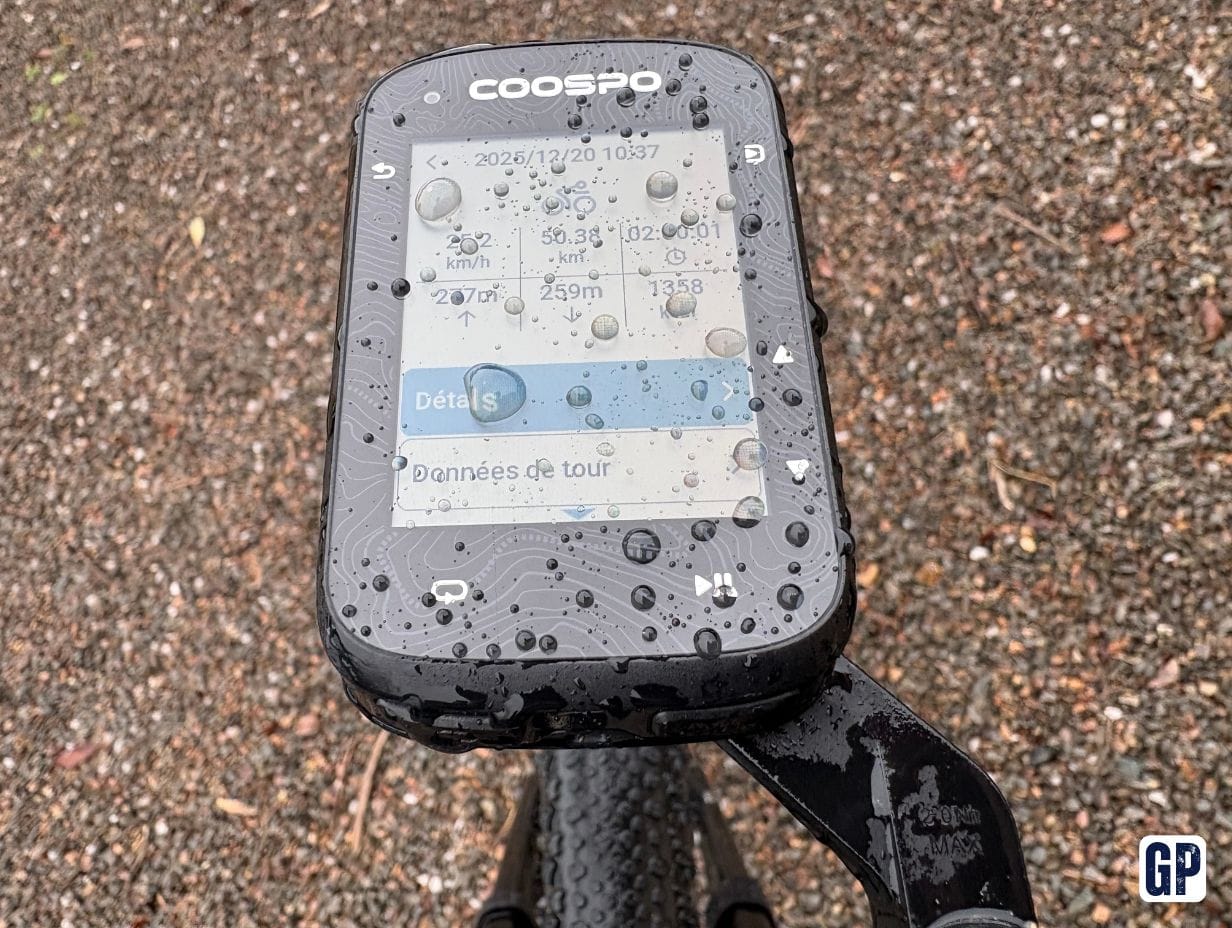
The whole unit is IPX7 certified. I can confirm it: rain, soaked roads, long rides in thoroughly uninviting conditions… The CS600 takes it all in stride.
A real surprise in terms of responsiveness
First startup is quick: choose the language and units, and you’re good to go. The interface is clear, legible, and above all very responsive. This is probably the aspect that impressed me most about this GPS.
The touchscreen is extremely responsive. In a direct comparison with my Garmin Edge 1040 Solar, it’s almost night and day.
Taps are registered immediately, with no perceptible lag. In use, that’s a real comfort, especially when navigating menus or switching screens while riding. I absolutely didn’t expect this level of smoothness at this price.
Another good idea: the CS600 isn’t purely touchscreen. It also keeps physical buttons.
Customisation is extensive. There are more than 150 possible data fields, with many screen layouts. For now, I’ve left the default screens, but the options are there and that’s appreciated.
Effective navigation, but with some limits
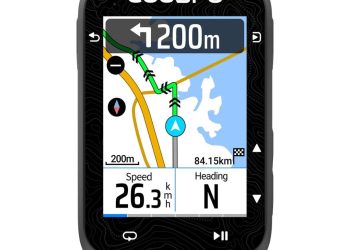
The CS600 comes with preinstalled global colour maps. On paper, that’s appealing. In practice, they’re fine for road use, but clearly too limited for gravel or MTB. Many paths are missing. You therefore have to download region-specific cycling maps from the Coospo website.
That’s where the experience gets more complicated. You have to connect the GPS to a computer, manually download the files, then copy them to the device. No direct download via the GPS, no management from the app.
Same for map updates. And the CS600 apparently accepts only official Coospo maps: impossible to install custom maps like on Garmin. Clearly, we’re a long way from the flexibility of more mature ecosystems.
Once the maps are installed, guidance is quite accurate. Direction changes are announced far enough in advance, with a default beep. Sometimes a simple bend is interpreted as a turn, which can be confusing if you’re not on the map display. If you leave the course, there’s no recalculation: the GPS simply shows “off course” until you get back on it.
Course selection also needs work. The GPS mainly displays the GPX file name. If your routes aren’t properly named, it gets annoying fast. Once selected, you get the distance and a line with no basemap, which remains pretty basic.
The CS600 records data every second, with no “smart” recording mode. Result: far more points than with Garmin. The tracks are broadly similar, but the CS600 sometimes shows inconsistencies in elevation gain. Otherwise, the results are very clean.
Training and advanced features
The CS600 offers training modes, sensor management (heart rate, cadence, power, Di2, smart trainer, rear radar), and solid ANT+ and Bluetooth compatibility. In my testing, no issues with my usual sensors.
On the other hand, some key features are still missing. No Climb Pro for now, even though a screen shows the profile for the next two kilometres and the current gradient. There are no smartphone notifications, and no reliable estimate of time remaining on a predefined course. Clearly, the software still has room to grow.
CoospoRide app: functional, but very limited
The companion CoospoRide app does the bare minimum. It lets you pair the GPS easily, manage sensors, configure certain screens, and sync rides, notably to Strava or TrainingPeaks. But automatic sync is flaky. You often have to open the app and go to the “device” tab to trigger the sync.
You can tell the app is still far from the level of Garmin Connect, and in practice, you rarely use it once the GPS is set up.