
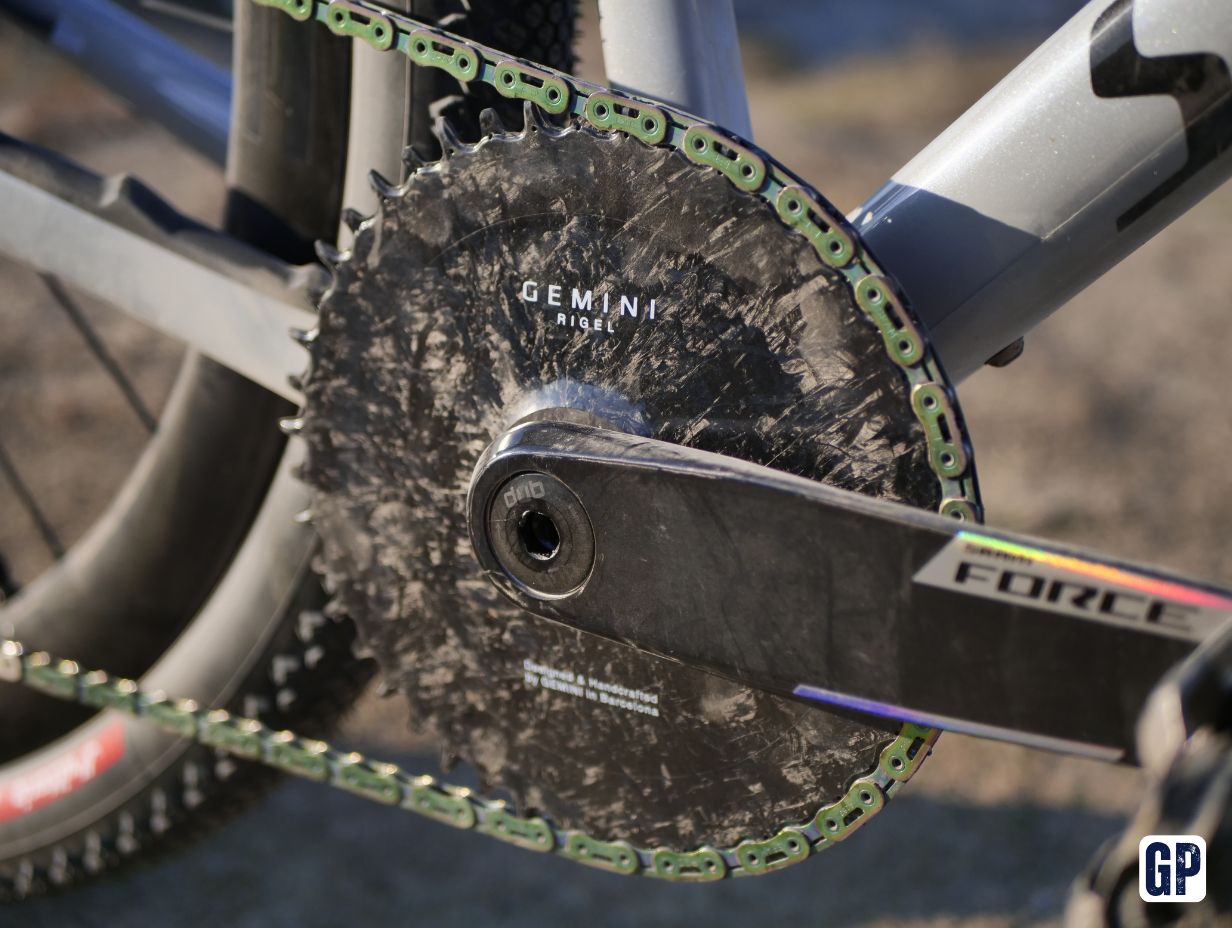

I was inclined to be sceptical about these Gemini RIGEL chainrings.
The Spanish brand is very visible on social media, the parts are spectacular, the photos make you want to rebuild your whole bike around a simple chainring. And often, in cycling, when a component ticks the Instagram box a little too well, I start by looking at what it really does on the road.
After several weeks with two Gemini RIGEL chainrings, a 46-tooth on a Specialized Crux 5 and a 52-tooth on a Pinarello Dogma F, my take is fairly simple: it is not just a beautiful object.
Strengths:
- Remarkably quiet operation
- Premium carbon finish
- Noticeable stiffness under hard efforts
Could be better
- Not yet compatible with certain SRAM 8-bolt cranksets with an integrated power meter
Two builds, two uses, one shared base
The RIGEL tested here is a carbon Direct Mount chainring, in my case fitted in the SRAM 8-bolt version. Gemini offers it for several interfaces, notably SRAM 3-bolt, SRAM 8-bolt, Race Face / Easton Cinch, and E-Thirteen, with a stated 6.5 mm offset.
The construction is distinctive: Gemini uses forged carbon around a metallic 7075-T6 aluminium core at the teeth. The idea is clear enough: keep the stiffness and lightness of carbon while avoiding a 100% composite tooth profile working on such a wear-sensitive area.

The product sheet also highlights compatibility with 1×11, 1×12 and 1×13 drivetrains. In my use, both builds were single chainring, one geared towards fast gravel, the other fully road.
A finish that makes a statement
Out of the box, the piece is superb. Not “nice, for a chainring”. Superb, full stop.
The carbon, the shapes, the visual continuity with the crank arms, the tooth relief, the almost sculptural side of the part: Gemini knows how to make a beautiful piece. I’ve ridden plenty of single-ring solutions, from SRAM chainrings to more artisanal or more exotic alternatives. Aesthetically, the RIGEL is right up there, and quite clearly so.
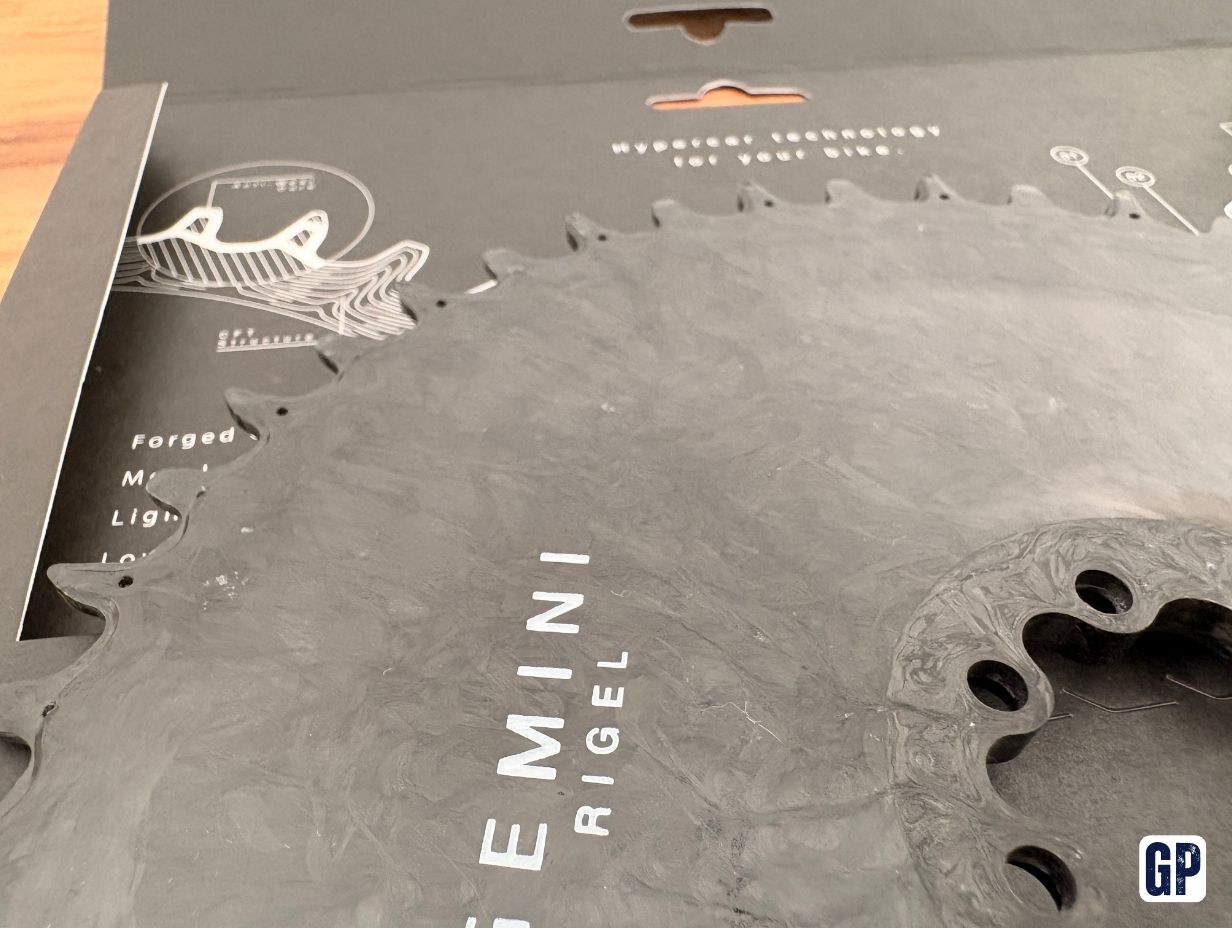
We still have to keep things in perspective: a chainring doesn’t make a bike faster because it looks good. And once you’re in the saddle, you don’t look at it any more. But on high-end builds, where every part contributes to the whole, this level of finish matters. On the Dogma F, it never feels like a tacked-on piece.
Installation: straightforward, provided you have the right interface
The SRAM 8-bolt version is easy to install. You need to remove the crankset, take off the existing chainring, bolt on the RIGEL, then reassemble everything. Nothing tricky if you’ve already handled a SRAM Direct Mount crankset.
The only real point to watch concerns compatibility with certain AXS cranksets that integrate a power meter. Gemini does not yet offer compatibility with the SRAM interface with a power meter integrated into the crankset (thread mount). That’s a pity, because this configuration is becoming increasingly common on Red and Force groups, on the road as well as in gravel.
I really hope Gemini covers this case, because it is the clearest limitation of the product today.
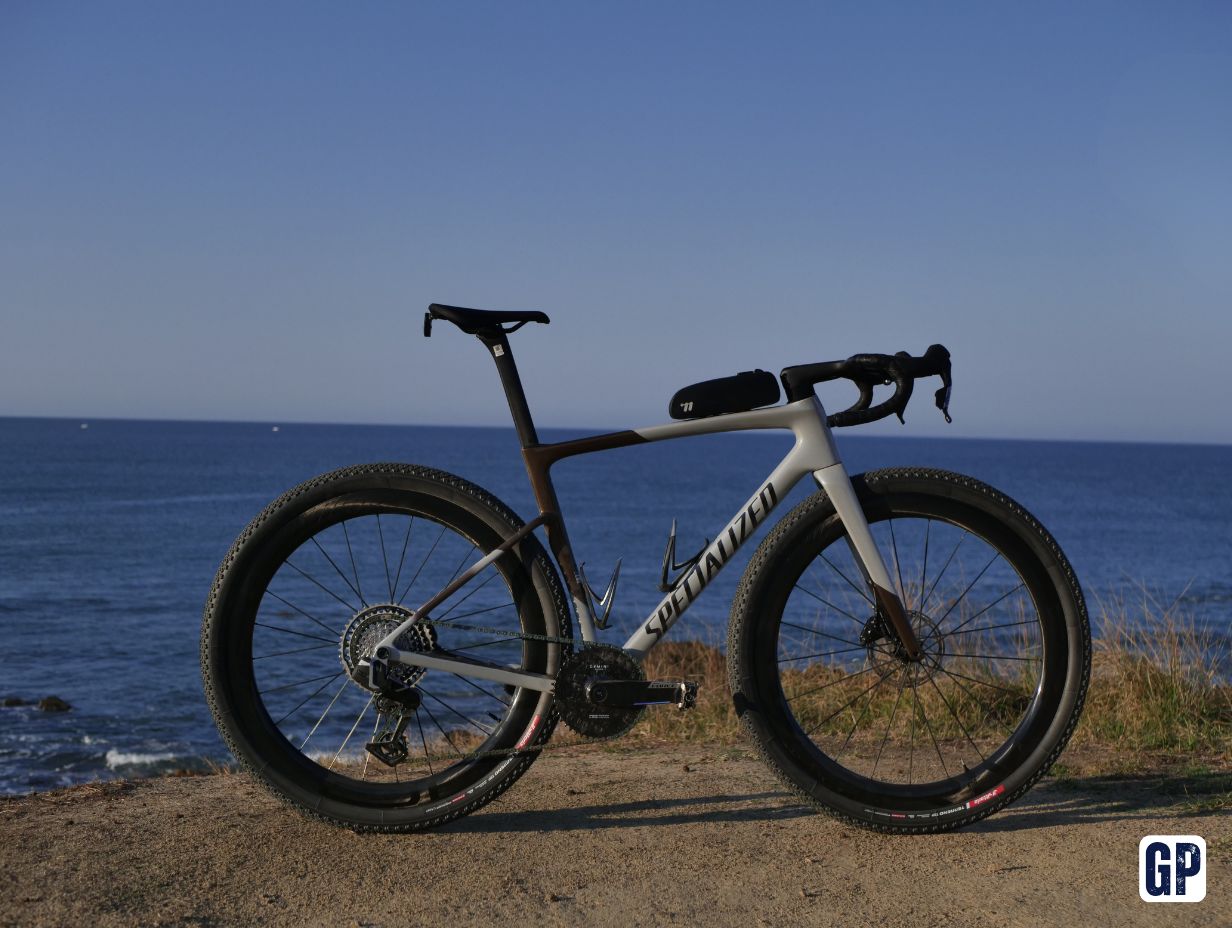
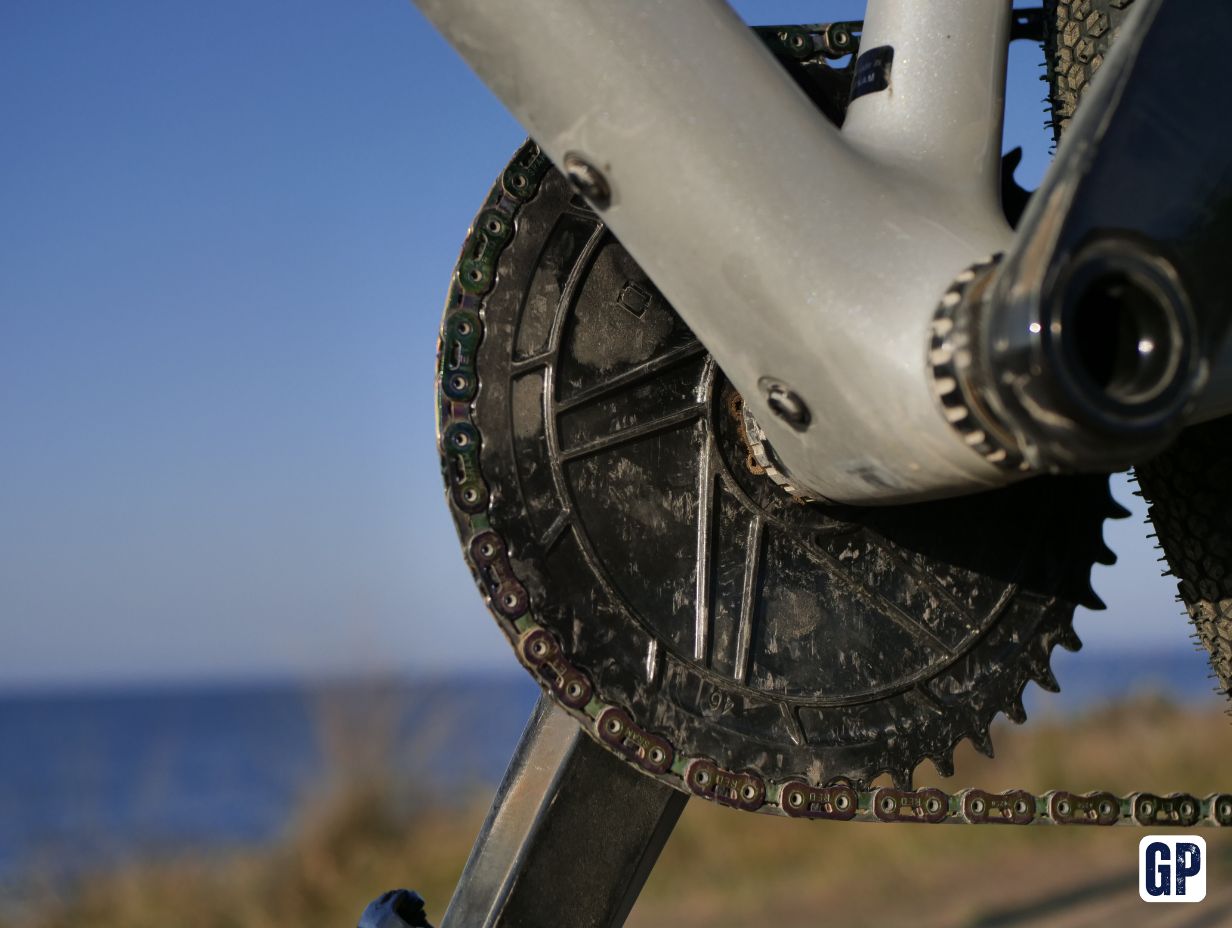
On gravel: 46-tooth, 10-46 cassette and standout silence
On the Specialized Crux 5, I chose a 46-tooth ring. It’s very personal. In Vendée, on tough yet fast terrain, with quick events, this gearing suits me well with a 10-46 cassette.
This 10-46 range makes more and more sense in performance-oriented gravel, as I had already noted in the SRAM Force XPLR AXS 2025 review, where it lets you keep an effective 1x set-up without breaking cadence too much on road-to-gravel transitions.
The first sensation with the Gemini isn’t the weight. Nor even the stiffness. It’s the silence.
I’ll be careful with grand statements, but among the chainrings I’ve fitted and ridden, it’s the one that gave me the quietest operation. The chain seems to settle more cleanly onto the teeth, with no unwanted noise, no pronounced metallic resonance.

I think two elements are at play here. First, the tooth design, which seems very well executed. Then the carbon structure, which appears to absorb some of the vibrations you sometimes get with aluminium chainrings. The result is quite obvious day to day: the drivetrain feels more muted, quieter.
Shifting posed no problems during the test. No odd behaviour, no sense of the chain being poorly retained, no noise reminding you that you’re riding something a bit different. I didn’t even use a chain catcher.
Wear: not enough mileage to say anything definitive
I don’t have 10,000 km on each chainring. So I’m not going to pretend to deliver a definitive verdict on durability.
After the kilometres ridden, I don’t see any extravagant signs of wear. Nothing that worries me, nothing that makes me think carbon would be a bad idea in the short term. But with a chainring, especially one with such a specific tooth profile, the real judge is still the long term: maintenance, how clean the chain is, weather, rider power, road or gravel use.
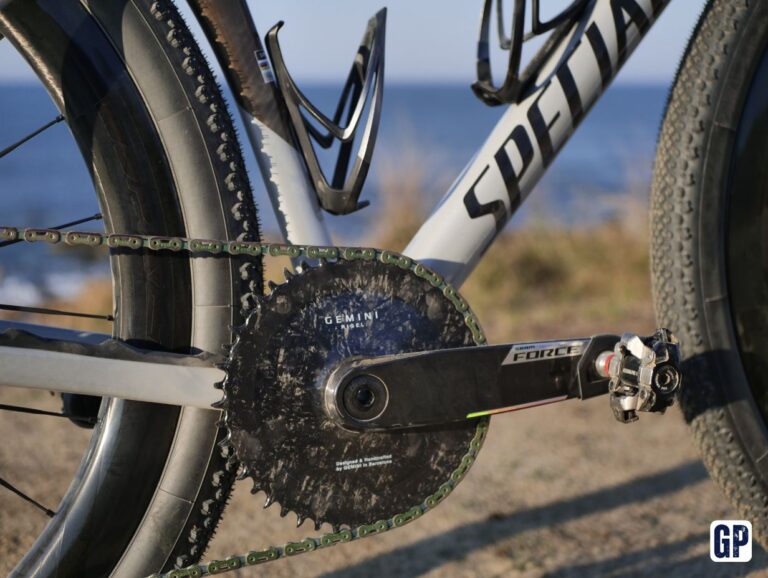
Gemini also recommends fitting a new chain to maximise the chainring’s lifespan and keeping the drivetrain clean, ideally lubricated with a dry lube. It’s common sense, but for this kind of part, it’s not a detail.
On the road: the 52-tooth changes how the bike feels
On the Pinarello Dogma F, the build was more radical: road 1x, 52-tooth chainring.
1x on the road remains a particular choice. It simplifies the bike, visually lightens the drivetrain and works very well on rolling terrain. But you do have to accept your gearing choice and its limits depending on the terrain.

Here, the Gemini fits the spirit of the build perfectly. Same finish, same silence, but with a sensation that stands out more on this bike: stiffness.
The Dogma F is already a very stiff bike. The bottom bracket filters very little, accelerations are crisp, and any part that’s a bit soft is felt quite quickly. With the RIGEL in 52-tooth, I never had that impression of a chainring twisting or flexing laterally with the effort.
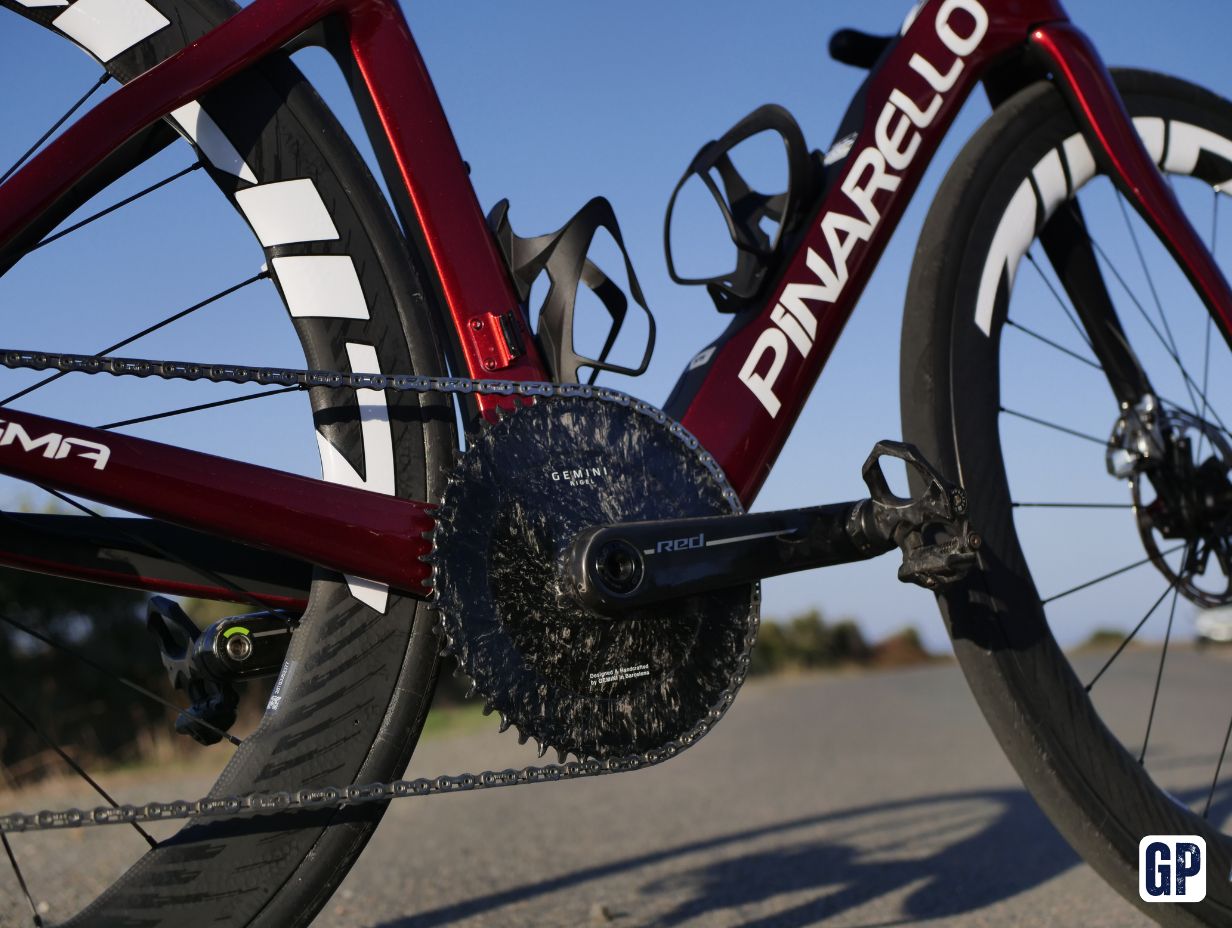
Under hard accelerations, the crankset-chainring assembly feels very direct. Obviously, not everything comes from the chainring. The frame, the crankset, the bottom bracket, the wheels – the whole system is at work. But the RIGEL doesn’t blunt the package. It stays crisp, stiff, almost transparent.
The carbon is not just for show
This is probably the point that changed my mind the most.
Before the test, I mainly saw the RIGEL as a spectacular, slightly exclusive chainring, designed for those who want a different piece. After several weeks, I see it more as a genuine performance component with a very strong identity.
Silence is its most noticeable argument. Stiffness stands out most on road builds or under hard accelerations. The finish is desirable, but it’s not the only thing that justifies the product.
Then there’s the price. Gemini is logically above many aluminium chainrings, while remaining in a zone comparable to certain high-end solutions. It’s not a rational purchase for everyone. If you are only looking for a reliable, discreet and cheaper chainring, there are very serious alternatives.
But if you’re building a high-end bike in 1x, road or fast gravel, and you’re sensitive to drivetrain silence, the RIGEL makes a strong case.
Who are the Gemini RIGEL chainrings for?
I can see them working very well on three types of builds.
First, a fast gravel bike in 1x, with a fairly large chainring and a wide-range cassette. Typically the kind of bike used on rolling, dry courses, where you want to keep speed without multiplying components.
Then, a road bike in 1x, best suited to hilly rather than mountainous regions, or to riders who know exactly which gear ratios they use.
Finally, a high-end build where aesthetics matter as much as function. Not because the look is enough, but because here, it doesn’t come at the expense of use.
After several weeks, I don’t have much to criticise about these chainrings. The product is beautiful, easy to install, quiet, stiff, and it works without demanding special attention. It’s not just a piece that catches the eye: it’s a piece you forget about when riding, except when you notice how quiet the drivetrain is.