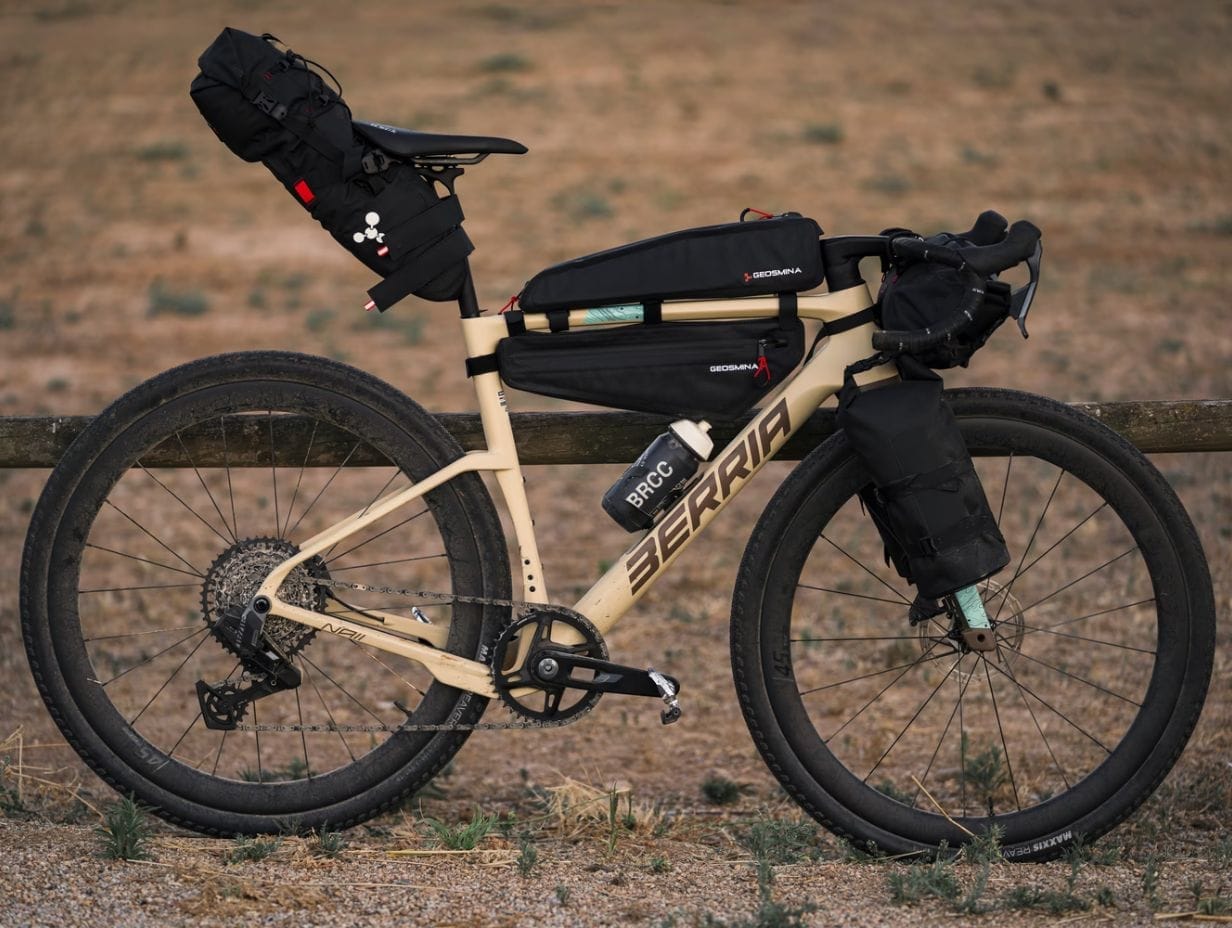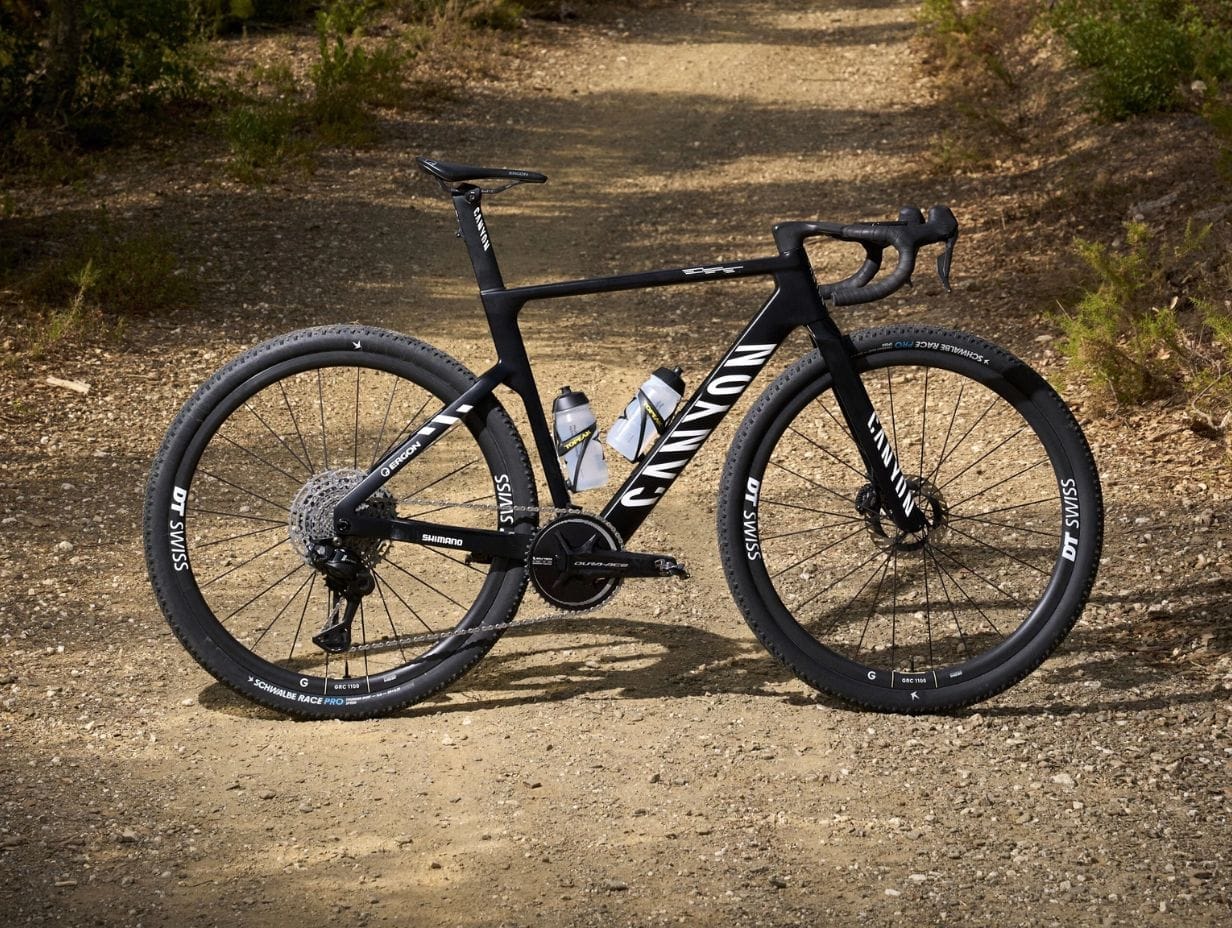

Balance. It is undoubtedly the word that comes up most often when we talk about a gravel tyre: balance between rolling efficiency and grip, comfort and toughness, road and trails. Many manufacturers promise it.
Out in the real world, things are sometimes more nuanced.
Strengths:
- Easy installation
- Very good tubeless sealing
- No punctures or cuts during the test
Could be better
- Manufacturer pressure recommendations that should be lowered
- Slightly less lively than some competitors
When Michelin offered to let me try its Power Gravel, I saw it as a chance to discover the French manufacturer’s vision in a particularly competitive segment.
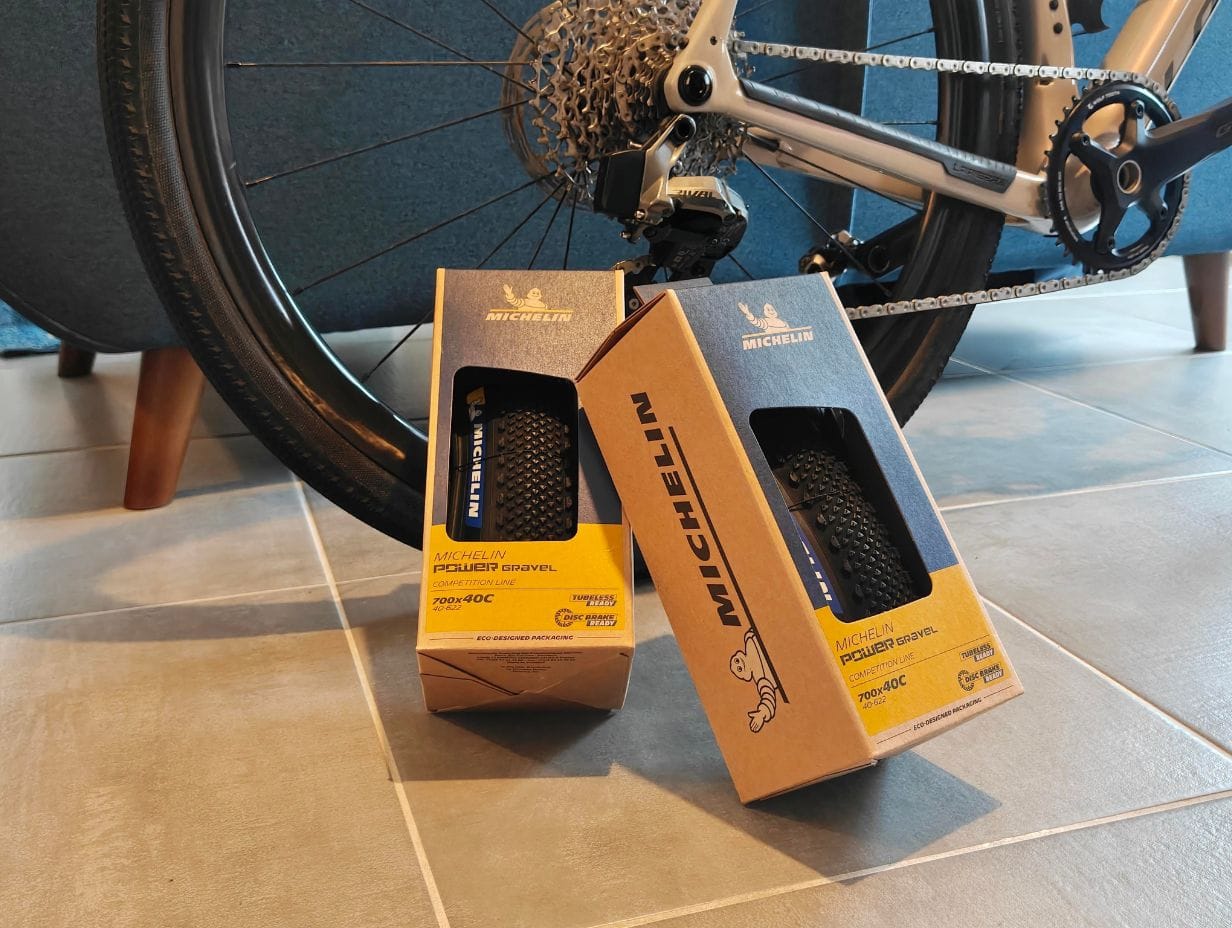
Available from 650B × 50 to 700 × 57 mm, the Power Gravel comes in a wide enough range to cover most uses, with Black or Classic finishes depending on the dimensions.
Used to the Hutchinson Touareg, which I have long appreciated for its value for money, versatility, and responsiveness, I approached this test with curiosity.
Above all, I hoped for a tyre able to link paved sections and trails naturally, with no real compromise. After several hundred kilometres ridden on very varied terrain, the Michelin Power Gravel ultimately revealed a personality all its own.
A build that inspires confidence
Right out of the box, Michelin stays true to what defines it. The packaging, entirely in recycled cardboard, goes straight to the point without trying to dazzle. A simplicity I particularly appreciate.
The tyre itself inspires confidence: the sidewalls look tough, the tread blocks are perfectly uniform, and the manufacturing quality is there.
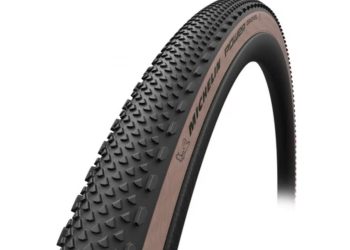
The tread pattern clearly sets the tone: tightly spaced centre blocks to preserve rolling efficiency, paired with more pronounced shoulders to secure cornering. A design consistent with the tyre’s all-round orientation.
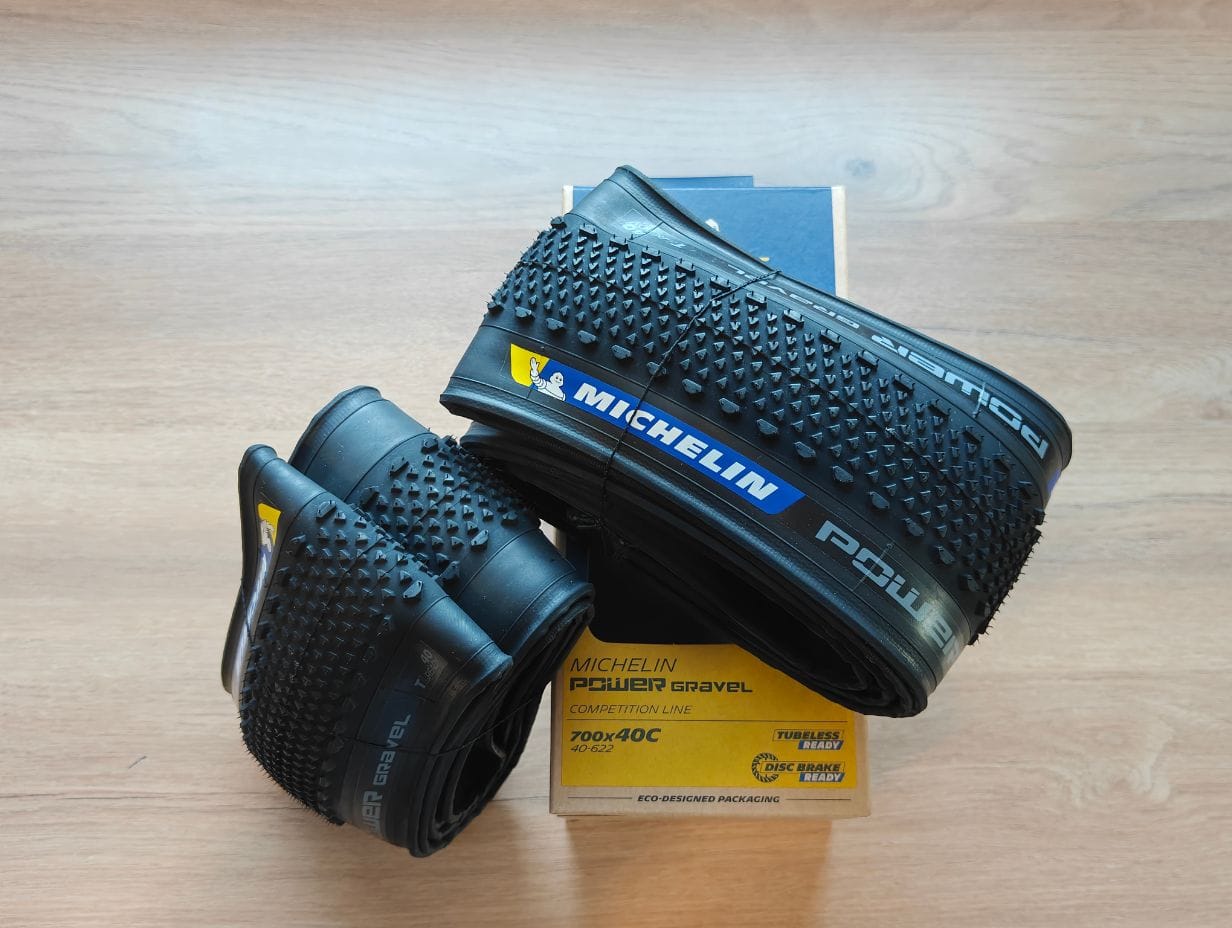
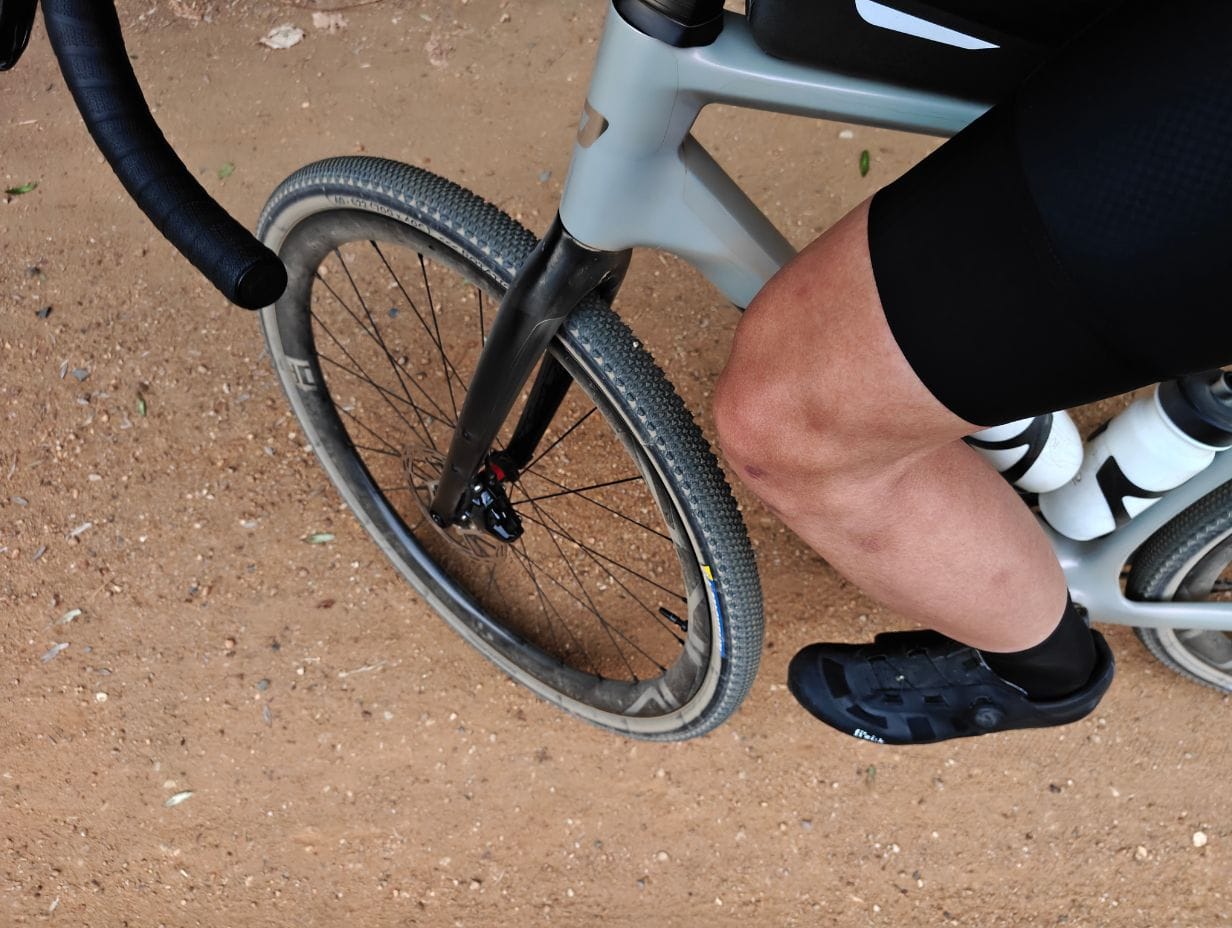
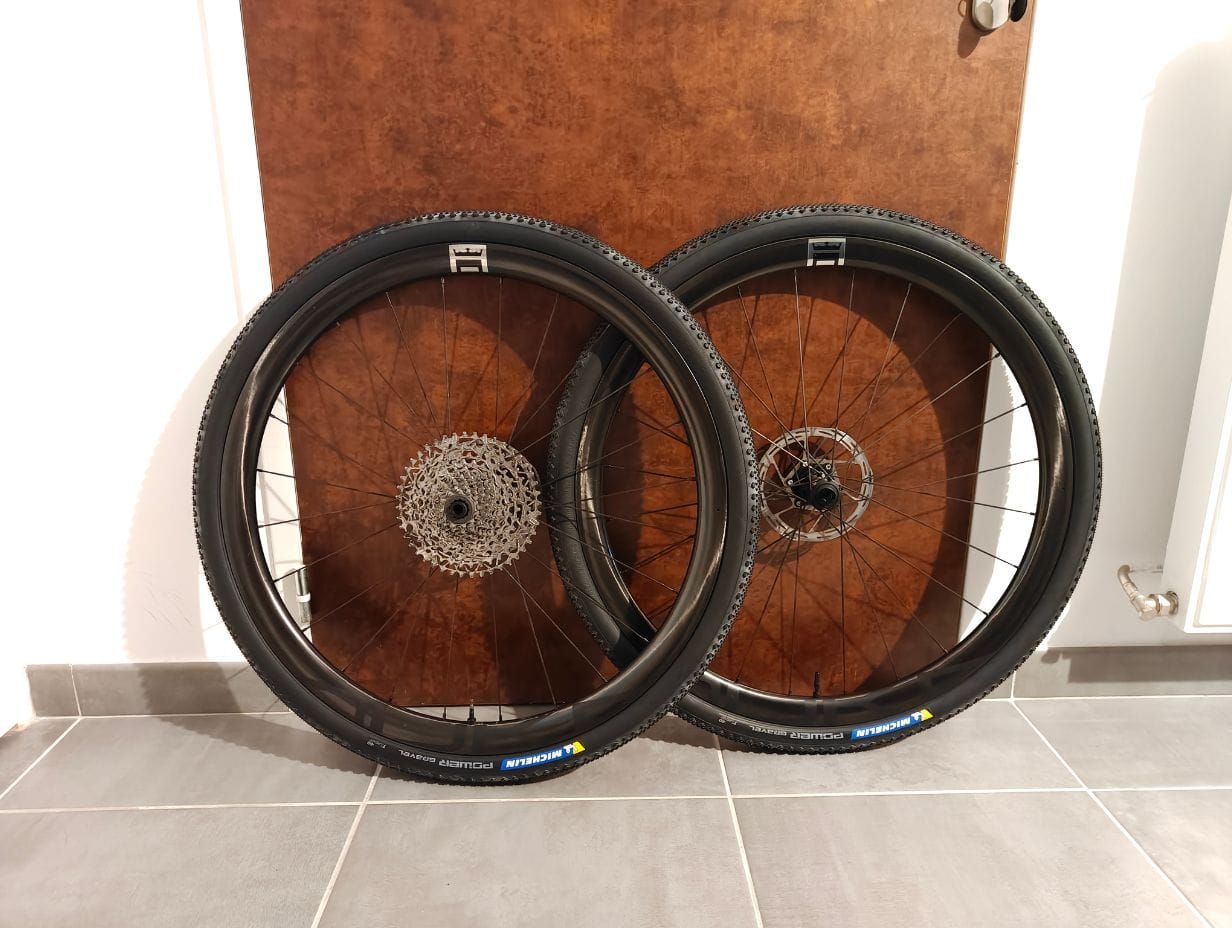
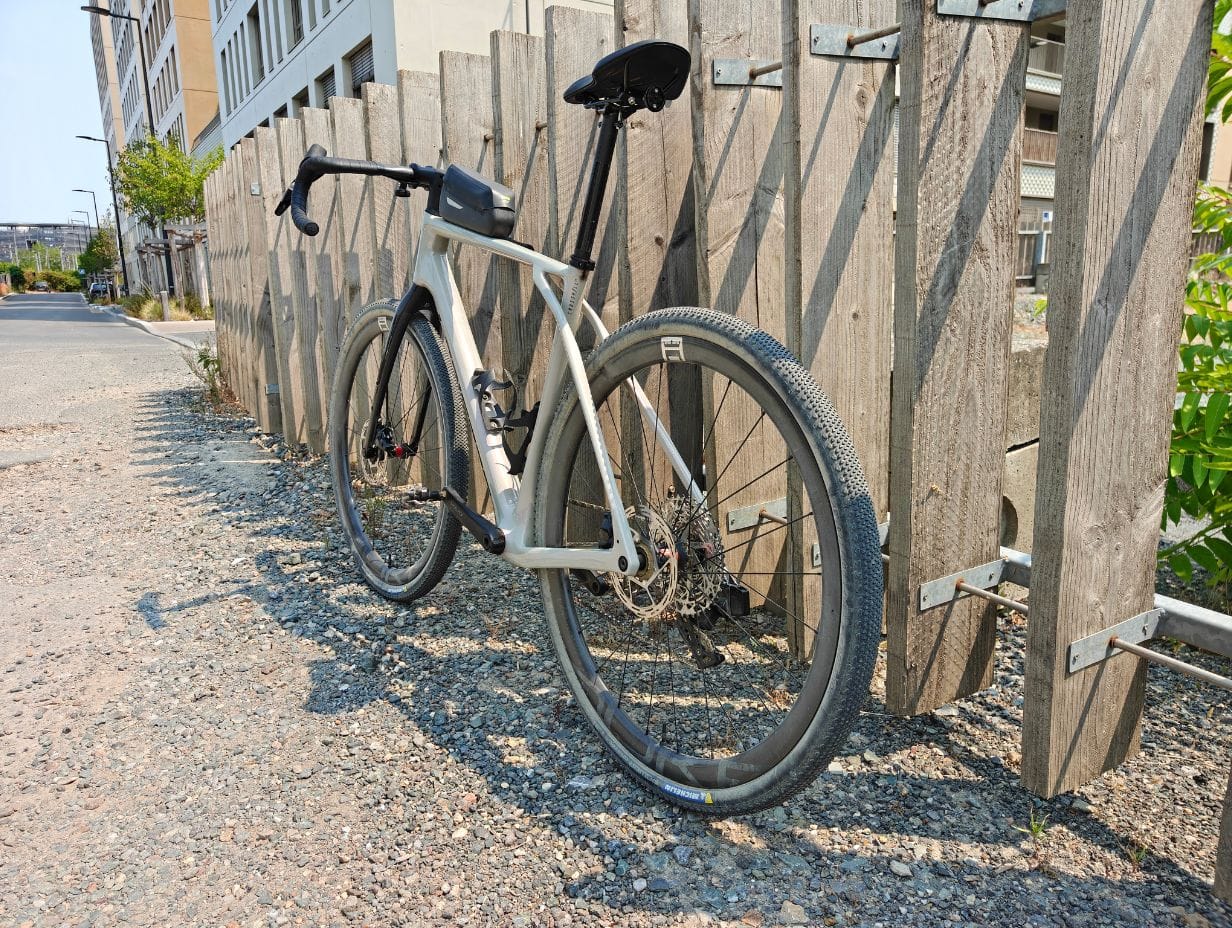
For this test, Michelin sent me the 700 × 40C version, set up tubeless on a pair of Duke Baccara RX36 SLR2 with 25 mm internal width rims, mounted on a Lapierre Crosshill CF 6.0 AXS.
On the scales, my two samples came in at 484.1 g and 499 g. Michelin claims 490 g per tyre, so the numbers line up perfectly.
Installation held no unpleasant surprises. The tyres went on entirely by hand, without tyre levers.
Inflation, on the other hand, took a bit more oomph. I could not get them to seat with a simple track pump. I used a Zéfal Tubeless Tank, which did the job in two blasts per wheel. For anyone new to this type of setup, our guide to fitting tubeless tyres to a gravel bike details the steps and the useful tools.
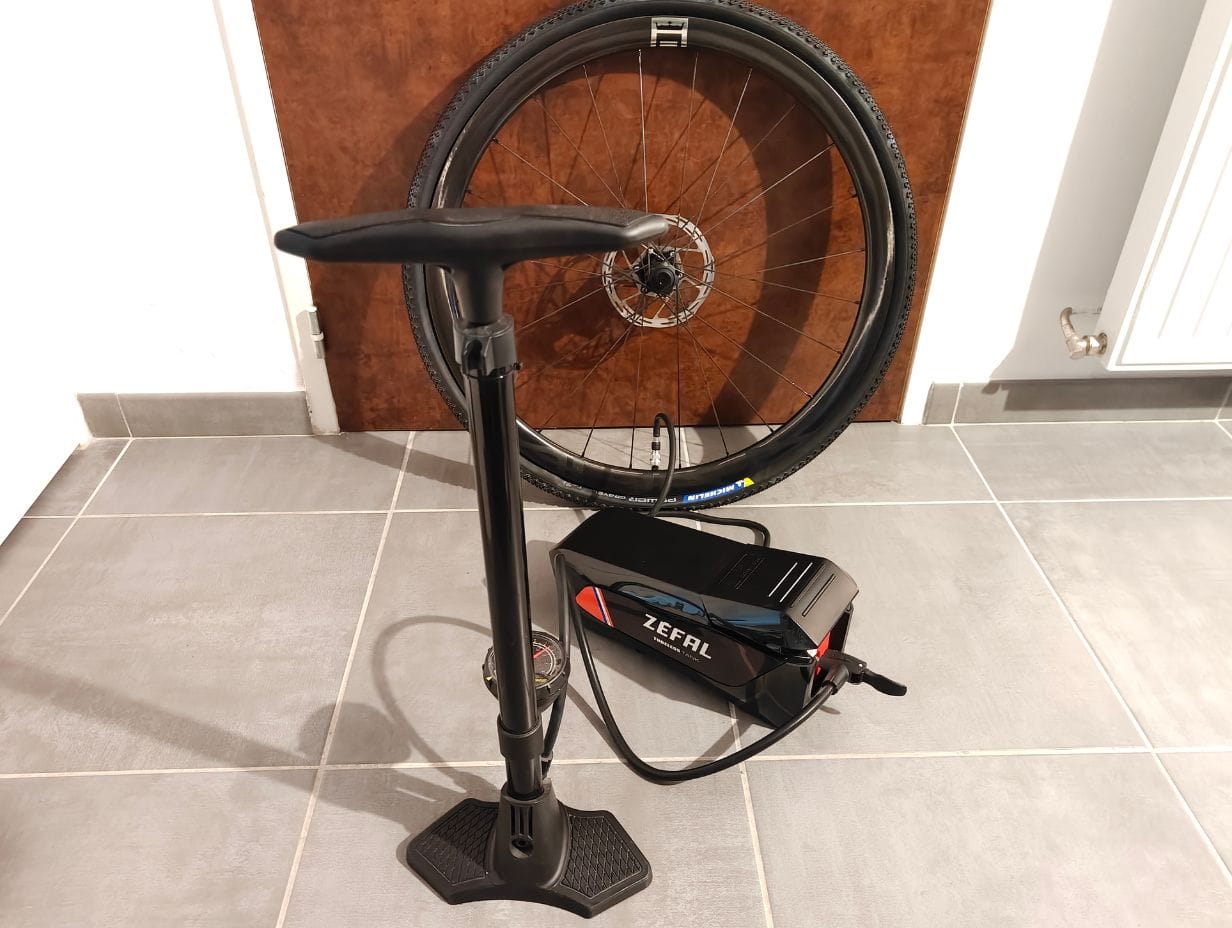
Once the beads were in place, sealing proved flawless. I then injected Joe’s No Flats sealant directly through the valves without difficulty.
After a few turns of the wheels, the setup was perfectly airtight, with not the slightest sealant weep at the beads or sidewalls.
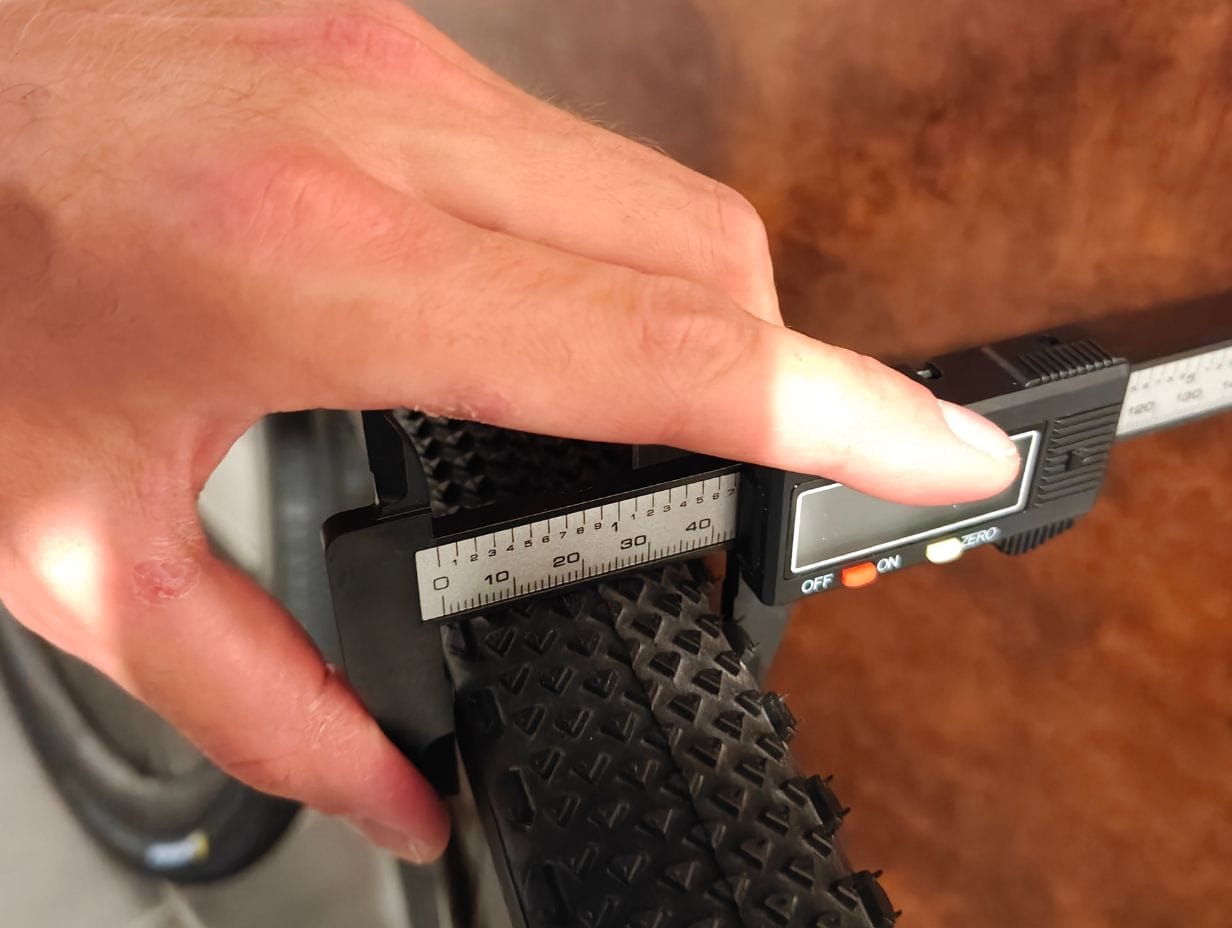
Mounted on my wheels, the tyres measure close to 44 mm actual width, a generous volume that promises good compliance.
Pressure changes everything
Yet my first ride left me with an unexpected impression.
The Michelin Power Gravel very quickly felt particularly firm.
I first set off with the pressures recommended by Michelin, between 3 and 4.5 bar.
Very quickly, I realised something was not right for me. The tyre bounced more than it absorbed imperfections and sometimes felt springy in ruts or farm tracks.
So I gradually lowered the pressure until I found a balance around 1.8 to 1.9 bar, both front and rear.
It was really from that moment that the tyre began to show its potential.
Comfort improves markedly, vibrations are better filtered, and the behaviour becomes much more natural, without ever feeling vague.
This experience also confirms the value of tubeless for gravel. The Michelin Power Gravel truly reveals its potential at low pressure, values that are much harder to exploit with inner tubes because of the risk of pinch flats.
Very convincing versatility
All it really takes is finding the right pressure for the Power Gravel to fully express its qualities. It is a useful reminder too: in our guide to choosing gravel tyres, pressure remains one of the parameters that most changes a tyre’s behaviour.
On the road, rolling efficiency remains very satisfying. It does not quite deliver the effortless feel of my Hutchinson Touareg, but the difference is relatively small.
Transitions between tarmac and tracks happen naturally and rolling noise remains surprisingly low for such an all-round tyre.
Off-road, the Michelin quickly confirms its orientation.
Over the course of this test, I took it on very fast-rolling tracks, dry gravel, forest roads, sandy sections, wet sectors, and a few muddy passages.
Overall, it proved consistent.
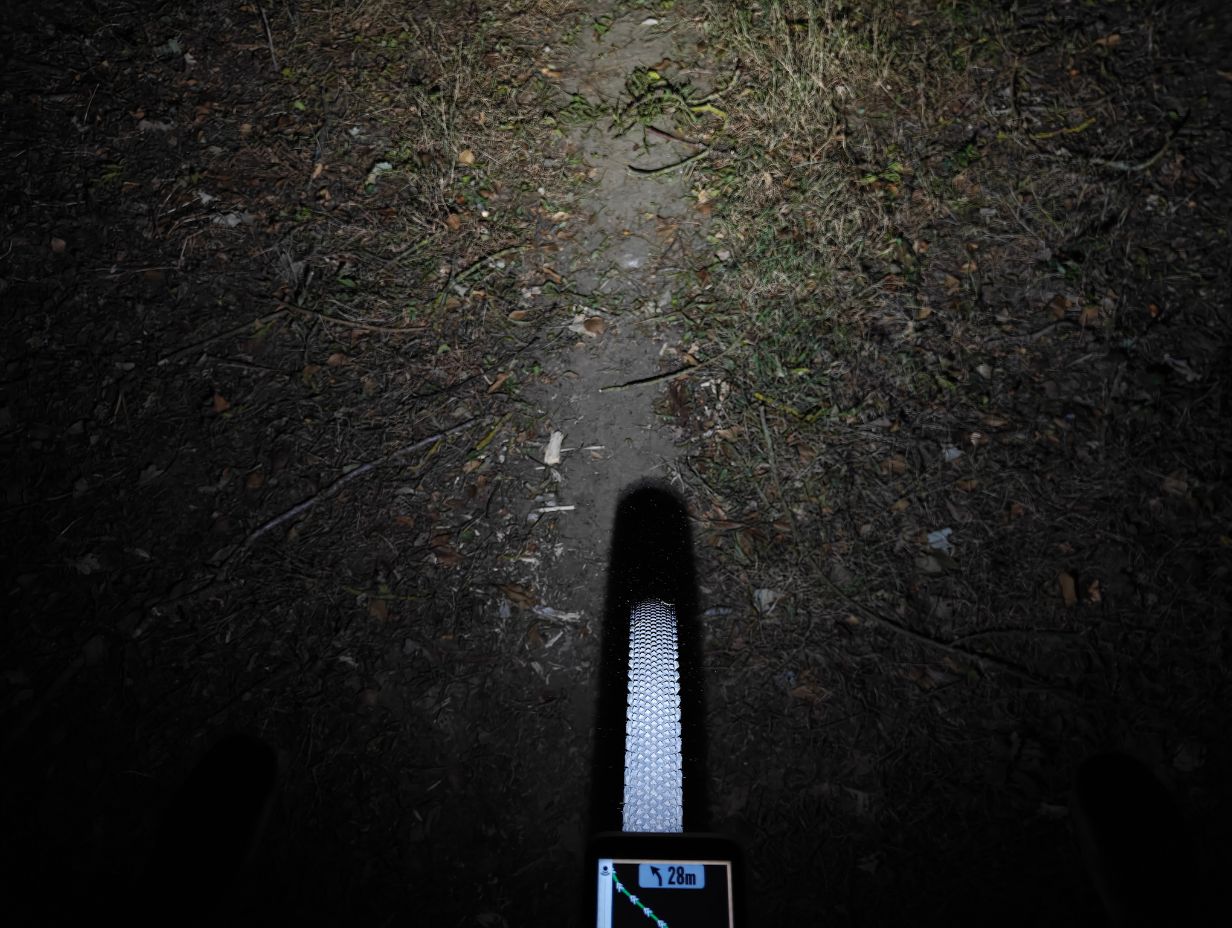
Climbs, even rocky ones, pose no problem. Out of the saddle, traction remains excellent and the tyre always keeps a controlled feel.
On descents, it immediately inspires confidence. Weight shifts are progressive, grip is predictable, and braking stays strong whatever the conditions.
Even in the rain, I never noticed any worrying behaviour.
Naturally, the Michelin Power Gravel reaches its limits when the terrain gets very greasy, where more aggressive tread will retain an advantage.
On the other hand, for mixed use spanning road, fast tracks, farm lanes, and forest trails, it shows great versatility. Within the Michelin lineup, it also sits differently from the Michelin Power Adventure, more oriented toward tarmac transitions and fast-rolling paths.
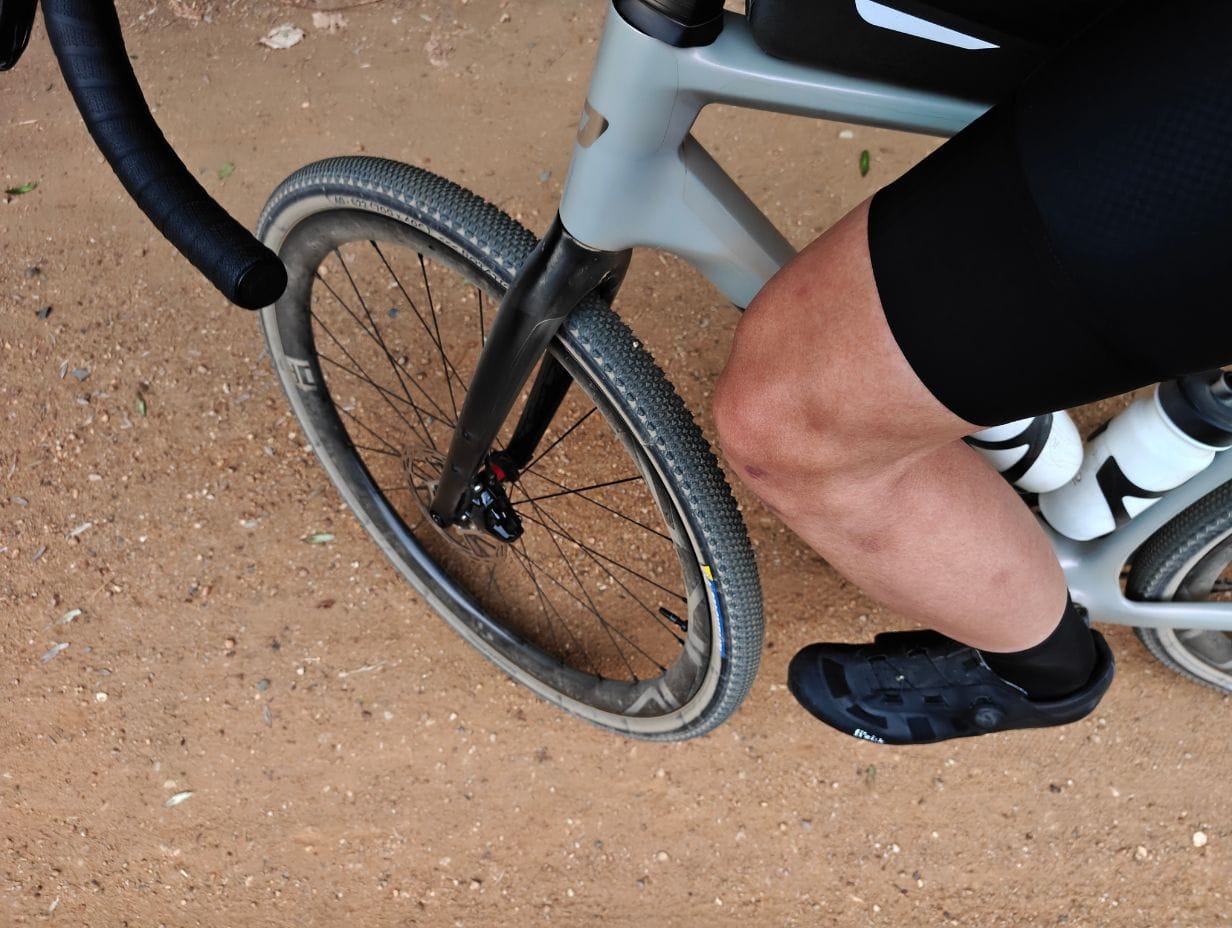
Kilometre after kilometre, what struck me most was neither rolling efficiency nor grip.
It was peace of mind.
Over more than 1,000 kilometres, I did not suffer a single puncture or cut. Yet some particularly rocky stretches even made me stop at times to check the tyres’ condition.
Every time I checked, nothing.
Pressure retention was excellent as well. The tyres seem particularly airtight and require very little topping up between rides.
Finally, wear is almost imperceptible after this first thousand kilometres, which bodes very well for longevity.
On this point, Michelin seems to have met its goal perfectly.
Limits to keep in mind
That said, the Michelin Power Gravel is not without flaws.
The first echoes a point already mentioned: the pressures recommended by the manufacturer.
To my eyes, the stated values are far too high to get the most from the tyre. Only after dropping pressure significantly did I find the behaviour I expect from a modern gravel tyre.
The second reservation is more subjective.
Compared to the Hutchinson Touareg, the Michelin feels slightly less lively on accelerations and offers a road feel that is a bit less supple on long rides.
The gap remains limited, but it exists.
In return, the Michelin answers with a toughness that truly inspires confidence.
My verdict on this tyre
The Michelin Power Gravel does not try to break rolling-efficiency records or impress with sheer dynamism.
What it does, however, is exactly what you want from an excellent all-round tyre: it quickly inspires confidence, soaks up the miles without flinching, and makes you want to head far without overthinking it.
If I were preparing a long bikepacking adventure tomorrow, this is exactly the kind of tyre I would mount without hesitation.
For more performance-focused riding, I would probably keep favouring the Hutchinson Touareg, whose comfort and liveliness I appreciate more.
But if your priority is to ride long, serenely, with a robust tyre capable of taking on both tarmac and the majority of gravel terrain, then the Michelin Power Gravel is a very compelling proposition.