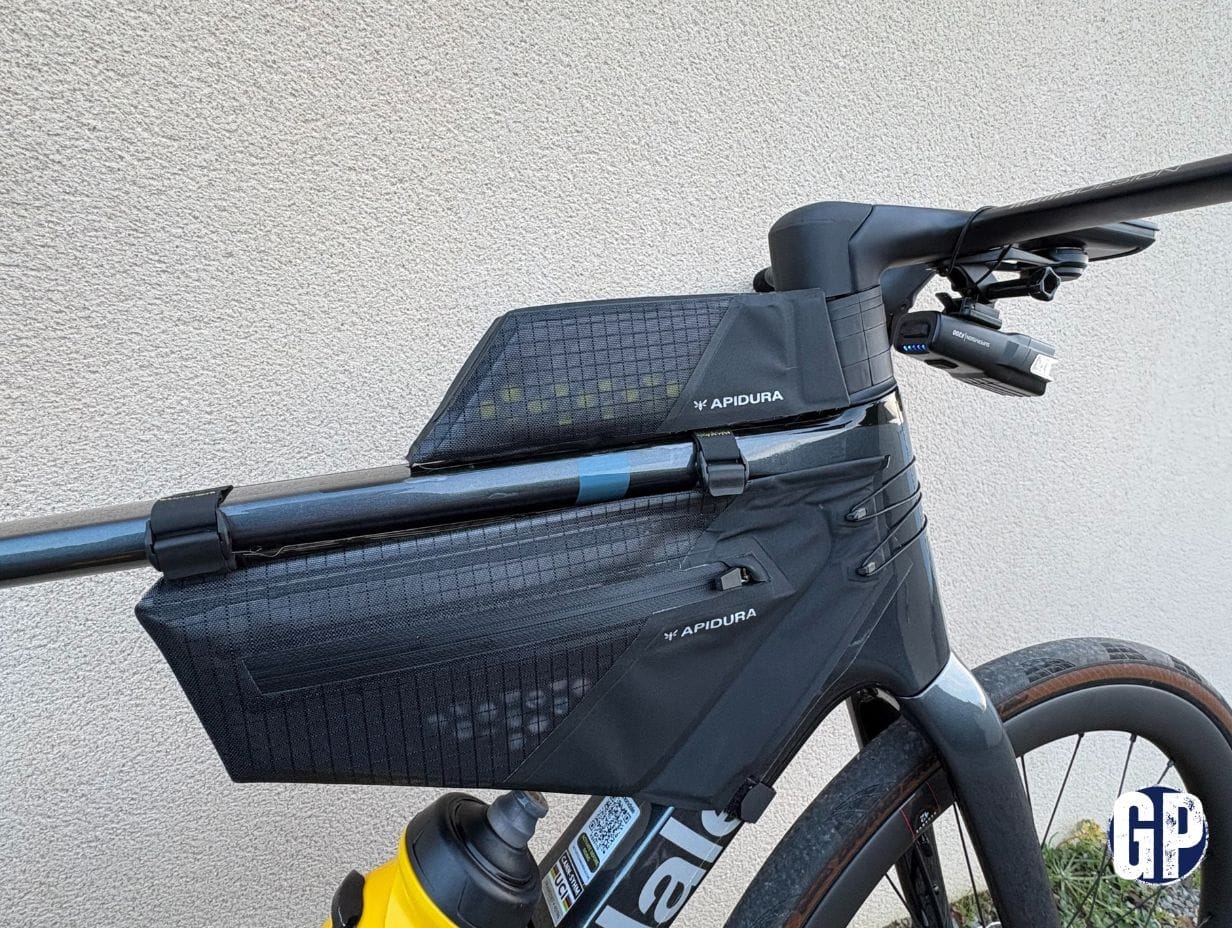

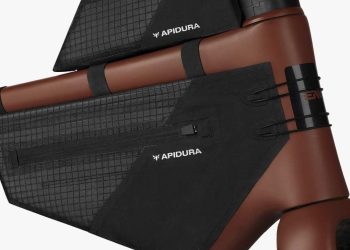
For several weeks now, I’ve been riding with the Apidura AeroSystem, a two-piece set comprising a top tube bag and a frame bag conceived not as simple storage… but as aerodynamic modules designed to smooth airflow and cut drag.
On paper, it’s a bold approach: replace a small section of the bike’s profile to cheat the wind and gain up to 5 watts at realistic gravel race speeds.
Strengths:
- Exemplary stability, even on rough terrain
- Quick access to nutrition
- A novel and bold concept
Could be better
- No bolt-on mounting
- Side edges are too aggressive
- Sizing is tricky depending on the frame
Apidura didn’t take this lightly: CFD, wind tunnel, prototypes for Unbound, collaborations with Ridley and Hunt… the project exudes seriousness. But, as is often the case with highly technical concepts, real-world riding sometimes tells a different story. And that’s exactly what makes this review interesting.

Design & finish: well executed build, questionable choices
Apidura knows how to make bags. You can see it immediately: premium materials (TPU-laminated Hexagrid, HDPE reinforcements), well-controlled stiffness, a secure, unwavering fit. The set arrives carefully packaged, and just handling the two modules makes it clear the brand hasn’t simply stretched fabric over a shape.
But one of the first surprises comes from the top tube bag: no bolt-on compatibility.
In 2025-2026, on a premium aero product, that’s hard to understand. The vast majority of modern gravel bikes include two inserts designed precisely for this kind of use.
Here, you have to use straps, and the visual ambiguity on the site (where you could think the straps belong to the frame bag) doesn’t help.

We can accept that certain shape constraints made integration complex… but on a product positioned as an aerodynamic optimisation, giving up a rigid fixing seems paradoxical. Personally, I ended up drilling two holes to get a clean installation, but obviously that’s neither recommended nor desirable.
You can also try using the frame bag’s straps to secure the top tube bag.

The closure philosophy of this top tube bag is also unusual. Apidura opts for a quick-access opening, without a conventional zip, designed so you can grab nutrition in seconds.
The intention fits a racing use, but in practice, as soon as you load it a bit, the bag never fully closes. Result: it loses versatility and clearly becomes a bento box, nothing more.

Finally, one element really surprised me: the side edges are surprisingly aggressive. With short bib shorts, I scuffed the inside of my knees from the very first rides, especially when out of the saddle. With long bibs, it’s the fabric that suffers.

For a product developed with pro riders, this kind of detail is hard to justify. I had to add some felt to soften the edges. It solves the issue, but it doesn’t exactly flatter the product.
Handling & ergonomics: intuitive, but dependent on the bike
The top tube bag, despite its limits, works well in the precise scenario it was designed for: quick access, intuitive to use, no time wasted. It’s very close to triathlon bento boxes, where fluidity is prioritised over versatility.

However, don’t expect to fit your full race nutrition, especially if you’re aiming for 120 g of carbohydrates per hour. 😄
Here in the photo there’s only a small bar and a fruit purée pouch!

The frame bag, on the other hand, demands more thought. Apidura offers two sizes (S/M and L/XL) with a simulation tool based on a photo of the bike.
On my size 56 frame, I naturally chose the L/XL. Yet once installed, nothing worked: the Cannondale Synapse’s very wide, profiled down tube prevented the bag from sitting flush. The edges flared, the integration became approximate, and the very idea of an aerodynamic gain lost all meaning.

It was only after trying the S/M size that I realised the AeroSystem sizing logic isn’t as simple as a correspondence table.
More compact, the smaller version ultimately suited my frame better. The fit was more uniform, the integration cleaner, and the whole system finally took on the shape imagined by Apidura.

The choice between the two sizes therefore depends as much on the frame’s volume as on its actual geometry, especially the width of the down tube. That’s not a drawback in itself, but the user has to accept a degree of trial and error.
Also worth noting a minor but real difference: one of my samples had a neon yellow inner liner, the other didn’t. Nothing dramatic, but surprising enough to mention on a product in this range.

In the field: exemplary stability, realistic-looking watts, and very real constraints
On the move, the AeroSystem immediately shows what you expect from an Apidura product: nothing budges. Whether on fast asphalt or demanding gravel, stability is impeccable.
No rattling, no sway, no flutter. The frame bag also proves narrow enough never to impede pedalling, even in technical sections.
As for waterproofing and care, the coating used does its job perfectly: the bag wipes clean in seconds, and the contents stay dry in most realistic scenarios.
Capacity is sufficient for a rain jacket or accessories. I do, however, regret there isn’t a second opening on the left side with a narrower pocket to slip in keys or a credit card, for example.

That leaves the central question: watts.
Apidura claims an average 5-watt gain, a figure stemming from a serious protocol: CFD, Bike Valley wind tunnel, tests on three types of bikes (aero gravel, adventure and all-road), yaw angles from 0 to 15°, realistic race speeds (36 and 44 km/h).
On this point, nothing sounds fanciful. The gain is measured, reproducible, consistent with the concept. But it rests on a non-negotiable condition: the fit must be perfect.
The slightest deformation, the slightest gap, and the promise collapses. That’s a limit inherent to the concept, not the brand.

Finally, a very concrete point: the AeroSystem combo severely reduces the space available for bottles. Even on a large frame, I couldn’t use my usual bottle cages. You have to switch to side-entry designs, otherwise the set-up becomes impractical.

Compared with a classic bag, the AeroSystem plays in a different league. It’s neither a versatile storage space nor a light travel tool. It’s a performance module designed for a specific use, with clear trade-offs.
Compared with Apidura Racing models or other slim bags on the market, the AeroSystem stands out for its more structured shape, greater rigidity and aerodynamic behaviour. But it sacrifices volume, ease of use and a good dose of versatility.
In short, it’s not a bag you buy to do everything. It’s a piece of equipment you install to go faster, and only in that context.

My take on the Apidura AeroSystem
The Apidura AeroSystem is a fascinating product because it opens a new path in performance gravel: one where bags are no longer an aerodynamic dead weight, but become an extension of the bike’s profile. The concept works, the watts do seem to be there, and the idea is brilliant.
But this first version still lacks maturity on very concrete points: comfort, ergonomics, compatibility, fit optimisation. Nothing crippling, but present enough to confine this product to a very clear niche.
The AeroSystem is aimed first at gravel racers obsessed with optimisation, able to accept the trade-offs and ready to adapt their kit around the product. For everyone else, there are simpler, more versatile and less demanding solutions.
The intuition behind this product is excellent. Now, we’re waiting for V2.