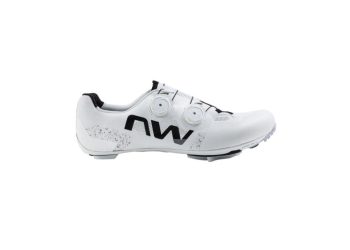
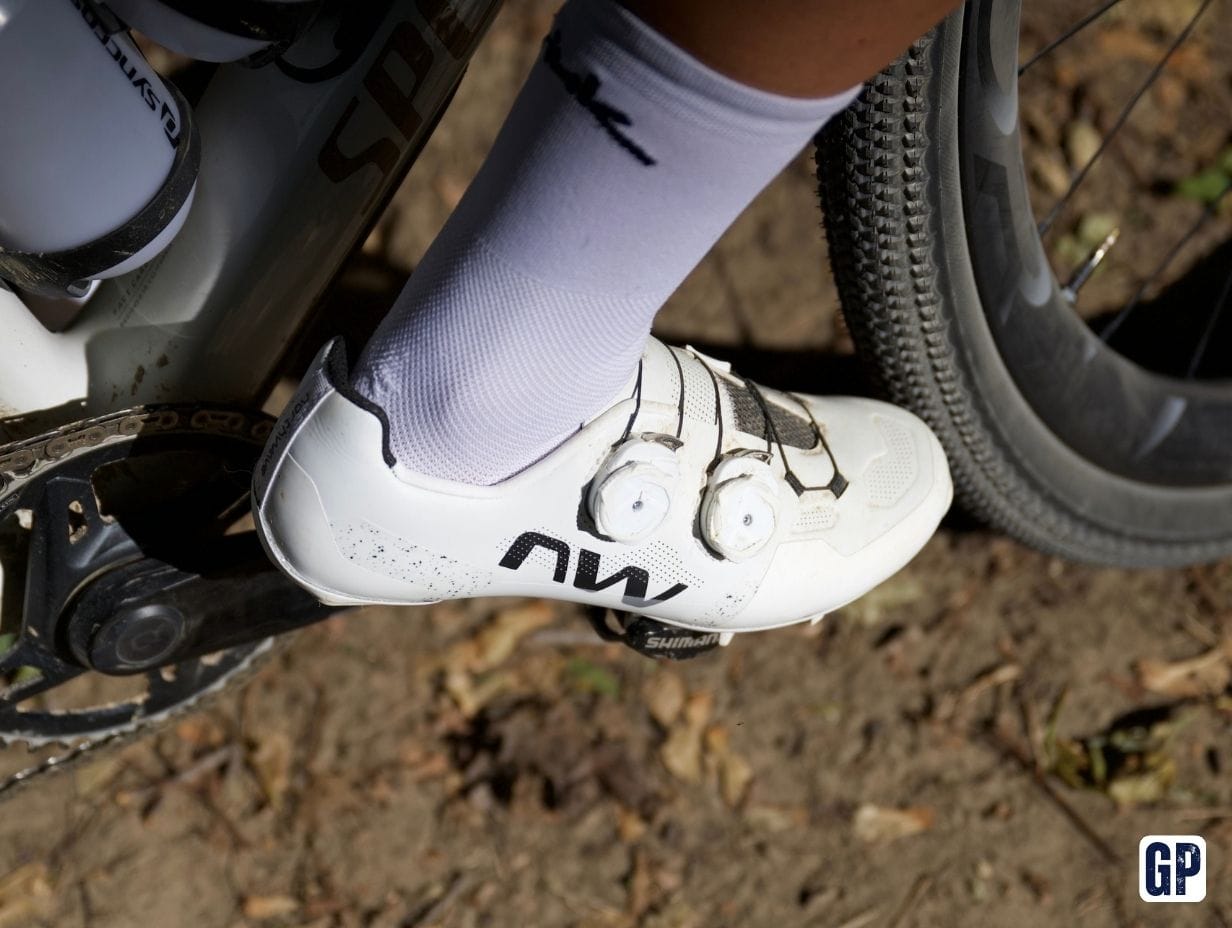

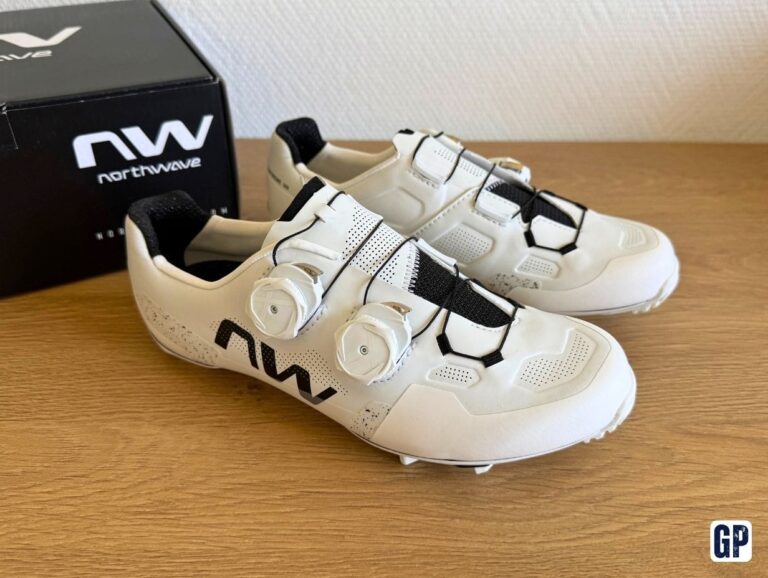
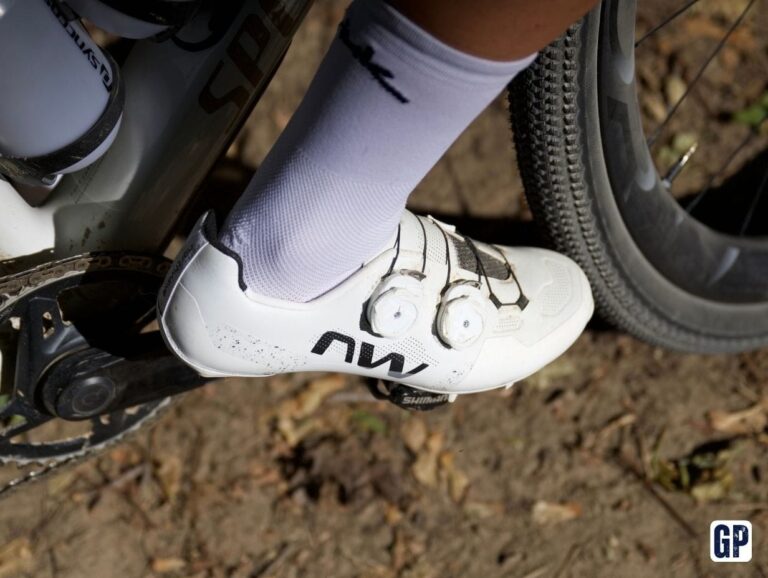
The Northwave Extreme X are premium SPD shoes, designed for hard riding in gravel or MTB, with a stated stiffness index of 15. In other words, not exactly the pair you pick to nip out for a loaf.
I tested them in white, in training and in races. And quite quickly, two things became clear: they are really comfortable for a race shoe, but their very flat shape will not suit every foot.
Strengths:
- Comfortable, roomy fit
- High stiffness and good power transfer
- Easy to clean, even in white
- Replaceable lugs and heel pad
Could be better
- Arch support too low for some feet
- Non-BOA closure less convenient
A neat box, with two insoles and a genuine volume option
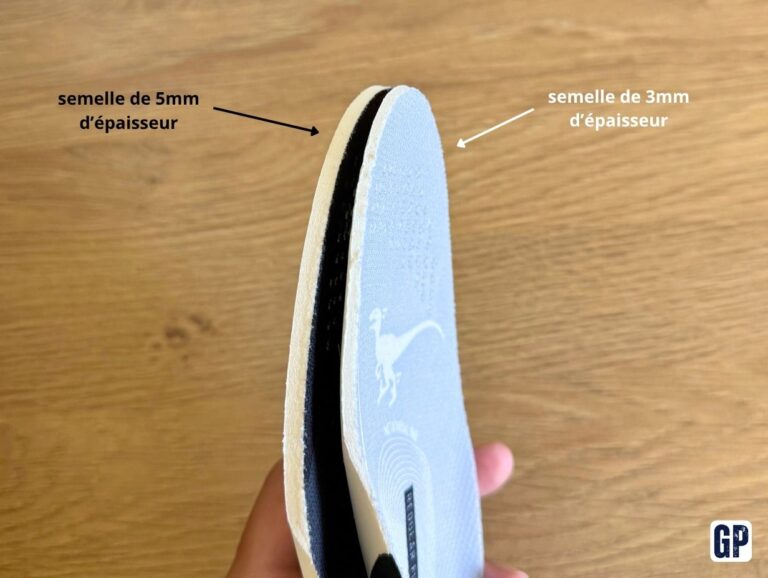
Northwave supplies the Extreme X with two pairs of insoles: one fairly thin (3 mm), the other slightly thicker (5 mm). This is not a gimmick, as it lets you fine-tune the hold inside the shoe, depending on whether you want a more locked-in feel or, on the contrary, more room.
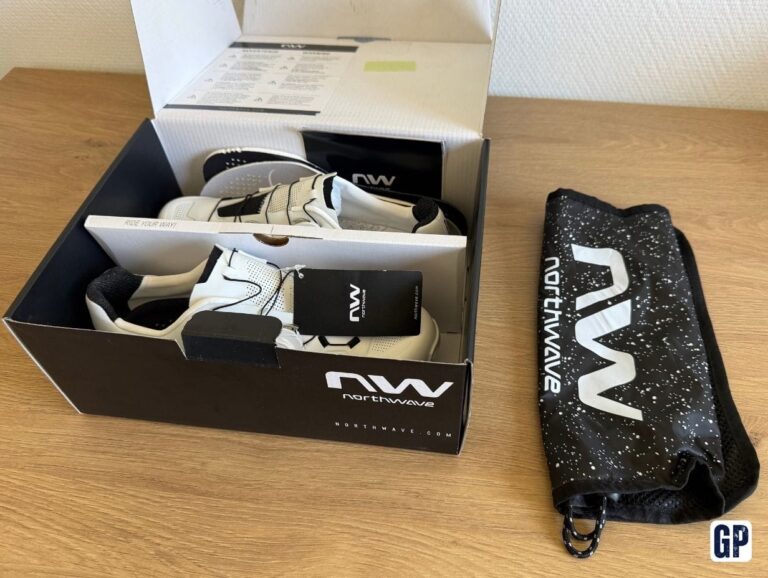
This dual-insole system seemed especially interesting because it matches the shoe’s overall character: the Extreme X offer more internal volume than many performance models I have worn.
There is also a shoe bag. At this price level, it is pretty much expected, but always appreciated when you move your shoes between rides, races or cycling weekends.
Sizing: follow the Northwave size guide
I usually ride in size 39 with Specialized, notably on the S-Works Recon, and also size 39 with Shimano. On the Northwave Extreme X, I went for 38 following the size guide. And in my case, it was perfect.
It is not simply a shoe that is “longer” in the straightforward sense. But it does give more space, especially in width and volume. I did not feel squeezed as in some narrower shoes.
You should not confuse it with a true wide version either. It remains a performance shoe, fairly close to the foot. It is simply much less cramped than some very race-focused models.
A very flat shoe - maybe too flat for some arches
This is what struck me most. The inside of the Extreme X is wide, but above all very flat. The insole does not create real support under the arch. And for me, as someone who already uses arch supports in some road shoes, you can clearly feel it.
Even with the thicker insole, I had the sensation of my foot collapsing a little in the shoe. Not because the outsole lacks stiffness. Rather because my foot needed a more structured platform under the arch.
It is a very personal feeling, but important. Some people like flat shoes because they leave the foot freer. Others, like me, need more present support to keep good alignment and avoid that feeling of the foot caving in.
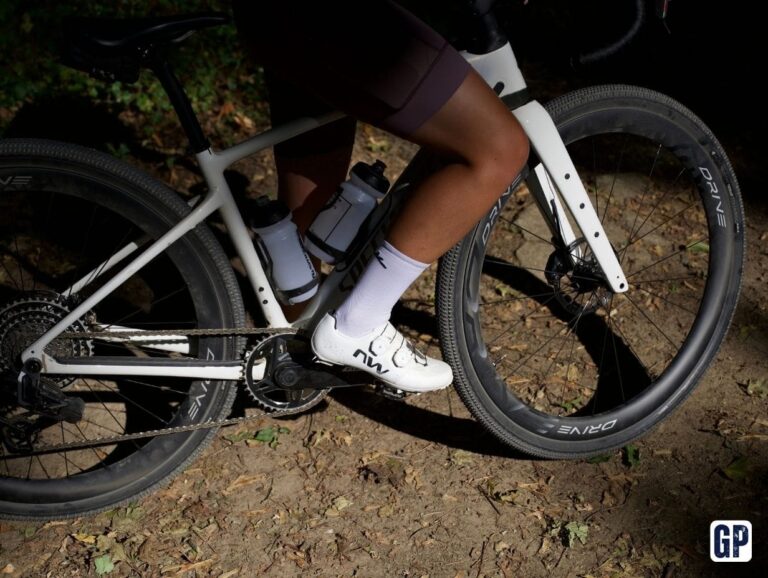
At this point, I already know that to reach ideal comfort, I need to add specific insoles with arch support.
Compared with the S-Works Recon, a less generous cleat adjustment range
I compared the sole of the Extreme X with that of my S-Works Recon. Even in size 38, the Northwave appears very close in length to a size-39 S-Works, even visually slightly longer.
The most important point concerns cleat adjustment. On the Extreme X, I could not move the cleat as far back as on my S-Works Recon. I use my cleats as far back as possible, because that gives me more stability underfoot.
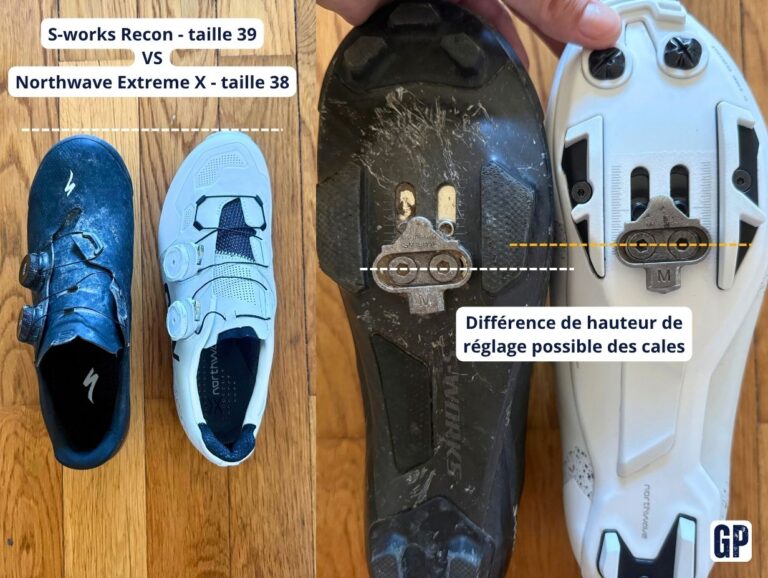
That will not be an issue for everyone. But if your position depends on a very rearward setting, it is worth knowing. A more limited range can change the pedalling feel, and may even require some bike fit adjustments.
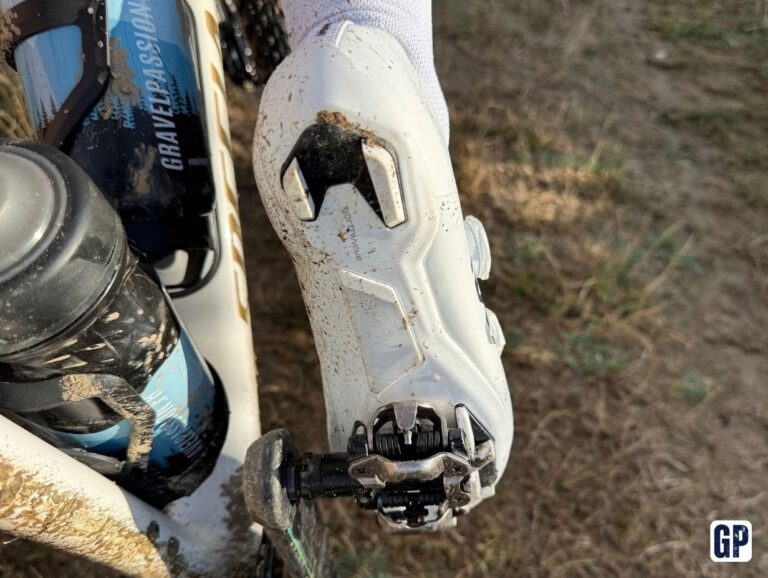
Off the bike, the cleat quickly touches the ground if it is set back
This cleat position also has a consequence when walking. Because I place my cleats quite far back, they end up close to the end of the small rubber reinforcements that frame the SPD area.
Result: I quickly heard more metallic noise when walking. And my cleats marked more quickly than with other shoes.
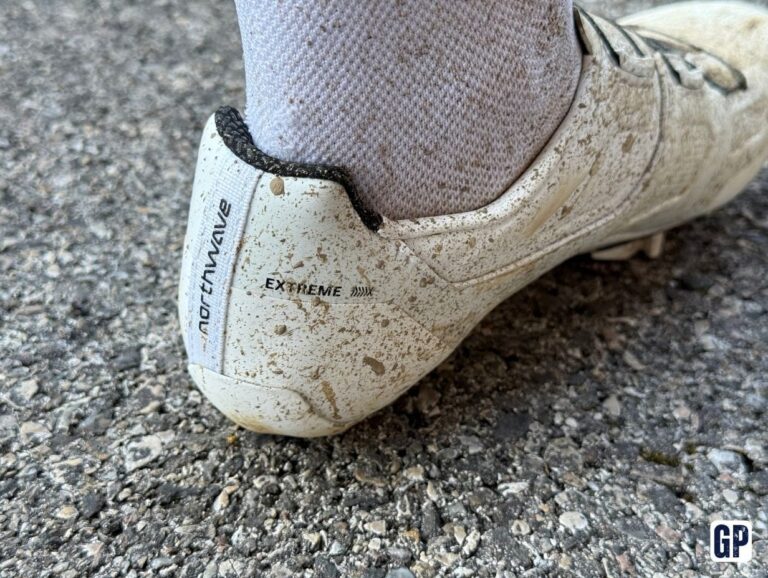
It is both related to my cleat position and to the curved shape of the rubber reinforcements. In gravel, sometimes you walk a little, sometimes a lot: a carry, a pause, a muddy transition, a feed stop. In those moments, I more often had the feeling of walking on the cleat.
If you place your cleats more centrally, the issue may be less present. But for very rearward settings, it is a real point to watch.
Replaceable studs, but not supplied
Under the shoe, Northwave has added some interesting elements. The heel pad and the lateral lugs around the cleat are replaceable (expect 20,50€ on the Northwave website). That is good news for durability, especially on a pair meant to handle off-road.
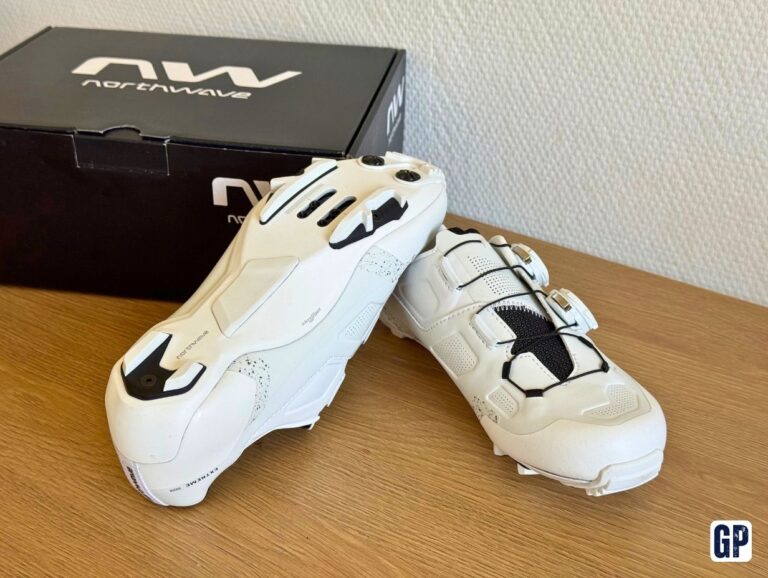
There are also two front inserts to add toe spikes. Except that the spikes are not supplied.
Not a deal-breaker. But on a €299 shoe, I would have liked the kit to be complete.
The heel reinforcement is well designed. There is an internal grip that helps keep the foot in place. With the shoe’s fairly generous volume, this detail helps maintain a stable feel.
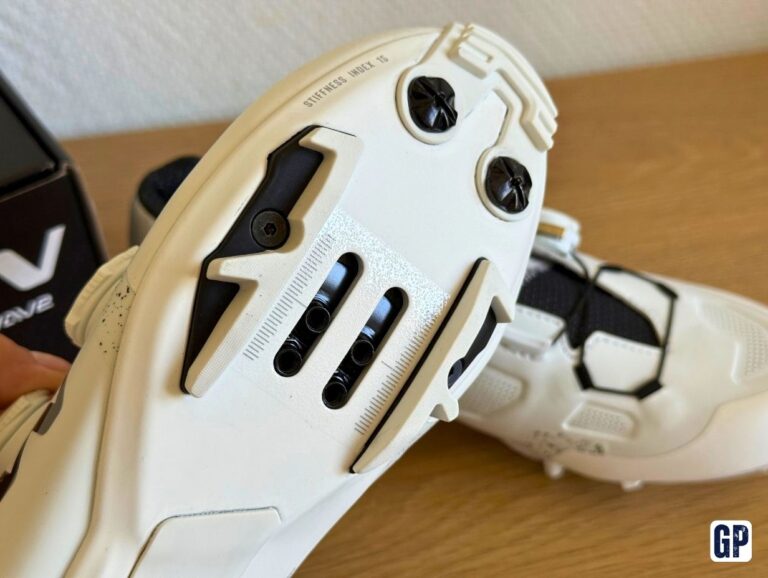
Dial closure, but not BOA
The Extreme X use two tightening dials. Visually, it is similar to what we know from a BOA system. But it is not BOA.
The laces are not small metal cables: they are textile laces. I actually liked this choice. It is more flexible, probably lighter, and I did not feel any pressure point on the top of the foot.
The operation takes a little getting used to. To tighten, you turn the dial like on a classic micro-adjust system. To loosen progressively, you press the small metal-coloured latch, which releases the tension click by click.
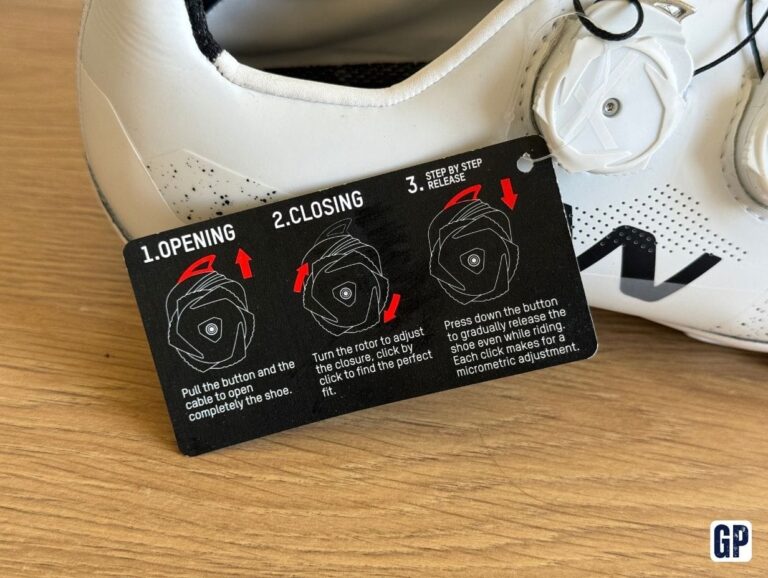
To open the shoe completely, it is less practical: you have to pull the latch while pulling the lace with the other hand. So yes, you need two hands. And honestly, I prefer the simplicity of a true BOA for this.
I did not have any durability issues during my test. But the dials are plastic, and there is no BOA lifetime guarantee behind them. Having already had BOA parts replaced on another pair, I know this service can really matter in the long run.
Here, in case of an issue, Northwave offers a dial repair service, priced at 54,99€.
A very synthetic upper that is easy to look after, even in white
The outer material of the Extreme X has a fairly plastic, very synthetic feel. It is not the most breathable upper at first touch, and it is not the one that feels the most natural under the fingers.
But it is heavily perforated, with many small holes. In use, my feet did not get soaked with sweat, nor did I notice any particular odour issue. So despite the very plasticky look, the ventilation seems sufficient for my use so far.
And there is a very practical advantage: in white, they clean up well. The synthetic surface washes easily. It is almost what makes the white colourway acceptable day to day.
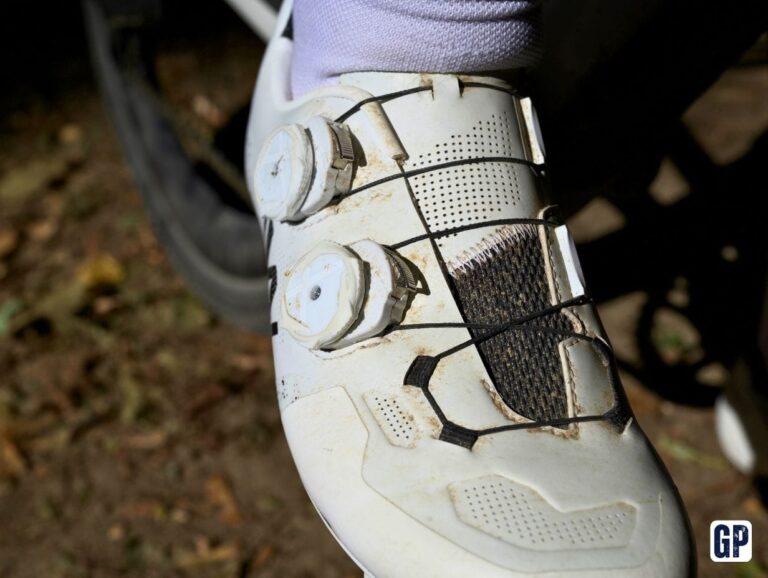
This plasticky side may feel less premium than other, more textile or more elaborate constructions. But for gravel use, it makes sense: it is easy to clean, it is not fragile, and the shoe does not deteriorate quickly visually.
On the bike: stiff, comfortable, genuinely performance-oriented
I rode the Extreme X in training, but also in race conditions. Once the cleats were properly set, I had no pain, no numbness, and no particular discomfort related to hold.
The stiffness is definitely there. When I felt any deformation, it came more from my foot lacking arch support than from the shoe itself. The sole does not feel like it twists or dulls your effort.
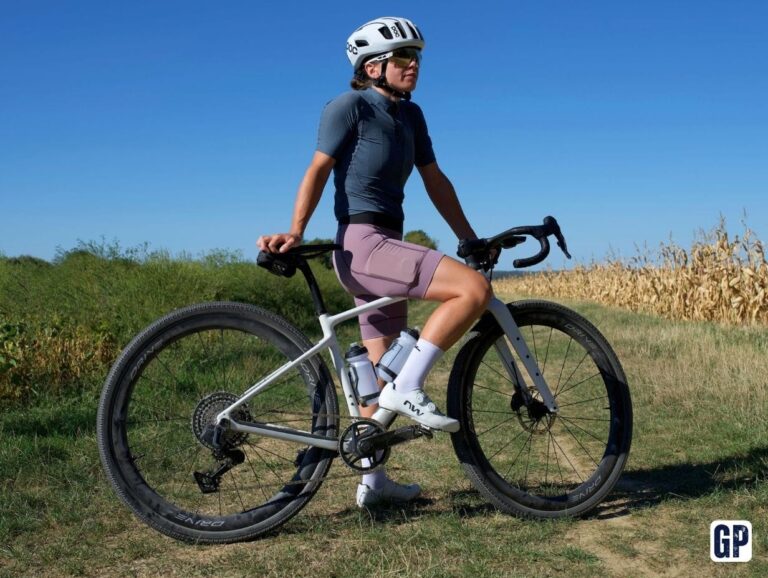
It is a race shoe. It transmits power well, holds well, and it does not give that overly soft compromise you sometimes find on more versatile models.
Comfort comes mainly from volume, not arch support
That is where the Extreme X are a little particular. They are comfortable, yes. But that comfort comes mainly from the space available, the absence of lateral compression, and the fairly supple closure over the top of the foot.
It is not a comfort based on a very sculpted arch support. If your foot likes to sit on a flat platform, you will probably be fine. If you need a more pronounced arch, you will need to plan for a specific insole.
In my eyes, that is the real trade-off of this shoe. Northwave offers a more accommodating fit than some very narrow references, but does not offset that volume with a structured internal support.
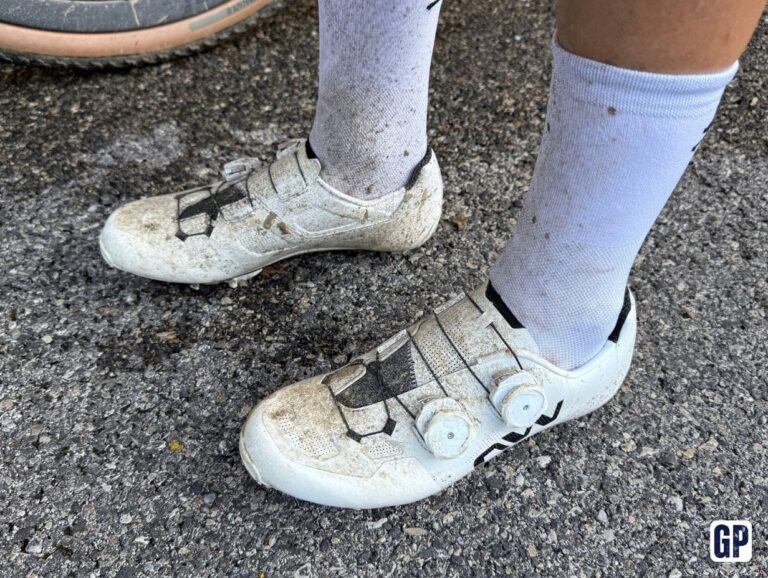
For my foot, that creates a pleasant feeling of freedom, but also a lack of support under the arch. The two can coexist. That is exactly what makes the choice of a shoe so personal.
Price and competition: Northwave positions itself smartly
The listed price around €299 puts the Extreme X in the high end, without reaching some of the market’s peaks. They are about €100 cheaper than the S-Works Recon, and line up against models such as the Shimano S-Phyre XC903.
They also remain cheaper than the Shimano S-Phyre RX910, another very gravel race-oriented reference.
At this price, the stiffness, overall comfort, the swappable insoles and easy cleaning play in their favour. The non-BOA closure and the lack of supplied front spikes weigh the other way.
So it is not a “cheap” shoe, but its positioning is rather well judged against high-end rivals.
My verdict after several months
The Northwave Extreme X left me with a broadly very positive impression. I like their stiffness, their comfort in width, their style, and the fact they remain easy to live with despite the white colourway.
I am more reserved on three points: the very flat internal shape, the less rearward cleat range than on my S-Works Recon, and the non-BOA closure that requires two hands for a full opening.
These are shoes I would happily keep wearing, but with an insole better suited to my foot. With that small tweak, they can become a very good option for fast gravel or XC riding, without reaching the very highest prices on the market.