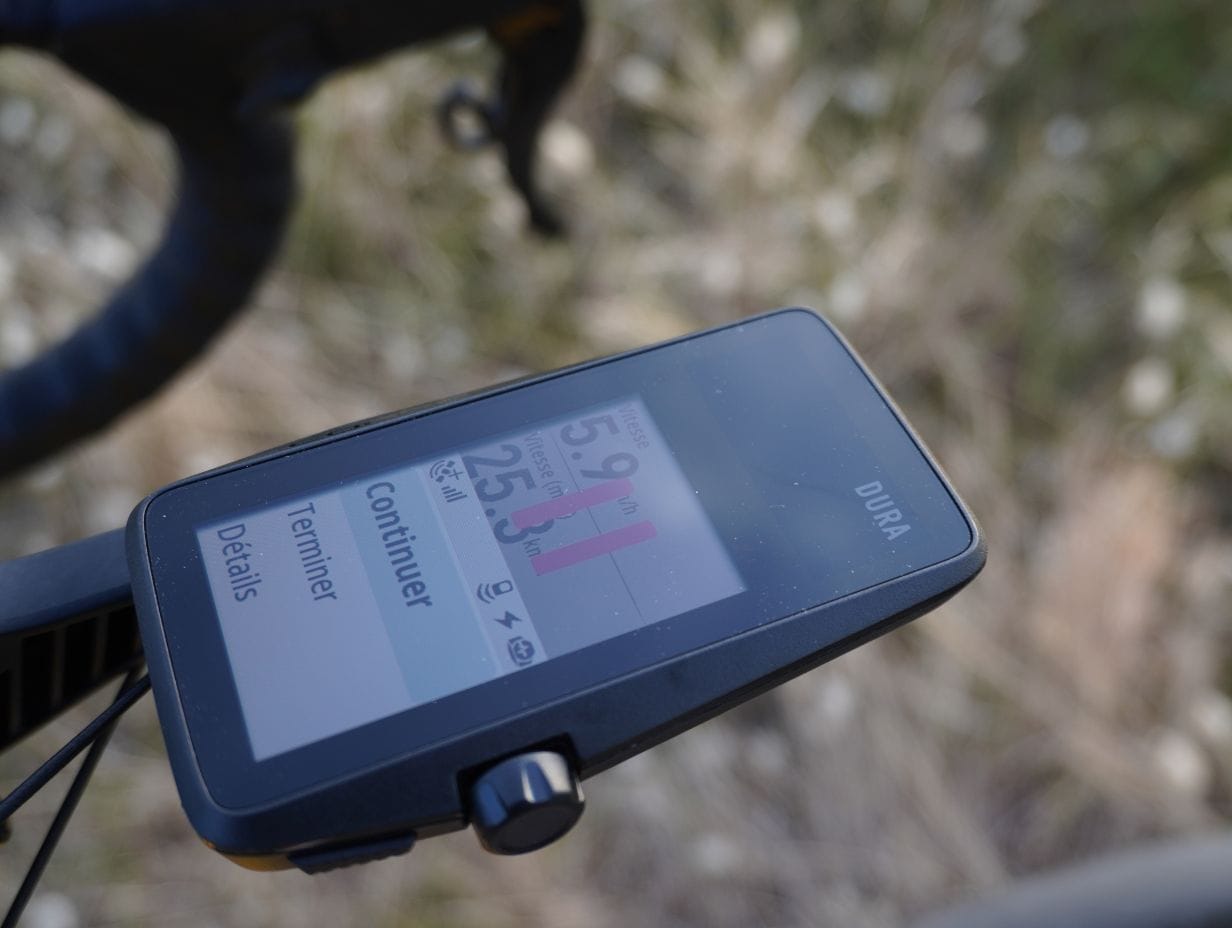

For several years, Coros has made a name for itself in the GPS watch market with reliable, durable products that are often more affordable than the competition. With the Dura, its first bike computer, the Chinese brand intends to challenge the dominance of Garmin and Wahoo, leaning on record-setting battery life and a streamlined user experience. After several weeks of intensive testing, here’s our unfiltered take. 👇
Strengths:
- Impressive battery life
- Effective solar charging
- Aggressive price (€289)
Could be better
- No offline rerouting
- Limited map zoom
A distinctive look with a full spec sheet
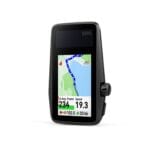
The Coros Dura lands as an ambitious GPS head unit, designed both for long-distance cyclists and for riders looking for something straightforward to use. It features a 2.7-inch colour transflective MIP display, which is particularly readable in bright sunlight. This technology choice plays a major role in the record battery life claimed by the brand.
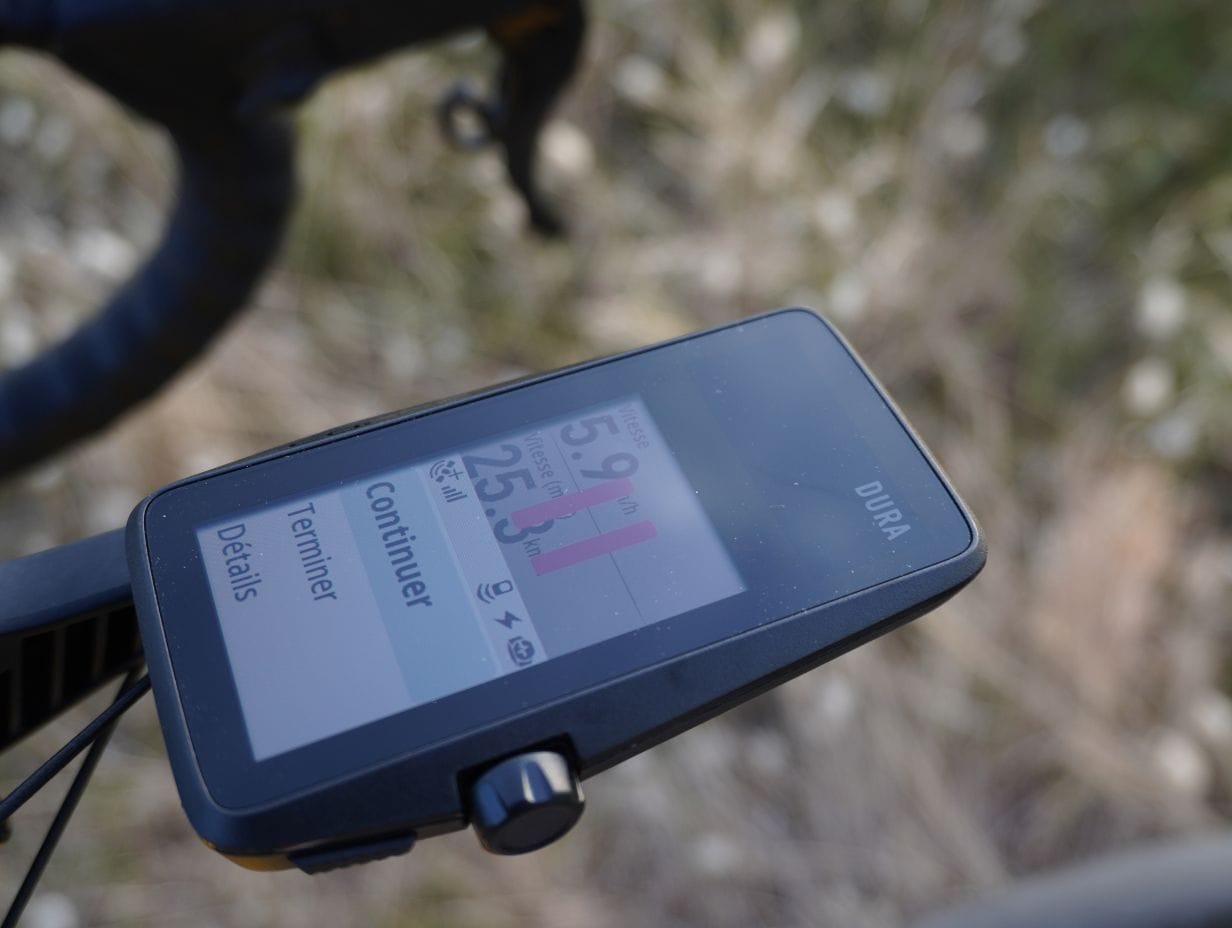
The ergonomics rely on an unusual control layout in the bike computer world: a rotary dial on the right side, paired with a back button and a touchscreen. In practice, the trio works well, though the touchscreen can sometimes be a touch sluggish.

Under the hood, the Dura uses a dual-frequency, multi-band GNSS chipset that delivers track accuracy comparable to the best references on the market. It also includes a barometric altimeter, a gyroscope, an accelerometer, a compass, and a temperature sensor.
Compatibility with ANT+ and Bluetooth sensors is comprehensive, whether for power meters, heart rate straps, radars, or electronic drivetrains.

Charging is via a USB-C port. A distinctive feature: the Dura also has a large solar panel integrated above the screen to extend battery life by capturing solar energy directly. The unit weighs just 97 grams, plus 36 grams for the included mount.
Finally, the device is sold for €289, an aggressive price point against its direct competitors from Garmin or Wahoo.
Setup and ergonomics
Setup is quick: the Dura attaches to a Garmin-compatible quarter-turn mount. The mount supplied in the box slightly wraps around the head unit for a more aerodynamic package.

Profile and screen configuration is done exclusively via the Coros mobile app. Simple and smooth, but if you like to set everything up on the device, this isn’t for you.

In use, navigating between screens combines the dial, the touchscreen, and the back button. While the dial is quite pleasant, the touchscreen sometimes lacks responsiveness. For example, to scroll through pages, you need very firm swipes. Some will therefore prefer to stick to the buttons.
Battery life and solar charging: the real revolution?
This is THE Dura’s headline promise: up to 120 hours of battery life without any solar charging, and up to 2 extra hours for every hour spent in full sun (75,000 lux).
In practice:
- Under intensive use (dual-frequency GPS, connected sensors, navigation), I measured average battery life around 70-80 h.
- With simpler navigation and fewer connections, you get closer to 100 h.
- Solar charging is genuinely effective. During a 1 h 30 ride in the middle of summer, the battery stayed at the same level!

On this front, it’s the best bike computer on the market.
Navigation and mapping
For navigation, the Coros Dura opts for mapping based on OpenStreetMap data, similar to what you find on the brand’s watches. Maps must first be downloaded over Wi-Fi from the Coros app, which lets you select the desired geographic areas and check the available storage on the device. This fast, well-guided step is the initial setup before you can head out to ride.

The Dura offers classic route following with the track displayed on the map and turn-by-turn alerts. The interface is clear and easy to read, with the route’s elevation profile shown at the bottom of the screen. The ClimbView function automatically detects climbs and details their profile as colour-coded gradient segments. It echoes Garmin’s ClimbPro, even if the whole thing is more basic.
“However, the Dura does not offer autonomous route recalculation. If you go off course, the device simply indicates the deviation from the original route.”
To generate an alternative route, your smartphone must be connected via Bluetooth, with the mobile app then taking over using Google Maps services. In concrete terms, if you head out without a phone, the computer will not be able to bring you back onto your route automatically.
However, since the July 2025 update, the Coros Dura offers a choice between automatic rerouting, manual rerouting, or no rerouting.

Another significant limitation, map zoom is capped at a maximum display scale of 2 km. So you cannot zoom out far enough to view an entire region or plan a long-distance route. This choice, hard to understand in 2025, could be a drawback for those who use navigation as their primary tool.

Despite these caveats, the system retains several strengths: route sync is smooth whether you use Strava, Komoot, or a simple GPX file, and interacting with the map remains broadly intuitive thanks to the touchscreen and the zoom buttons.
Finally, the responsiveness of the turn-by-turn notifications is decent. At the start of my test in June 2025, turn-by-turn did not show street names, which was a bit disorienting compared with Garmin, for example. But since the latest update, street names are now shown on every turn-by-turn notification.
Sport profiles and data customization
The Coros Dura takes a simple but effective approach to sport profiles. From the home screen, you access six predefined profiles: road, gravel, MTB, indoor trainer, e-bike, and electric MTB. You cannot change the names of these profiles, but you can hide some if needed. The idea is to offer a coherent base for each type of riding, without excessive complexity.
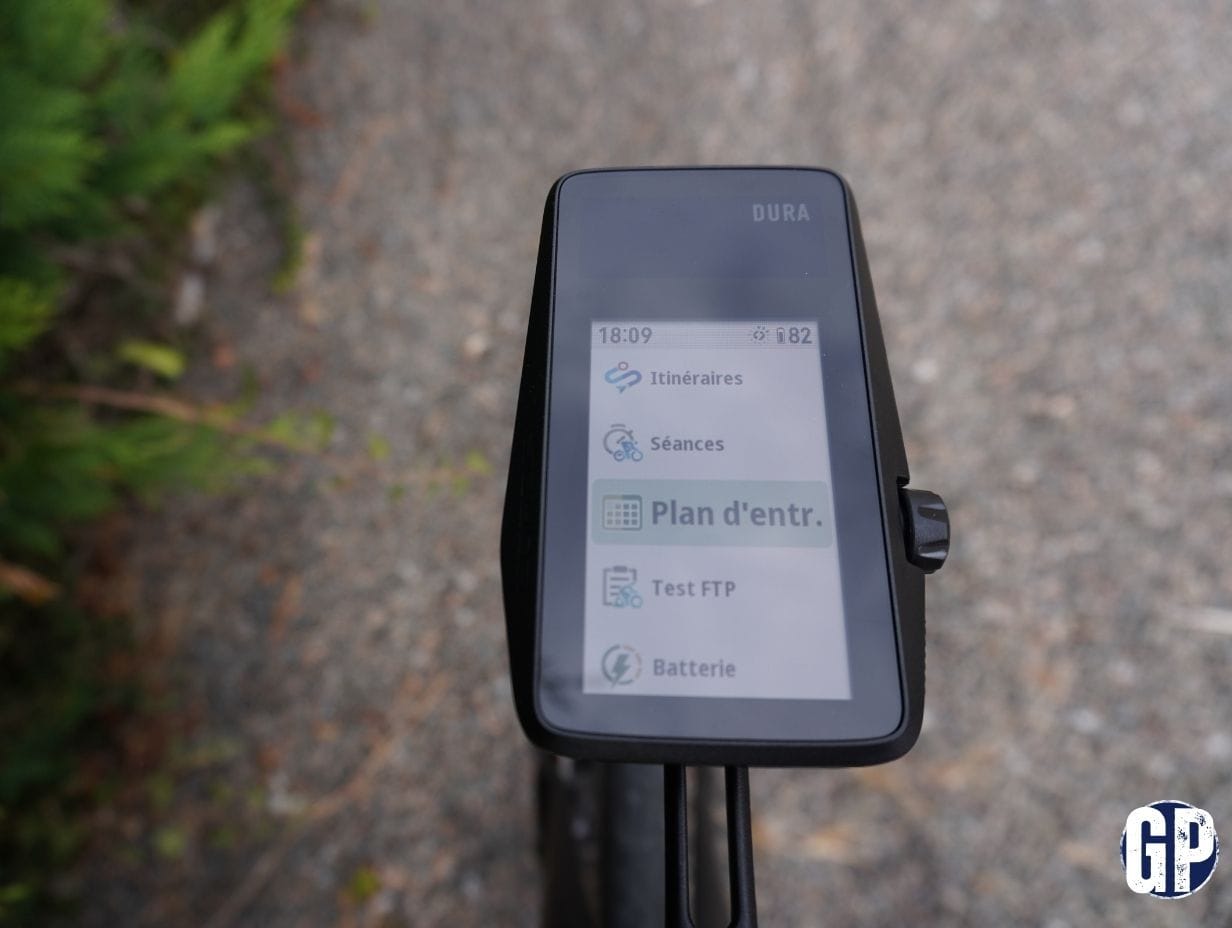
Customization then happens in the Coros mobile app, which centralizes all profile settings. For each activity, you can create data pages in full-screen mode (up to nine fields) or in split-screen mode, where the map is displayed at the top and two data fields at the bottom. This second mode is particularly useful for navigation while keeping an eye on essentials like distance and heart rate.
“There is plenty of choice in the available fields: time, distance, speed, cadence, power, heart rate, training load, temperature, elevation gain… Performance-oriented cyclists will find everything they need.”
You can also set up automatic alerts – for example, a lap every 5 km, or an alert if power goes over a certain threshold – directly from the app.
This clear, smooth structure lets you get to grips with the Dura quickly, without getting lost in a complex maze. The whole thing remains intuitive, as long as you accept that all changes go through the mobile app.
Sensor integration and ecosystem compatibility
On the compatibility side, Coros has cast the net wide. The Dura supports most sensors on the market via ANT+ or Bluetooth: heart rate straps, speed or cadence sensors, power meters, rear radars, electronic drivetrains…
During my tests, I paired Favero Pro MX-2 pedals, a Varia RTL715 radar, and a Di2 drivetrain without any trouble.
Data integration is neat. The Dura lets you display dedicated fields for power, gear ratio, and even for vehicles detected by the radar.

Real-world behavior
After several weeks of testing – on the road, for bike commuting, and during rougher outings – the Dura proved generally reliable. The GNSS system, in automatic mode, delivered precise tracks even in dense urban environments (in Tours) or under tree cover.
Same satisfaction with the barometric altimeter. Automatic calibration is generally very accurate, with elevation differences often under 2%. Altitude data follows consistent curves with good responsiveness to gradient changes.
Screen readability is flawless in full sun. The transflective MIP panel, combined with an ambient light sensor, allows quick, reflection-free reading. At night, however, readability remains lower than on Garmin or Hammerhead computers, notably in the absence of a manually adjustable backlight.

For navigation, the Dura works correctly when following a track. Turn-by-turn prompts appear at the right time and the sound alerts are discreet enough not to be annoying. But the lack of autonomous rerouting if you go off course remains a real limitation if you ride without a phone.
Verdict: should you go for the Coros Dura?
The Coros Dura isn’t just the brand’s attempt to “tick the bike computer box.” It’s a well-rounded product in many respects, and particularly relevant for a certain category of cyclists. Its colossal battery life, ease of use, connectivity quality, and very competitive price make it an excellent choice for long-distance riders, bikepackers, or simply those who want an effective computer without having to recharge every other day.
However, the Dura still has room for improvement in some areas: limited navigation without a smartphone, zoom capped at 2 km, a touchscreen that still needs work… Nothing deal-breaking, but things to know before adopting it as your main tool.
That said, Coros has a big advantage over other brands: continuous updates to a product even several years after launch, like the one in July 2025 that added a few new features in the middle of my test. So we can expect a bright future for this Coros Dura.