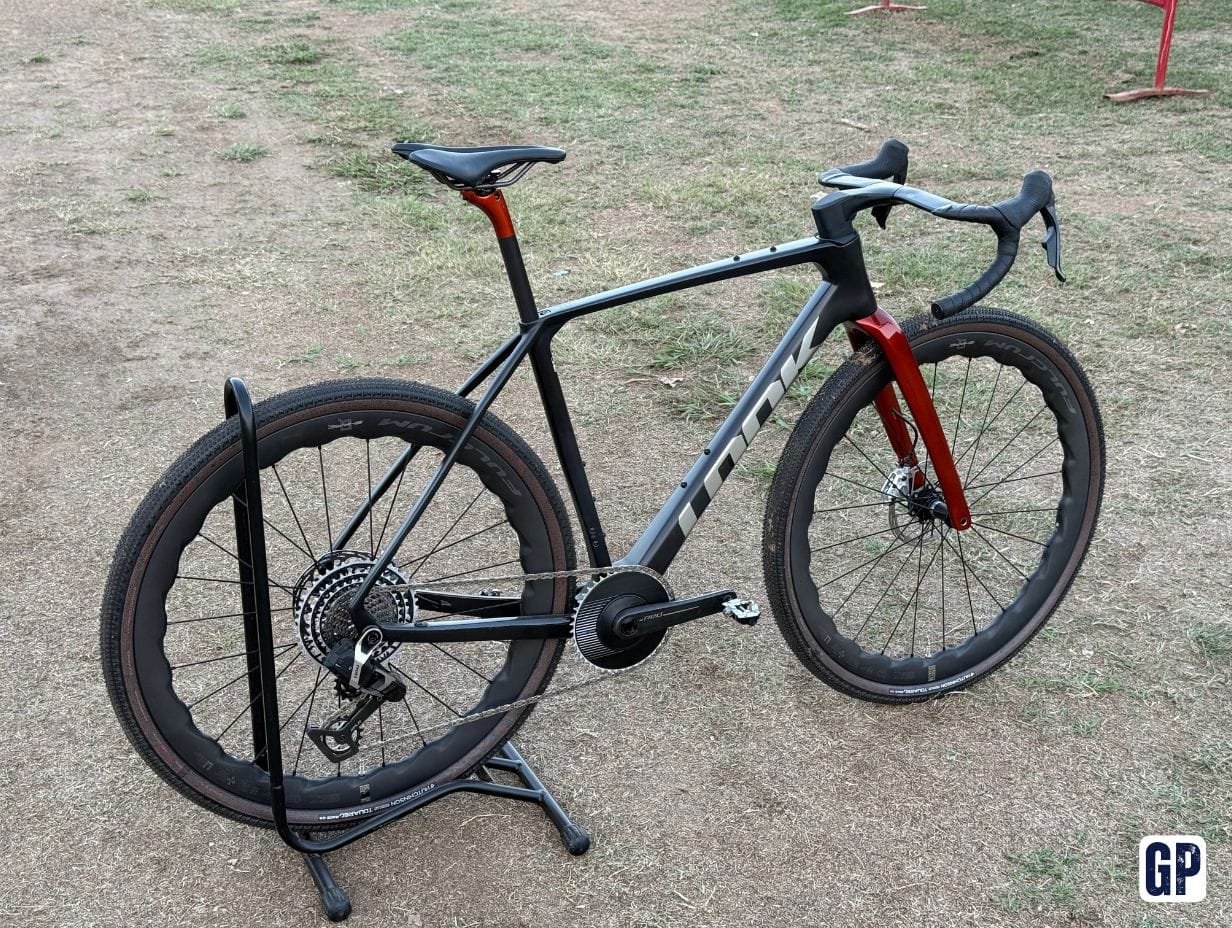
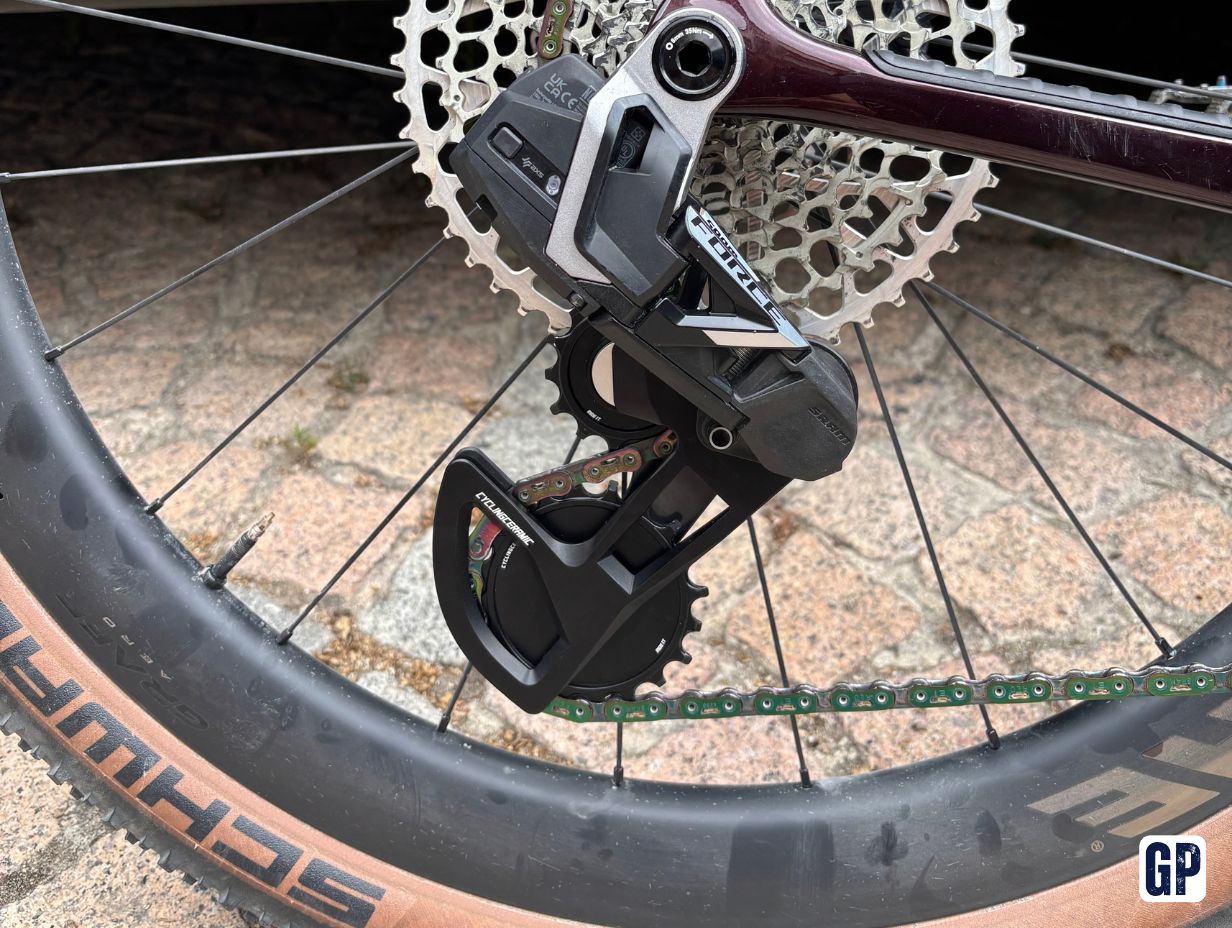

The oversized cage market loves to promise free watts, a smoother drivetrain and an instant boost in looks. On paper, the CyclingCeramic SRAM OSPW XPLR 13 ticks plenty of boxes: 14/20 pulleys, hybrid ceramic bearings, CNC machining, compatibility with SRAM XPLR 13-speed and even the Garbaruk 10-52 cassette.
My test mostly highlighted something else: it is a very well executed product – serious, stiff, effective once properly dialled in – but it is not a trivial bolt-on to fit between coffees if your drivetrain sits a little outside the standard SRAM template.
Strengths:
- Meticulous finish
- Noticeable stiffness under power
- Noteworthy Garbaruk 10-52 compatibility
Could be better
- Fine adjustment required with a 10-52 cassette
- 10-tooth shifts sensitive to micro-adjustment
An unboxing that sets the tone straight away
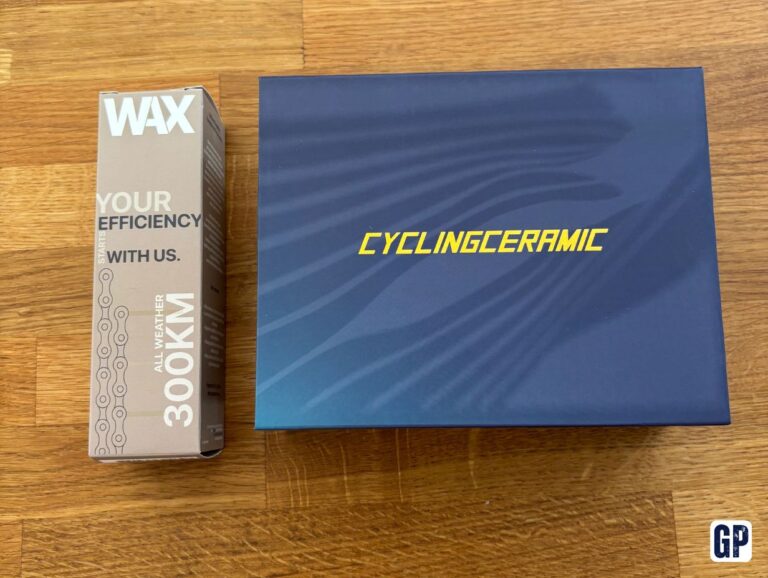
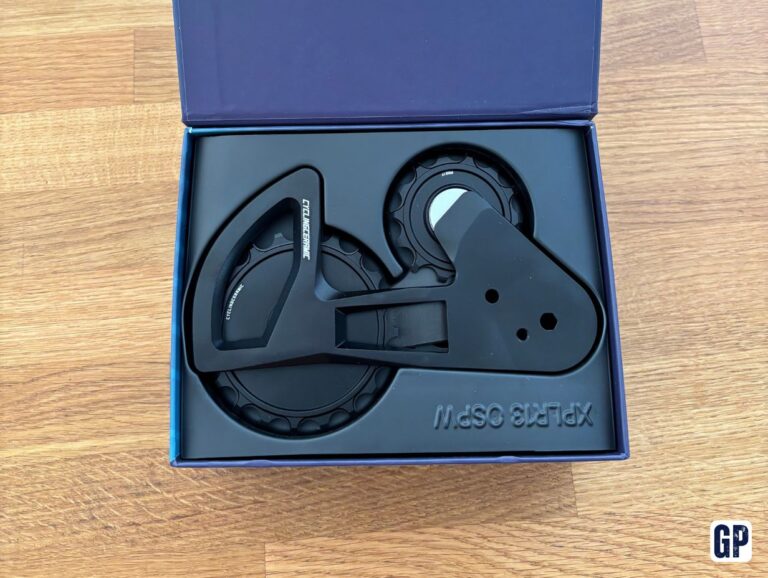
First contact: the packaging is really neat. Not just pretty for the photo, but clean, organised, with that impression of a technical product you do not want to rush.
In the box, the cage arrives pre-assembled and pre-greased. CyclingCeramic also supplies maintenance oil, recommended roughly every 4,000 km, the tool needed to remove the SRAM cage, a QR code to the instructions and a few stickers.
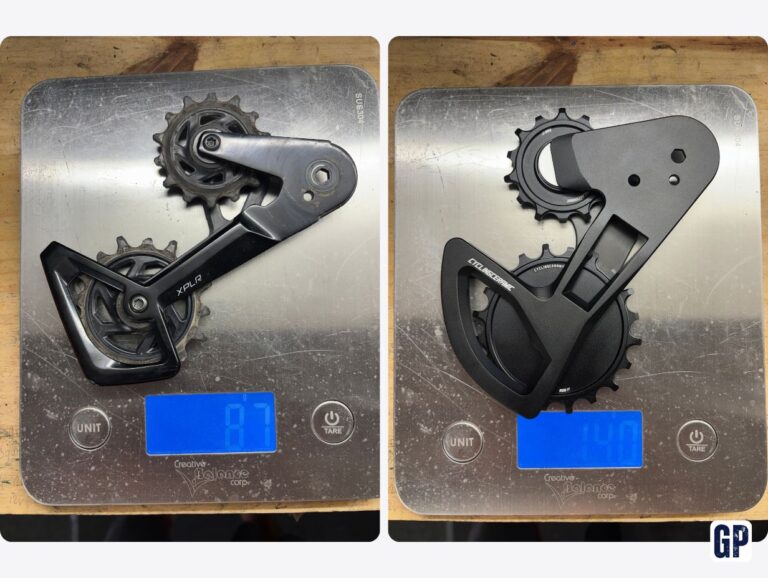
The part itself impresses. Crisp finish, tidy machining, no detail that feels DIY. On the scales, my setup comes out around 50 g heavier than the stock SRAM Force cage. Not huge, but worth noting: this is not about pure weight saving.
Installation: simple at first, subtler in real life
Basic installation is not difficult if you follow the procedure. The cage is designed for SRAM Rival, Force and Red XPLR 13-speed groupsets. You remove the wheel, take off the chain, put the derailleur in workshop position, remove the original cage, then fit the CyclingCeramic while restoring spring tension.
CyclingCeramic recommends torque of around 3.5 to 5 Nm for the cage. Then, as the cage size changes, you redo a standard UDH setup, with the usual SRAM torque specs at the derailleur and at the wheel. At this stage, nothing exotic if you have already worked on an SRAM AXS drivetrain.
Good news: I did not need to lengthen the chain. You keep the original length, unless your chain is already worn or incorrectly sized. This matters, because an oversized cage can sometimes suggest you need to rethink everything around it. Here, no.
With a Garbaruk 10-52, the setup becomes subtle
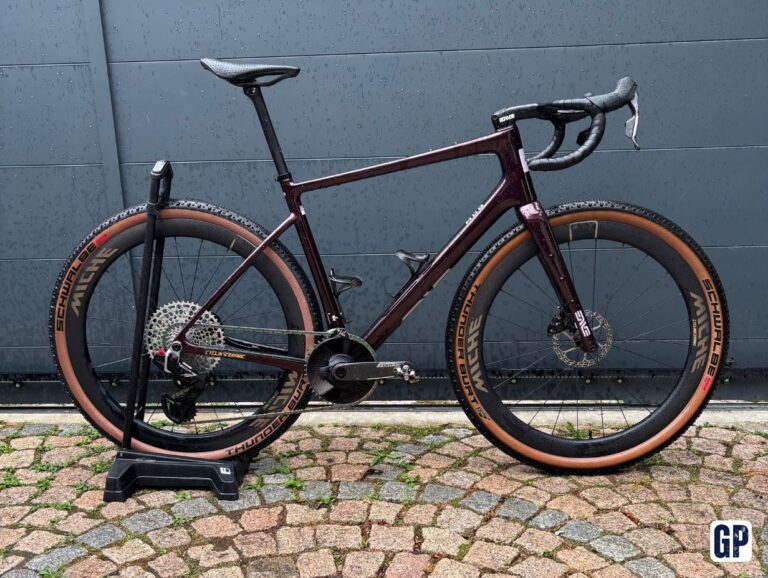
My build was not the simplest: SRAM Force XPLR 13-speed, CyclingCeramic cage, Garbaruk 10-52 cassette. The brand lists this compatibility, and it does exist. But in practice you step outside a very standard SRAM build, so the adjustment window gets tighter.
The key recommendation: keep the number of links as if you were fitting a 10-50 / 10-52 cassette, following SRAM logic. The tricky point is mostly tension and the shift onto the 10-tooth sprocket. If you set it too neatly by the basic method, shifts to the 10 may not engage cleanly.
I had to go at it several times. Micro-adjust via the SRAM AXS app, a slight easing on the adjustment, test, repeat. Nothing impossible, but clearly, it is not for everyone if you are not comfortable with fine drivetrain tuning.
A problematic early pulley, then a more convincing update
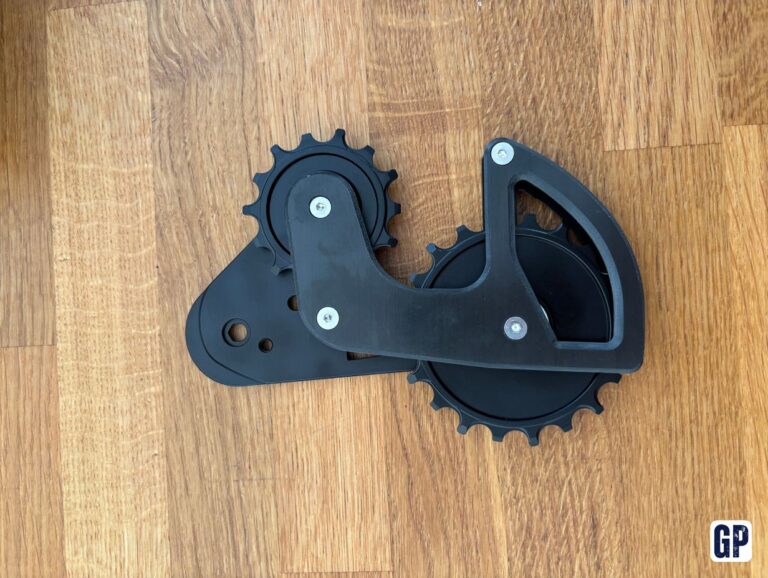
It is also worth stating a limitation of my test: I first rode with an initial pulley version that was not the correct one. And that was not much fun. The chain jammed in the pulley several times, notably at a gravel race in Belgium. Not the kind of detail you forget quickly when it happens in real conditions.
CyclingCeramic was responsive and then supplied a new pulley. With this update, I did several rides and the behaviour was much more reassuring. The drivetrain works better, the found adjustment seems to hold, and I have not seen the same jams again.
On the bike: more stiffness and a drivetrain that holds big torque better
Once correctly adjusted, the cage gives a distinctly sorted feel. The drivetrain feels well controlled, with no unwanted vibration, and a perceptible stiffness when you put torque through it.
I deliberately tested the 52-tooth on long climbs. It proved fine. No odd wavering, no worrying noises, none of that feeling of a drivetrain working on the limit. The big sprocket is taken cleanly, and the whole gives confidence when you push hard.
Did I measure an efficiency gain? No. And I am not going to invent watts. Oversized pulleys and ceramic bearings have a mechanical logic: reduce the chain articulation angle and limit friction. But without a measurement protocol, I prefer to talk about feel: it spins cleanly, it seems solid, and the drivetrain feels more composed.
The real interest is not just efficiency
With this type of product, you immediately think of marginal gains. That is part of it, yes, but not necessarily what I retained most.
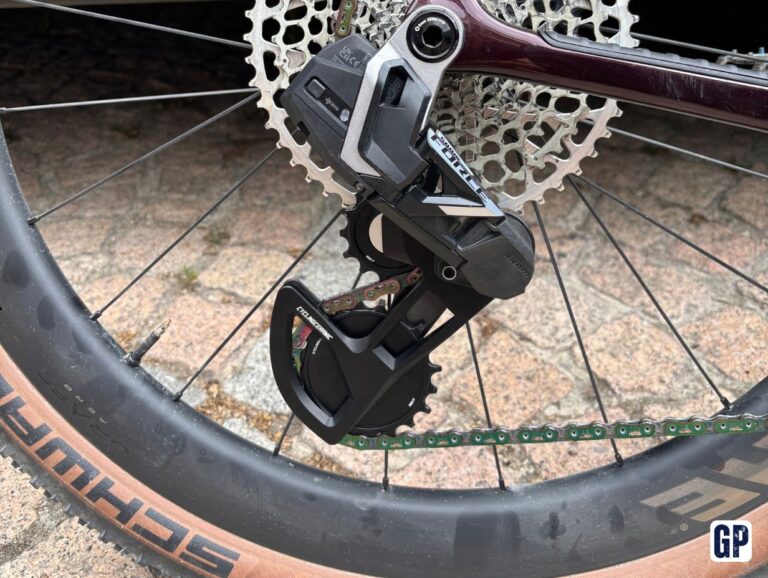
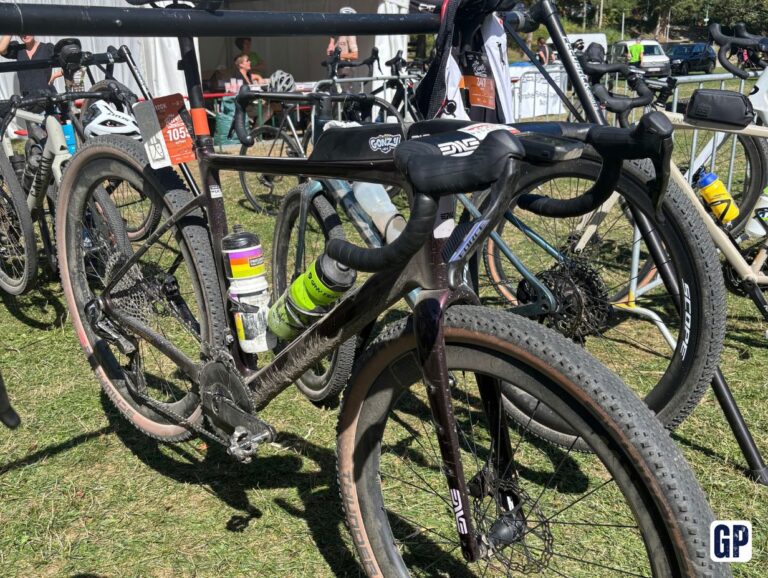
The CyclingCeramic also changes the visual and mechanical behaviour of the bike. The cage gives the drivetrain a different presence. It fills the rear of the bike better, it has a racier look, and on a high-end gravel build, that matters to many buyers.
There is also the interest of the large solid pulley in dirty conditions: fewer openings, so potentially less mud, twigs or small debris getting stuck. But again, I must add a caveat: I only rode on dry terrain. No truly muddy ride, no sustained rain, no winter slop test. This part therefore remains to be confirmed.
Not essential, but interesting for a demanding build
This is probably the most important point of this review. The CyclingCeramic SRAM OSPW XPLR 13 is not a must-buy to make an SRAM XPLR drivetrain work. The stock cage already does a very good job for the majority of riders.
Here, we are talking more about an enthusiast upgrade: someone who wants to optimise their build, gain in perceived stiffness, improve smoothness, refine the aesthetics and, in some cases, run a Garbaruk 10-52 cassette with an SRAM XPLR 13-speed derailleur.
On a more conventional cassette, like a 10-46, I think the build will be simpler and more natural. With the Garbaruk 10-52, it works, but you need to accept a finer adjustment phase. If your bike often passes through your own hands, no problem. If you want a fit-and-forget approach, you may need to go via a careful mechanic.
Who would I really recommend it to?
I would recommend it to a rider already on SRAM XPLR 13 who likes tidy builds, understands the basics of UDH / AXS setup, and is looking for a more accomplished product than the stock cage, without expecting a measurable revolution at every pedal stroke.
I would be more cautious for someone who just wants to make their bike more reliable without touching the settings. In that case, the stock SRAM cage keeps an advantage: it is designed to work simply in its ecosystem, with fewer variables.
My final feeling is quite clear: the product is beautiful, well finished, stiff and convincing once properly adjusted. But its interest depends heavily on the build around it. With a Garbaruk 10-52 cassette, you need to be precise. With the new pulley, it is heading in the right direction. I still need more kilometres, especially in the wet and the slop, to say it is fully validated in all gravel conditions.
Not an obligatory accessory. Rather a fine technical upgrade, best reserved for builds where every detail really counts.