I’ll say it up front: I came in with a bias. “Custom” products often come with a very enticing pitch, but in the real world, the gap to a good standard product is sometimes slim. So I mainly wanted to see whether the promise holds up over time, and whether made-to-measure brings more than just a neat bit of storytelling.
Although the saddle was sent to me free of charge by the brand, that’s not the case for Marie, our contributor who has been using it for many months now, following a personal purchase.
We’ll therefore compare our points of view throughout the article.
Custom work that inspires confidence
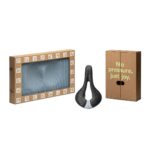
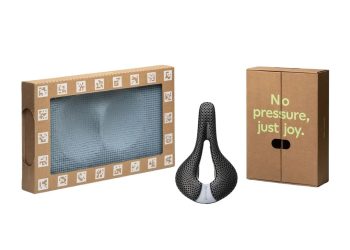
The process starts with receiving the Smiling Butt Kit at home, an imprint kit designed to precisely measure sit-bone spacing. It’s easy to use as long as you scrupulously follow the positioning instructions. It’s not complicated, but you definitely shouldn’t rush this step.
Once the imprint is made, you simply photograph the kit from several angles. Nothing to send back: the brand then works from these images via digital processing. Next comes a fairly thorough questionnaire covering your riding, annual volume, type of rides, flexibility, position on the bike, and any discomfort experienced so far. The approach is serious, and you can tell the data isn’t just a box-ticking exercise.
After more than 10 years on a single brand’s model, a bike fit highlighted a width issue that compromised my stability, and while I didn’t have any actual injuries, I felt I had something to gain by switching. But to what?
Having focused mainly on long-distance riding in recent years, that pushed me to explore options beyond the standards: namely a made-to-measure saddle.
Between the moment I sent the photos and received the saddle, 5 weeks went by, which was one week less than the lead time announced when I ordered. What I particularly appreciated was the real-time tracking of my order. Despite the distance, I was informed of each production step and the timeline to reach the next one, with the document linked to my order. A true after-sales model, which makes the wait easy for the most impatient.
After validation, you need a bit of patience. In my case, the lead time was several weeks, likely extended by the holiday period. That’s not surprising for a made-to-order product, but it’s worth keeping in mind.
On receipt, first surprise: the weight. My Joyseat Pro version, with carbon shell and 7×9 mm carbon rails, weighed 162 grams on the scale, very close to the stated figures. It wasn’t my number-one criterion, but it’s hard not to be pleasantly surprised.
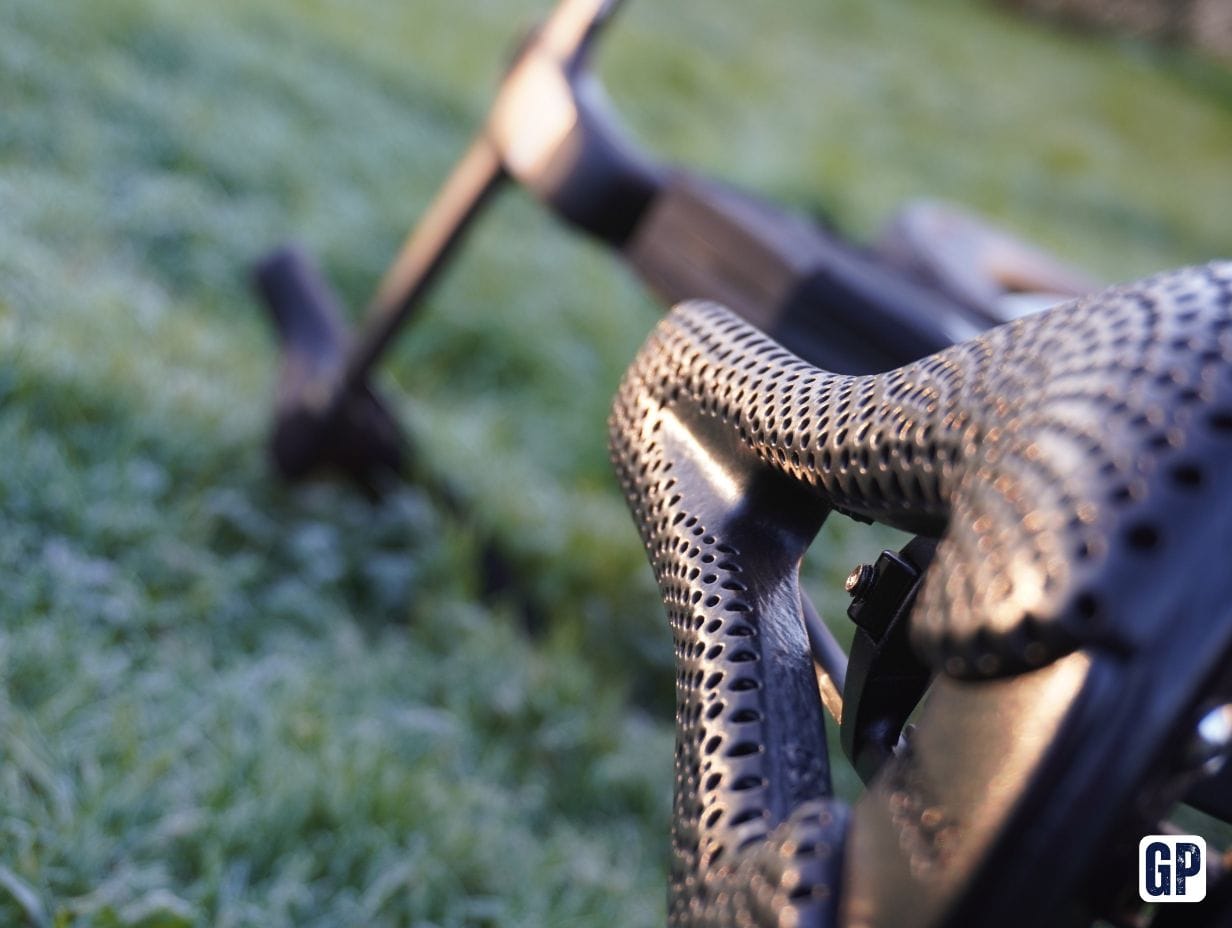
The finishing is impeccable. The 3D lattice is precise, uniform, with no excess. The assembly exudes quality and, despite the lightness, the saddle inspires confidence. It’s clearly on par with, if not above, what some big brands offer on their high-end non-custom models.
Also note the ability to customise the padding colour and integrate a name or nickname in the saddle’s channel, a gimmicky detail for some, but nicely integrated here.
A saddle designed around the rider
My profile is fairly clear: 15,000 to 20,000 km per year, mostly on fairly short rides, with a few longer events in the year. My position is rather aggressive, even on an endurance bike, and I have good back flexibility.
Based on the collected data, Posedla steered me towards a width of 137 mm, very close to one of my personal benchmarks, the Specialized Power Mirror in 143 mm. The difference lies elsewhere: here, width is only one parameter among others, since the lattice density varies by zone according to the pressure applied.
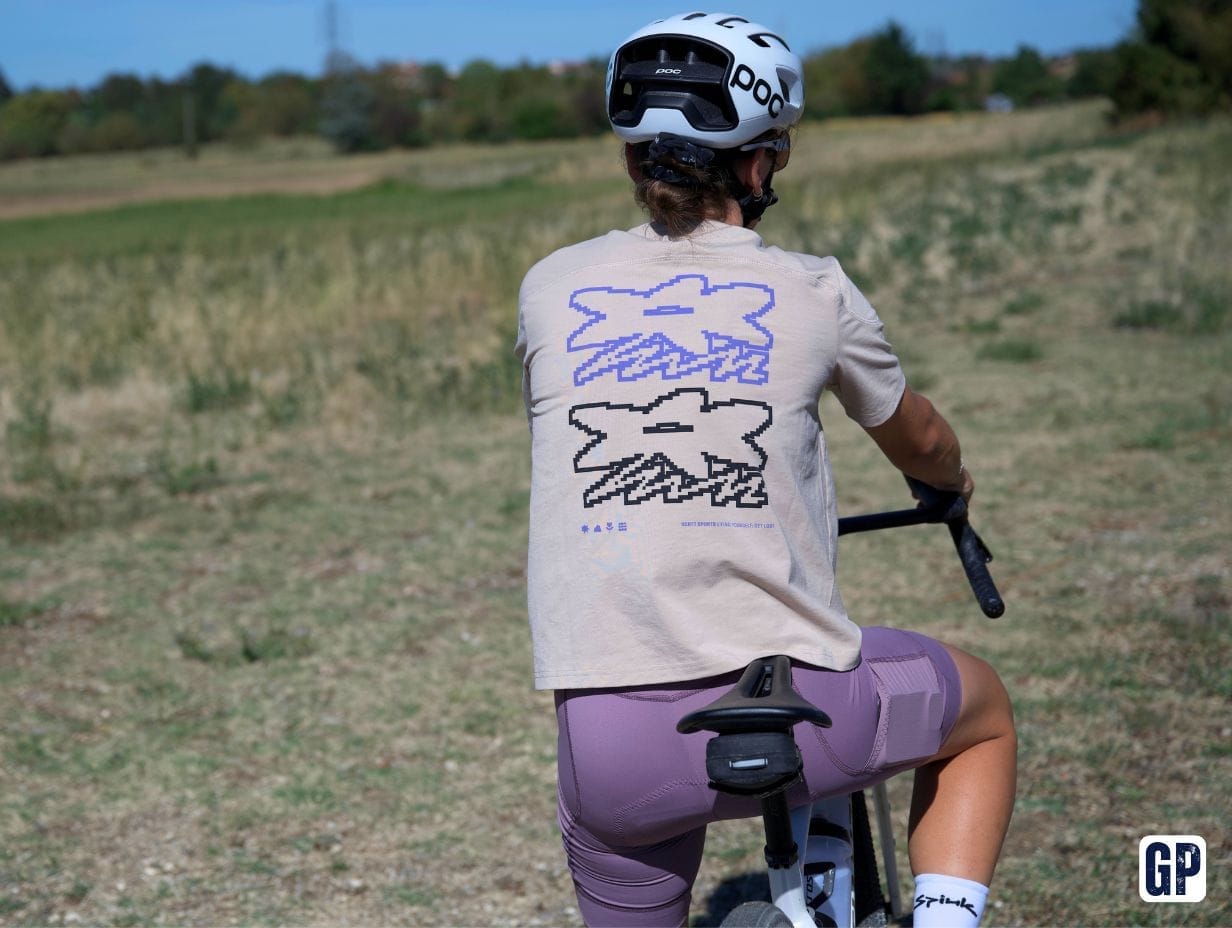
Installation poses no particular issues. The carbon rails are perfectly compatible with suitable seatpost clamps, torque-tightening brings no surprises, and once the saddle is positioned, nothing moves. No unwanted noises to report, even on rough terrain.
Field test: a saddle that disappears
From the first rides, you immediately get the typical sensations of a 3D saddle. You feel like you’re sitting “in” the saddle rather than on it, with a more stable position than with traditional foam. The surface hugs the pelvis, limits unwanted micro-movements, and encourages a fairly fixed position.
Notable point: no break-in period. Within minutes, the saddle literally disappears beneath me. No discomfort, no excessive pressure zones, including with thicker winter bib shorts. On this point, the promise is kept.
From the start, I felt “at home,” whether for width, shape, or comfort; and that immediate gap was quite striking.
I tempered that feeling, fearing a placebo effect, and waited for confirmation over longer distances. The final arbiter was the “Paris – Clermont” event last September, run over a solid 400 km. With the saddle validated in those real conditions, I noted just one caveat: in a sustained position on the aerobars, I felt the saddle nose a bit wide on the thighs, which caused chafing. Something I hadn’t felt in training, since I rarely use the aerobars and it was a factor I hadn’t included in the brief when ordering.
If the “made-to-measure” aspect makes you reluctant due to potential resale in case of dissatisfaction, note that Posedla offers a “100% satisfaction” service. How does it work in practice? You can request a return after a remote video call with someone from Posedla to explain your issue. The refund can be issued minus the cost of raw materials, i.e. €160.
After more than 1,600 km, the verdict is simple: the Joyseat has completely disappeared. And for a saddle, that’s probably the best compliment you can give. No pain, no numbness, no particular rubbing. You stop thinking about your saddle and focus solely on pedalling.
Let’s be honest: I can’t say the gap with my favourite saddles so far is “huge.” But the difference shows in the consistency and the total absence of flaws. Where some very successful saddles may reveal a minor annoyance on certain rides or in certain conditions, the Joyseat stays neutral, whatever the duration or intensity.
Posedla offers three tiers, with prices starting at €389 for the Plus version, €489 for the Pro (tested here), and €589 for the Ultra. Amounts that may raise eyebrows, but they need context.
Today, a high-end 3D saddle from a big brand regularly exceeds €400 to €450, without being truly made to measure. Here, we’re talking about a fully personalised product, from width to padding density, including the overall shape. The price-to-performance equation then becomes much more coherent.
You also need to factor in Posedla’s industrial approach: local manufacturing in the Czech Republic, TPU 3D printing, carbon shells and rails for the Pro and Ultra versions, and an end-to-end process that’s clearly under control.
After more than 5,000 km on my road bike, do I stand by this purchase? Yes, without hesitation, all the more so because when I take my gravel bike that doesn’t have it, I don’t feel as good, even uncomfortable after a few hours.
Durability is also very good, because despite road use over winter, the equipment hasn’t been spared. I’ve only noticed slight “smoothing” of the material on friction zones, and above all no damage to my bib shorts.