
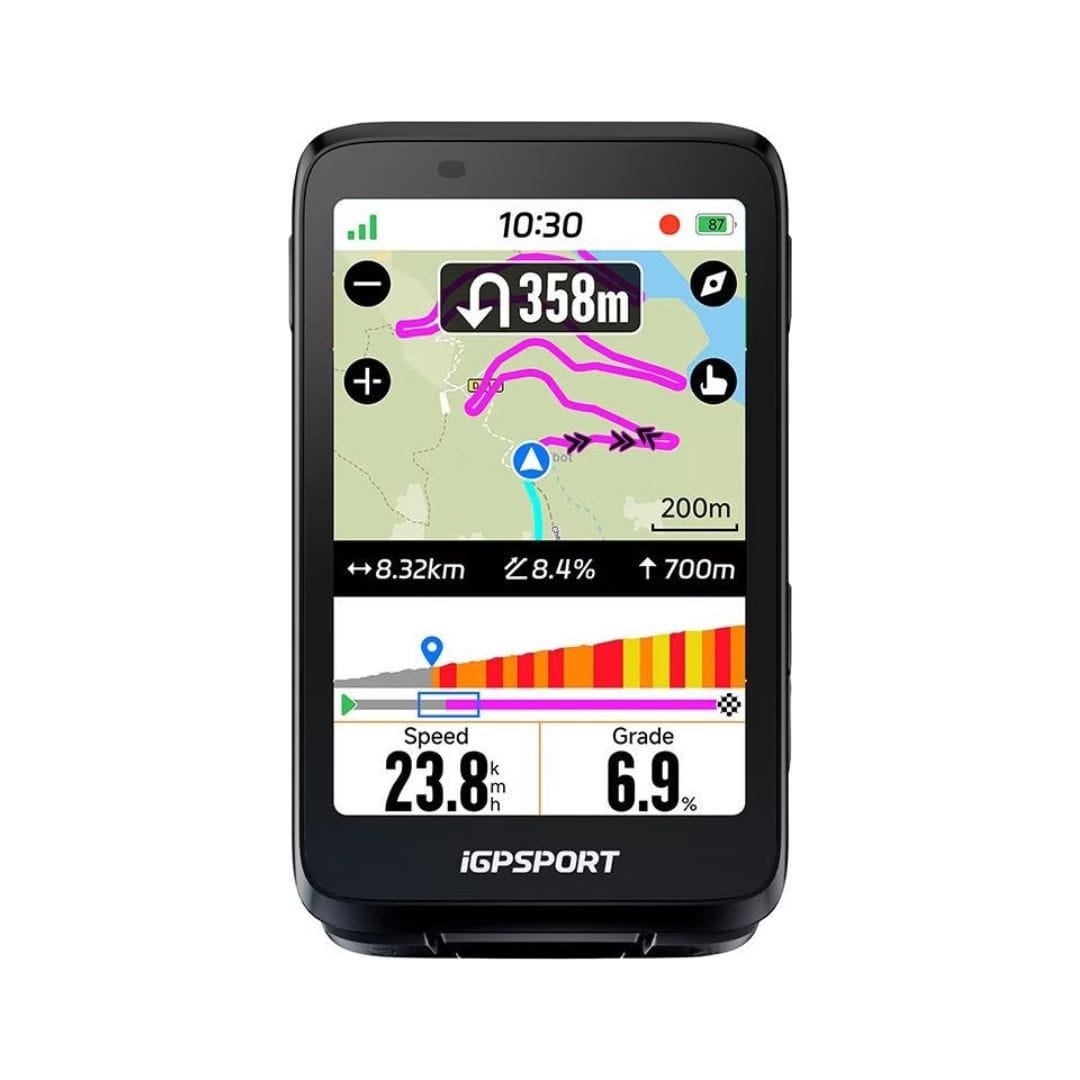
With BiNavi, iGPSPORT adds a mapping-enabled GPS computer aimed at both road and gravel. On paper it majors on three things: a large colour display, broad sensor connectivity, and – above all – a claimed battery life of over 35 hours, a headline figure for long rides and ultra-distance events.
BiNavi packs a 3.5″ display (320 x 480) into a 101 × 60 × 14.5 mm unit, with a stated weight of 103 g. It combines touchscreen operation (glove compatible) with six physical buttons – a setup many gravel riders appreciate when rain, mud or cold make touch less dependable.
The device is rated IPX7 and operates from -10°C to 50°C.
iGPSPORT quotes support for more than 160 metrics across 16 categories, with customisable pages and a multi-theme, widget-driven interface. Up to 12 data fields per page are available, and the usual features are present: auto pause, auto sleep, auto power-off, auto page scroll, automatic brightness and backlight, alerts, manual/automatic laps, and more.
BiNavi offers map-based navigation with cartography and turn-by-turn directions. A “return to start” function is provided, with two options: retrace the route ridden or return by the shortest route.
The manufacturer also highlights “multidimensional turn prompts” and curve detection/prediction capability (data stated as tested in the iGPSPORT lab). In practice, only time on the bike will show how relevant these alerts are, notably on road descents and fast gravel tracks.
The computer integrates iClimb 3.0, presented as a climb pacing aid with elevation profile and climb overlays on the map. iGPSPORT mentions a logic close to Grand Tour-style climb classifications, with clearer visualisation of climb segments.
BiNavi claims FULL GNSS positioning with dual-band (L1 + L5), as well as A-GPS (ephemerides). It also integrates a barometric altimeter, an accelerometer and a light sensor.
On the sensor side, compatibility is broad:
BiNavi is also stated compatible with SRAM eTap, Shimano Di2 (with Di2 control) and Campagnolo EPS electronic drivetrains.
The 1250 mAh battery is quoted at more than 35 hours, with USB-C charging taking a claimed 1.5 hours. Internal storage is 32 GB, an important point for mapping and offline data.
BiNavi works with the iGPSPORT ecosystem (app and web) and offers synchronisation with Strava, TrainingPeaks and Komoot, three services widely used by road and gravel riders for analysis and/or route planning.
At €249.90, the iGPSPORT BiNavi sits in a fiercely contested space: versatile mapping GPS units, used as much by road riders (training, sensors, segments) as by gravel riders (readability, buttons, water resistance, battery life). On the spec sheet, the standout promise is the claimed 35 h+ battery life, paired with a 3.5″ screen and 32 GB memory – three pillars of long-distance navigation.
In this price bracket, one factor is often decisive: the quality of the navigation experience (clarity of instructions, recalculation, map legibility, reliability of alerts) plus day-to-day ergonomics. That’s where the real gaps emerge between devices, beyond tick-box features. If iGPSPORT delivers on dual-band GNSS accuracy and the relevance of its guidance, BiNavi could be a credible option for riders after a full-featured GPS without stepping up to the market’s priciest models.
Retrouvez toutes les caractéristiques ainsi que les détails techniques de ce produit.
| Battery life (h) | 35 |
|---|---|
| Mapping | Yes |
| Touchscreen | Yes |
Reviews
There are no reviews yet.