Unboxing & design: the user experience, out of the box
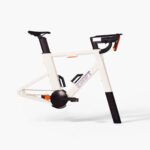
The Zwift Ride arrived in several boxes (frame, bar and controls, and indoor trainer), on two different dates but within the announced timeframe. Everything feels well-oiled: clear manual, video tutorials, thoughtful little touches.
Assembly is child’s play: a single Allen key… stored under the top tube. You set handlebar height, saddle fore-aft, and bar reach in seconds. The claimed range (riders from 1.52 m to 1.98 m) checks out: at 1.85 m, I found my fit in a flash.
The frame happily accommodates multi-user life: you can swap settings in no time, or even buy a second seatpost to keep your own saddle ready to go. You do need to accept a few compromises: default 170 mm cranks and a 42 cm bar. If needed, Zwift sells adjustable cranks (100 €). Flat pedals are included, but I fitted my clipless with no issues.
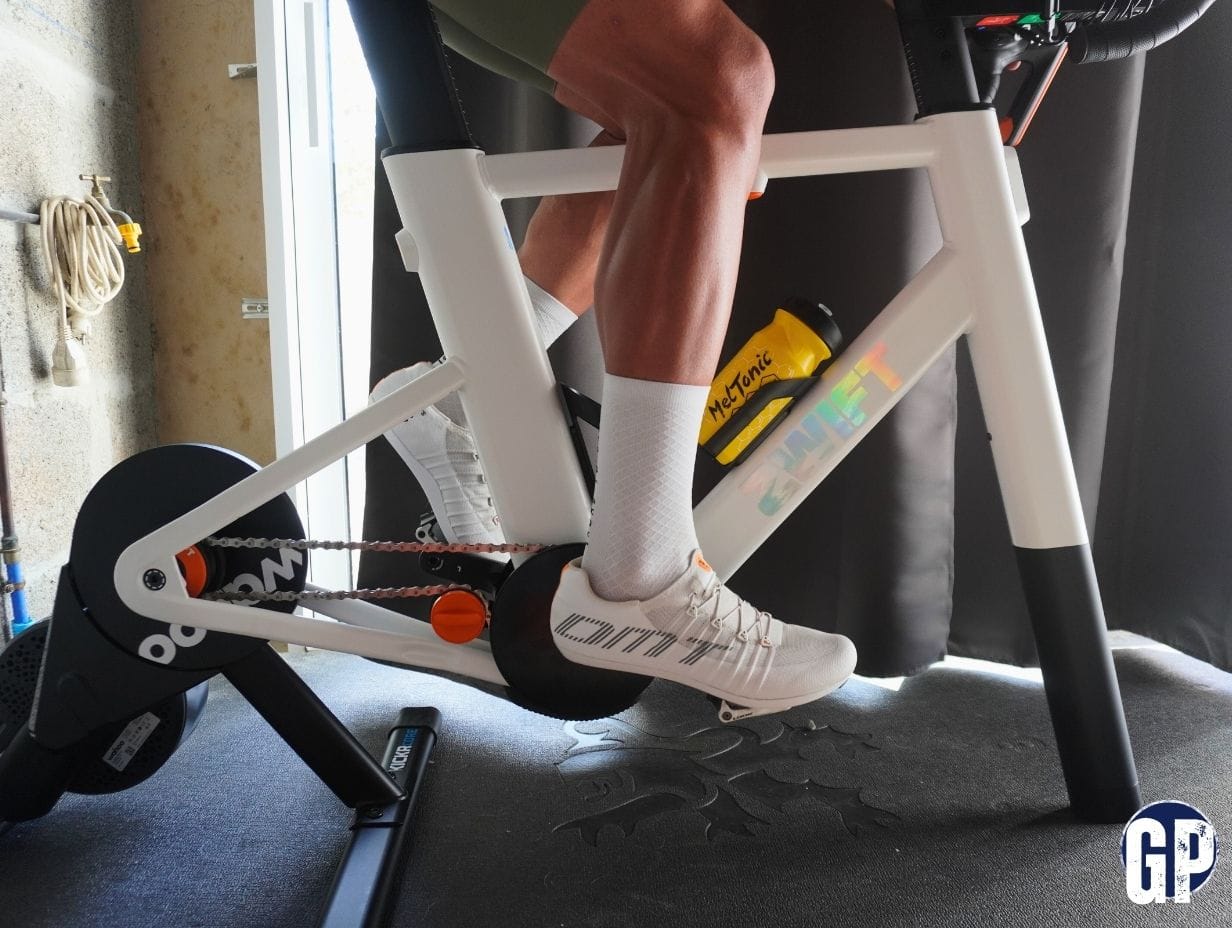
Another strong point of this setup is the footprint. Very compact, it takes up less space than a classic bike plus indoor trainer setup. Plan for about 60 cm in width and 140 cm in length. Ideal if, like me, your pain cave sits between two cinderblock walls at the back of the garage. 😅
On the cockpit side, the rechargeable controls (USB-C, claimed 20 h battery life) make life easier. Zwift supplies a dual-ended cable and magnetic guides that run along the frame: clean, neat, effective.
Ease of use & ergonomics: control everything from the bars
I’m deliberately setting the indoor trainer aside here (KICKR CORE 2) – it will have its dedicated test. What matters is the Ride experience. Once set up, you get very natural pedalling sensations, obviously dependent on the indoor trainer used, but this cockpit changes everything.
The two controllers in the bar hoods let you operate Zwift without touching a tablet screen or a laptop trackpad. Change view, start a workout, trigger a PowerUp, navigate menus – it all happens under your thumb, with no lag, and feels very intuitive after a short adjustment period.
The levers aren’t just for show: you can brake, steer left/right, and… shift gears. This is where the Zwift Cog makes sense: a single cog on the trainer side, shifting becomes virtual and silent. Result: no tension from indexing or cross-chaining, just the right gear displayed on screen.
Field test (between four walls): rediscovered fun
I didn’t think I’d get sucked back in, yet Zwift’s gamification quickly reeled me in. The whole setup holds up very well: the frame is stable, and confidence is there well past 1000 W. The smoothness of the handlebar controls and the lack of latency remove any cognitive friction – you pedal, you play, you sweat, period.
One small drawback that held me back at launch: compatibility was once limited to Zwift. Today, the ecosystem is more open: there’s talk of compatibility with platforms like Rouvy.
Do note some exceptions on the trainer side: the Zwift Ride frame isn’t compatible with certain models (e.g. Tacx NEO 3M or Wahoo KICKR v5 and earlier), but the list is evolving. Otherwise, the bundle with the KICKR CORE 2 and Zwift Cog 2 offers very solid specs for training without second-guessing (±2% accuracy, 1800 W, 16% simulated gradient, etc.), but I’ll come back to this in the dedicated test of that indoor trainer.
Versus integrated smart bikes (Kickr Bike Shift, Tacx Neo Bike Plus, Stages SB20, Wattbike Atom)
The Zwift Ride takes a modular approach: a connected frame + a smart trainer.
The entry cost is far lower and maintenance is simpler. Not to mention the ability to upgrade the trainer over time. You do, however, give up the total integration of some very premium connected bikes (integrated fans, screens, motorised millimetre-precise adjustments, etc.).
Versus the Zycle ZBike 2.0, I preferred the feel and perceived quality of the Zwift Ride. The stability and consistency of virtual shifting via the Cog seemed superior to me, at an overall better price in the tested configuration.
Practical details & costs
The Zwift Ride is available at 1,199.99 € in a bundle with the KICKR CORE 2 (with Zwift Cog) or at 800 € without an indoor trainer. Add 100 € for shipping (or 60 € if purchased on its own). Yes, it stings, but given the total weight and three-box logistics, it makes sense. Honestly, I would have appreciated an all-in delivered price for clarity.