
Founded in 1935, Selle San Marco is an Italian brand specialised in bicycle saddles. Since 2019, it has been part of the same group as Selle Italia and for 2026 it is launching a new Shortfit Allroad range, made up of three models: Sport, Racing and Supercomfort Racing.
I fitted the latter to my Lapierre Crosshill CF 6.0 AXS 2025 for several hundred kilometres.
More comfort- and long-distance oriented, the Supercomfort Racing is the most accomplished model in this new range. Suffice to say the first impression was strong: immediate comfort, pelvis well supported and no sense of restriction.
Strengths:
- Excellent comfort over long distances
- Very good vibration damping
- Effective pelvic support
Could be better
- Cover that is starting to smooth slightly
A finish that inspires confidence the moment you pick it up
The Shortfit Allroad Supercomfort Racing immediately looks very well finished.
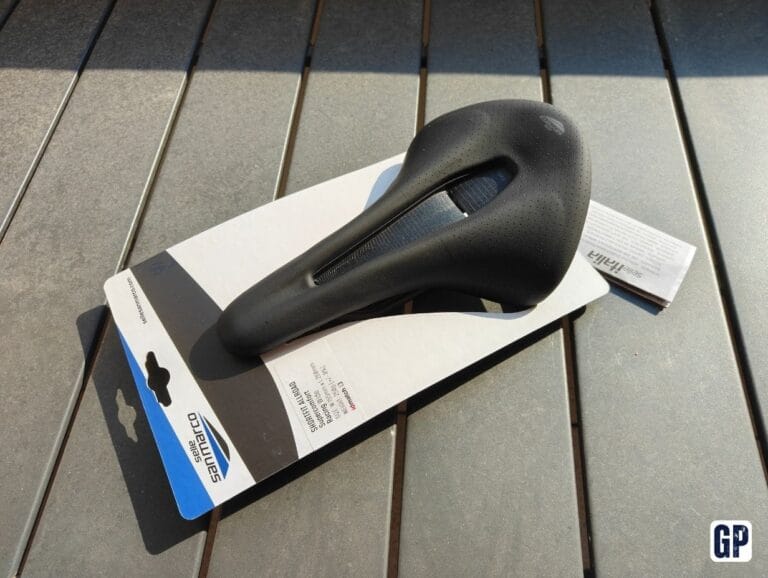
The materials feel high-quality, the various elements are well assembled and the Xsilite rails add an elegant touch overall.
The saddle comes in two sizes: S3 at 140 mm and L3 at 155 mm. As I am generally above 145 mm and used to a Fizik Terra Argo X7 in 150 mm, I naturally went for the wider option.
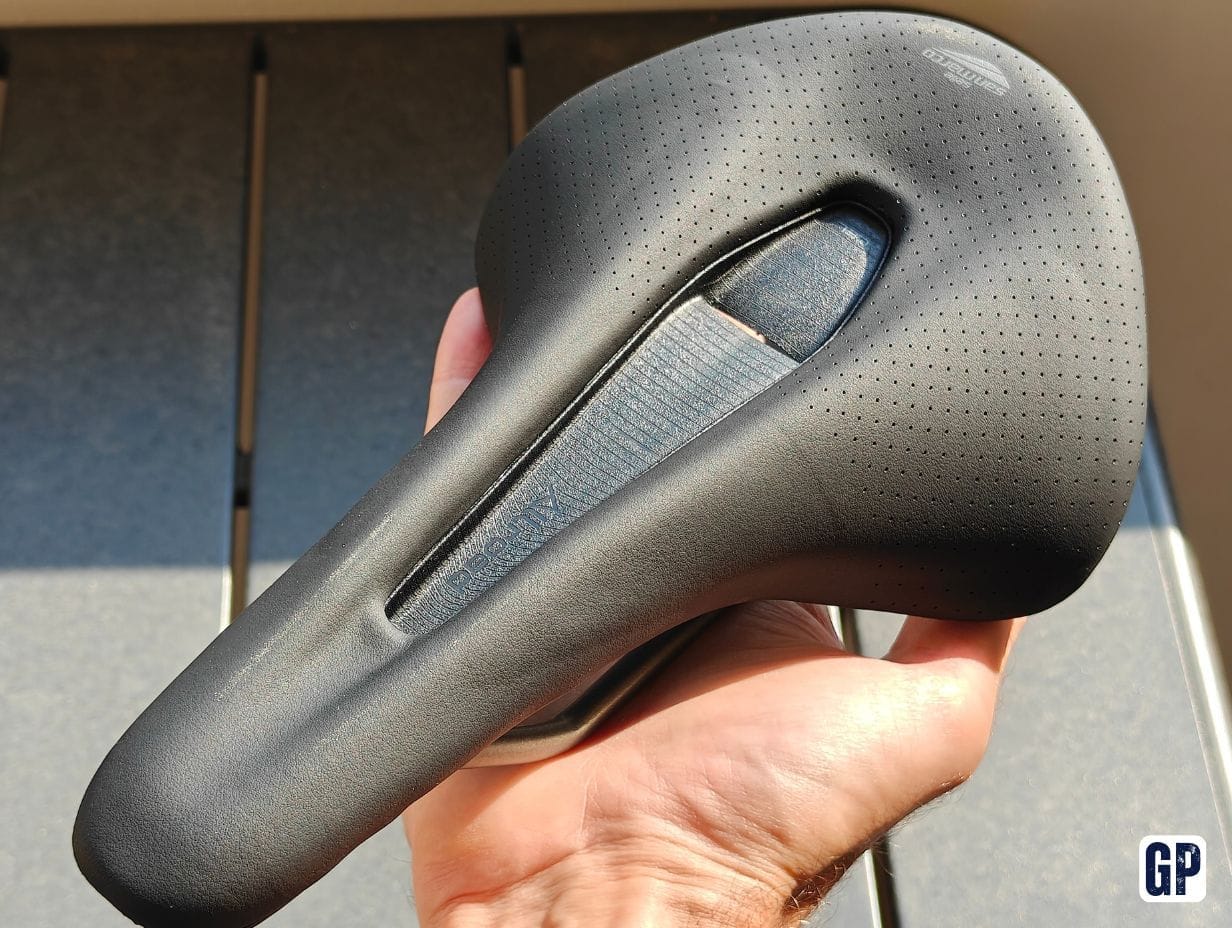
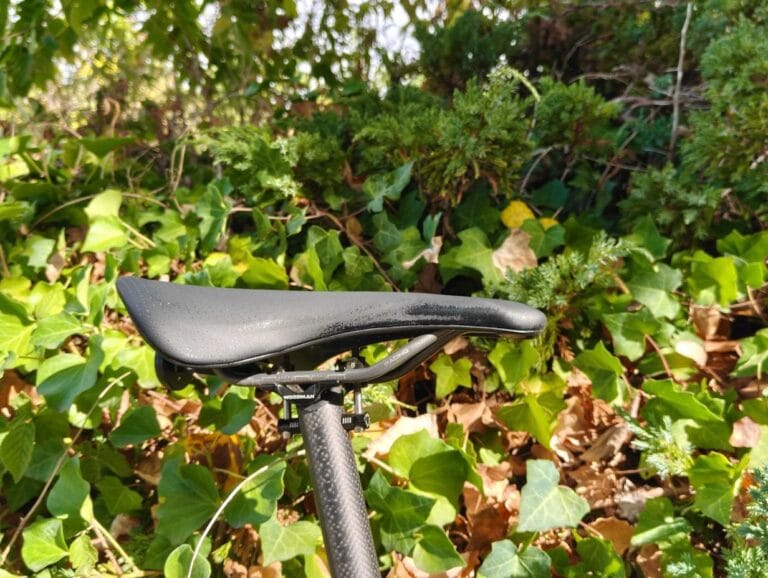
With its 155 mm width and 262 mm length, the Shortfit is indeed quite substantial, but its shape remains elegant and well executed. It is also more structured than a completely flat saddle.
The shell is made of high-performance nylon reinforced with carbon fibres. The rails are Xsilite, a material with a high percentage of silicon including titanium and carbon particles. Selle San Marco promises a combination of lightness, stiffness and durability. Their diameter remains standard, at 7 mm.
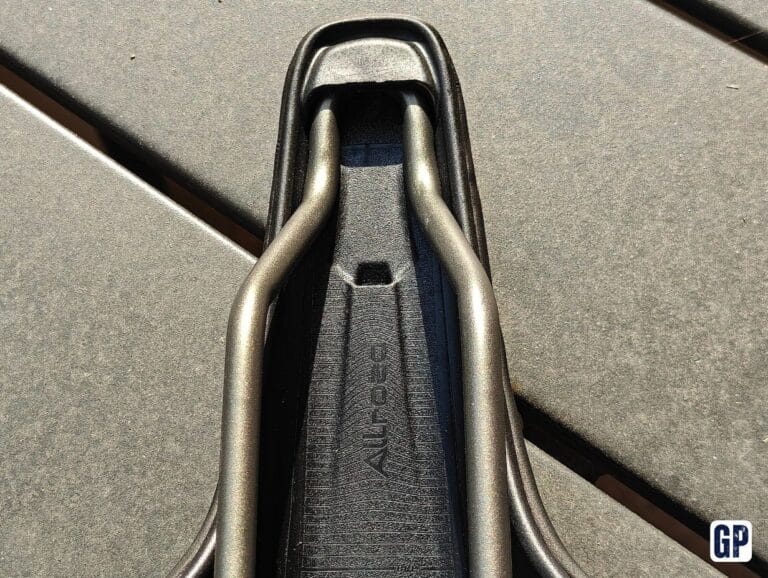
The Microfeel cover sits over Biofoam Plus padding combined with a gel layer. The finish is really well executed and the whole lot inspires confidence straight away.
A setup with no adaptation period
I installed the saddle at exactly the same coordinates as my Fizik Terra Argo X7 150 mm, in a neutral position with no particular tilt.
From the first few kilometres, I immediately found myself in a familiar position.
The rails hold well in the clamp and, once the saddle is properly tightened, it does not move. A detail that may seem trivial, but one that is always appreciated on a component you sometimes tweak several times to fine-tune your position.
After several hundred kilometres, I have not needed to touch the clamp bolts or adjust the saddle position.
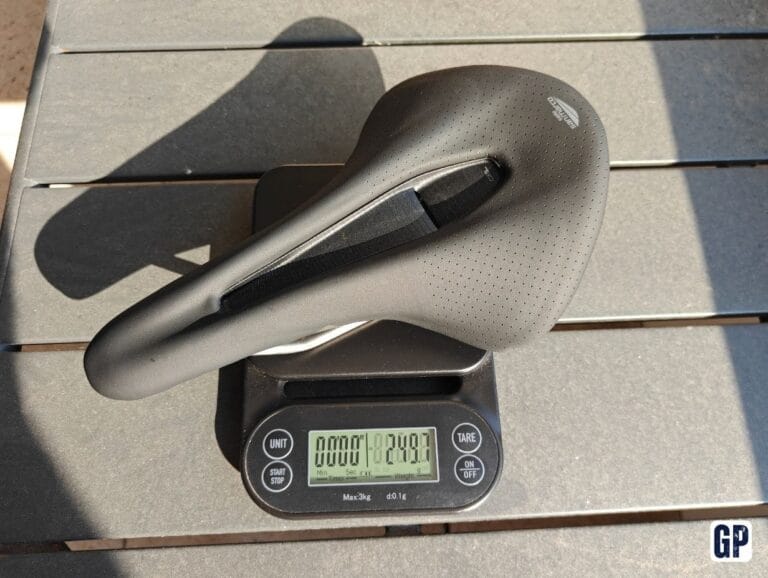
On my scales, the 155 mm Shortfit comes in at 249.7 g. By way of comparison, my Fizik weighs 271.5 g: a small 21.8 g saving, always welcome, even if that is obviously not what will determine the appeal of this saddle.
The saddle is also perfectly silent: no creaks, no unwanted noises cropped up during the test.
Comfort that is immediately noticeable
The first sensation that stands out is very good vibration damping.
The Shortfit Allroad Supercomfort absorbs small irregularities effectively and is particularly pleasant when the surface starts to break up.
San Marco relies on several features for this. The Bow Rail System allows the shell to work around the rails to better absorb micro-impacts, while the Shock Absorbers integrated into the shell filter high-frequency vibrations.
The gel padding completes the package by absorbing impacts and distributing pressure.
But more than pure damping, it was above all the saddle’s behaviour under the pelvis that struck me.
Pelvis held, not locked
Its fairly structured shape and Microfeel cover provide significantly more support than my Fizik Terra Argo X7.
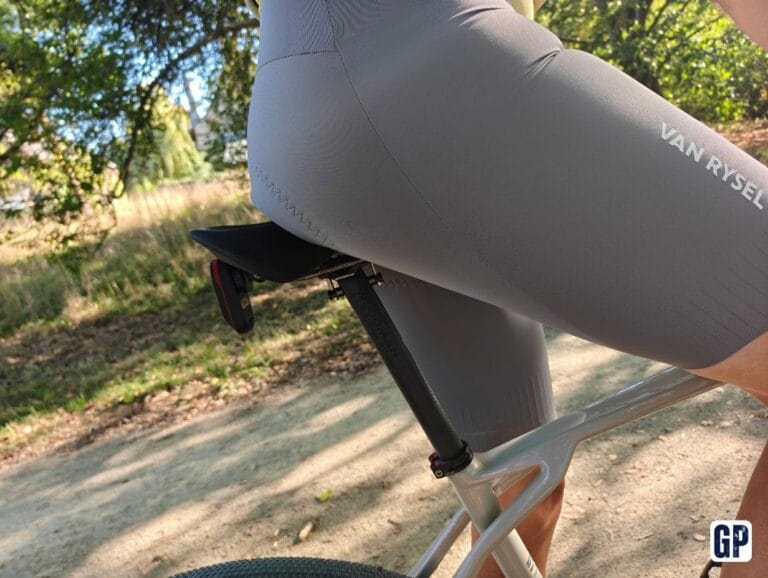
With the latter, whose cover is much smoother, I would regularly slide and often had to reposition myself. With the San Marco, that phenomenon has almost disappeared: the pelvis stays in place, whatever bib shorts I use.
This locked-in feeling at the pelvis brings real composure on the roughest sections. I feel better planted on the bike and can focus more on line and terrain, while still being able to move forwards, backwards or adjust my pressure points when needed.
Ultimately, that is what I find particularly successful: the pelvis is well supported without being confined. The saddle remains firm enough to preserve good feel, and its comfort never comes at the expense of bike feedback.
On the road, comfort is certainly there. But it is really on gravel that I find San Marco’s proposition most coherent, in that area where support, compliance and freedom of movement must coexist. To put these sensations in perspective, our guide to choosing a gravel saddle clearly reminds us how personal shape and contact points remain.
Comfort holds up as the ride goes on
It is of course on long rides that a saddle really has to prove itself.
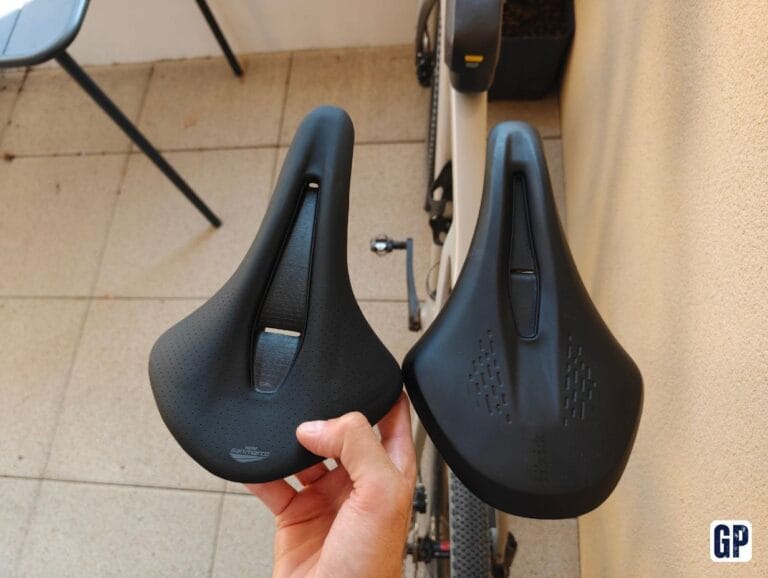
After more than four hours on the bike, the Shortfit remains very comfortable. Beyond 100 km, I inevitably feel a little muscular fatigue at the contact points, but nothing that seems abnormal after several hours on a bike.
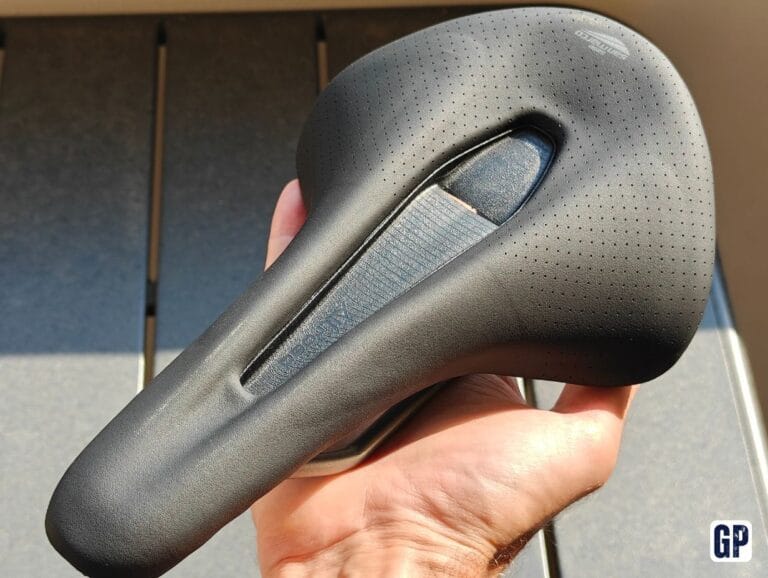
Above all, I did not experience any particular discomfort in the perineum. The central cut-out does its job well and maintains a good distribution of pressure.
This opening is protected by a small flexible flap that partially closes the channel from below. It therefore limits spray from the rear wheel, without preventing water and sweat from draining from above.
This is not specific to San Marco, as my Fizik already uses a similar system, but it is a welcome detail on a saddle intended for gravel.
As always on a long ride, I change position regularly. I go from the hoods to the drops, sit up, sometimes get out of the saddle for a few moments to get the blood flowing again, then sit back down.
The saddle never gives me the impression that I have to work around it, even when I change position frequently.
Stable support, even in a low position
Even after four hours, I can stay in a low or more aerodynamic position without any particular pressure points appearing.
This stability seems important to me. A comfortable but too vague saddle often ends up being tiring, because it forces you to search for your place. Here, the Shortfit gives the opposite impression: it helps you settle in, without totally fixing the pelvis.
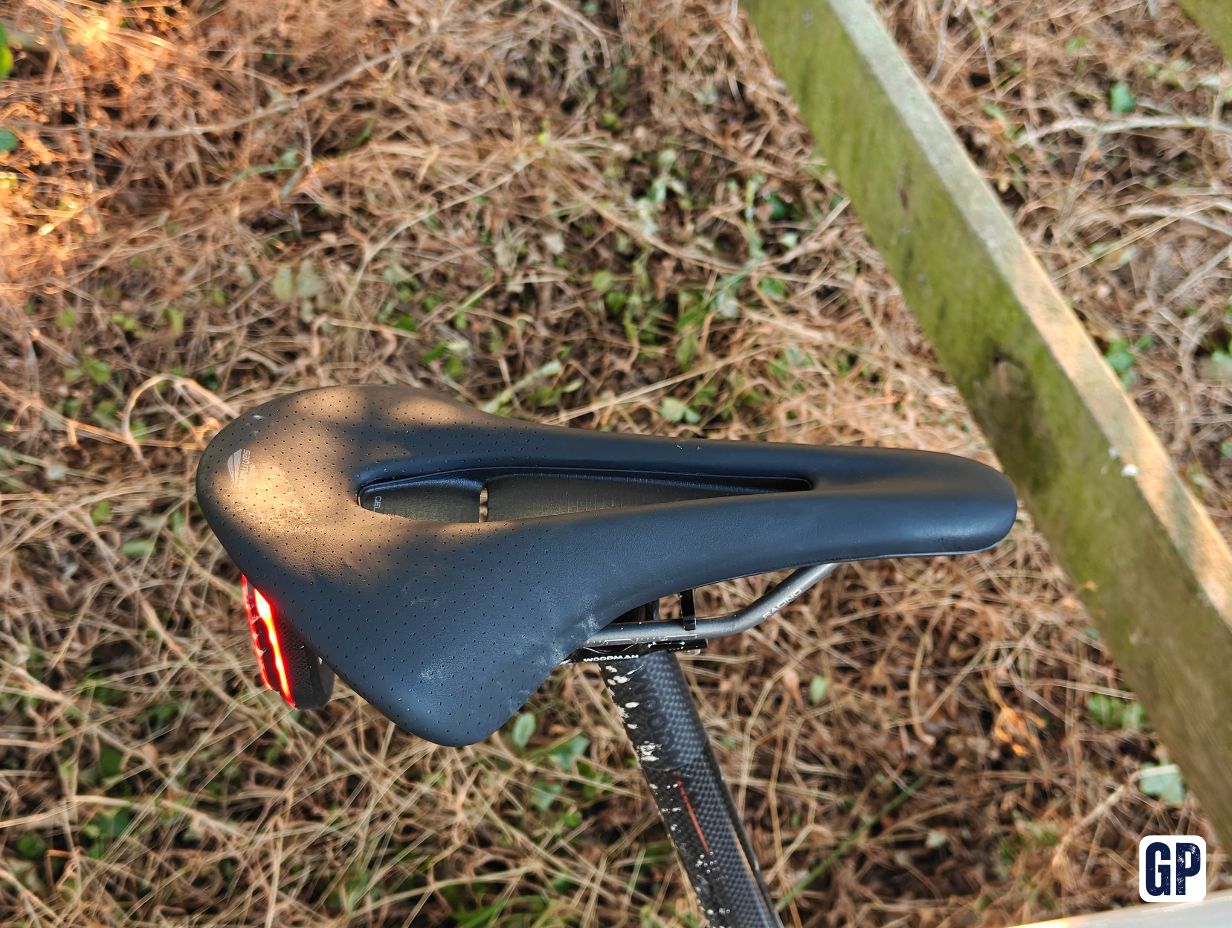
That is also what, to my feel, sets it apart from my Fizik Terra Argo X7. The San Marco is more structured, more compliant and grippier. Not necessarily freer, then. But for my long-distance gravel riding, this more supportive perch works very well.
A cover to keep an eye on over time
After several hundred kilometres, I have not really found any faults with this saddle.
I have, however, noticed that the cover is starting to smooth slightly in certain areas in contact with the bib shorts when I change position. It becomes a little shinier and gets polished in those spots.
At this stage, I would obviously not speak of a durability issue. It is still early days and this change is for now purely visual.
It is simply a point I will continue to monitor over time.
A saddle I would gladly keep on my gravel bike
After several hundred kilometres, the bottom line is quite simple.
The Selle San Marco Shortfit Allroad Supercomfort Racing convinced me from the first rides and confirms that impression over time. Its comfort is excellent, its compliance is particularly pleasant on uneven tracks and the pelvic support is a real plus without preventing you from changing position.
It is also very well finished and its weight remains reasonable for a 155 mm saddle.
The comparison with my Fizik Terra Argo X7 mainly helped me highlight what characterises the San Marco: more pronounced support, superior damping to my feel and a more structured perch.
But beyond that comparison, it is above all a saddle I find particularly successful for long-distance gravel riding.
I would recommend it first and foremost to riders who string together long rides, do bikepacking or tackle irregular gravel routes and who are looking for both comfort and good pelvic support.
If you tend to move around a lot on your saddle or you enjoy a very free, very flat perch, its more structured shape and grippier cover might, on the other hand, require a little adaptation time.
After this test, I can even put it quite simply: on gravel, it is one of the best saddles I have had so far.