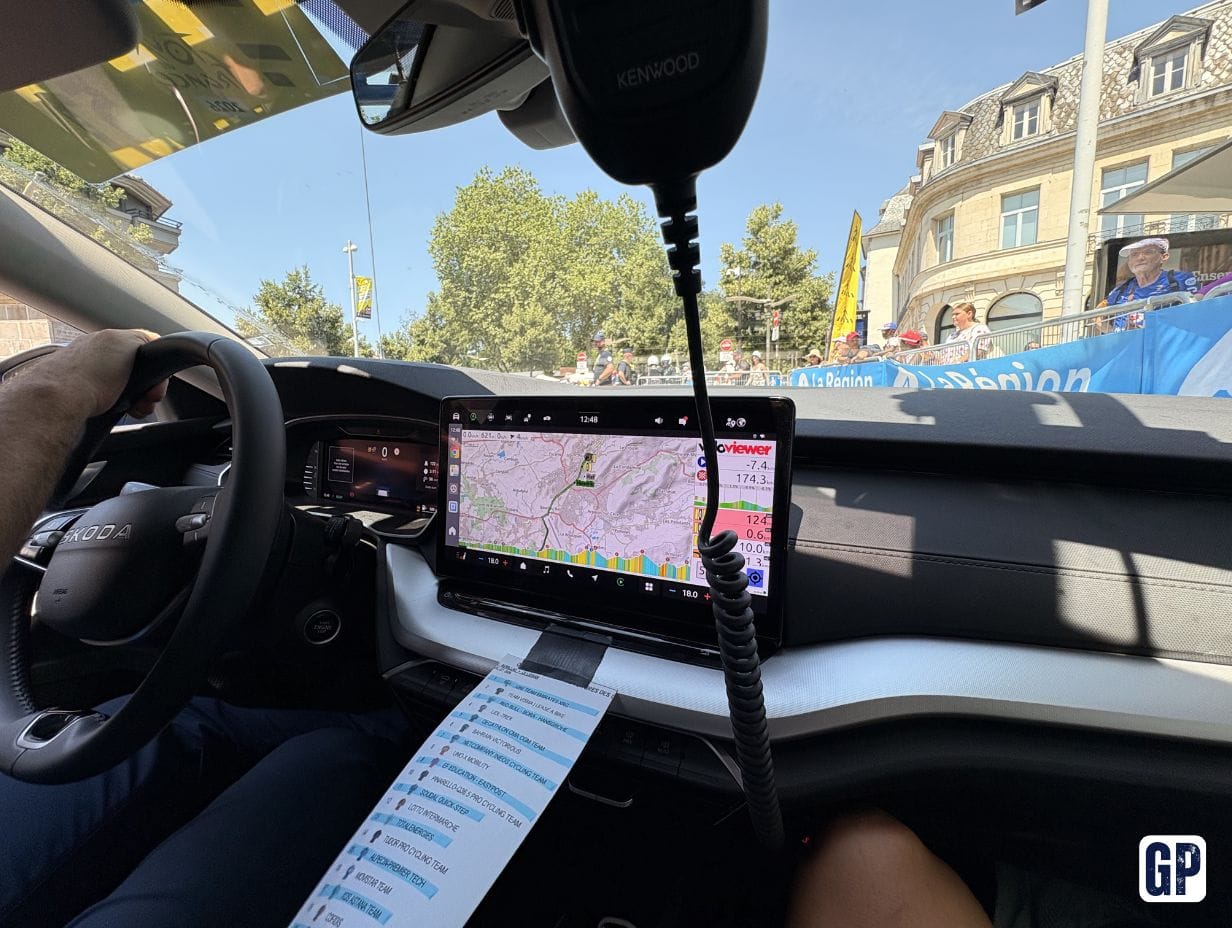

During Stage 10 of the 2026 Tour de France between Aurillac and Le Lioran, I had the privilege of taking a seat in Shimano’s first neutral service car. A day spent just a few meters from the breakaway, then from Tadej Pogačar, to discover a job where the slightest second and the tiniest technical detail can change a rider’s fate.
The radio crackles constantly
Radio Tour updates come one after another, gaps change, groups form and then explode. In front of us, the best cyclists in the world hurtle down the narrow roads of Cantal at a speed that is sometimes hard to grasp when you are just watching the race on TV.
In the car, however, no one seems truly impressed.
Or rather: no one can afford to be.
Up front, Servais Knaven keeps one hand on the wheel and the other close to the radio. Behind me, Kévin, the mechanic, watches the race and the riders’ behavior. Around us, a dozen pairs of wheels, several complete bikes, tools, bottles, and nutrition.
Everything is ready.
Because if a rider raises a hand, pulls over to the side of the road, or stares intently at his rear wheel, there will only be a few seconds left to understand the problem and act.
Welcome to Shimano neutral service car number one.
Where team cars can no longer intervene
Since 2021, Shimano has been the title partner of neutral service on most of the major races on the calendar, including the Tour de France.
Its role is simple on paper: help a rider when his team car is not in a position to do so.
In reality, the mission is much more complex.
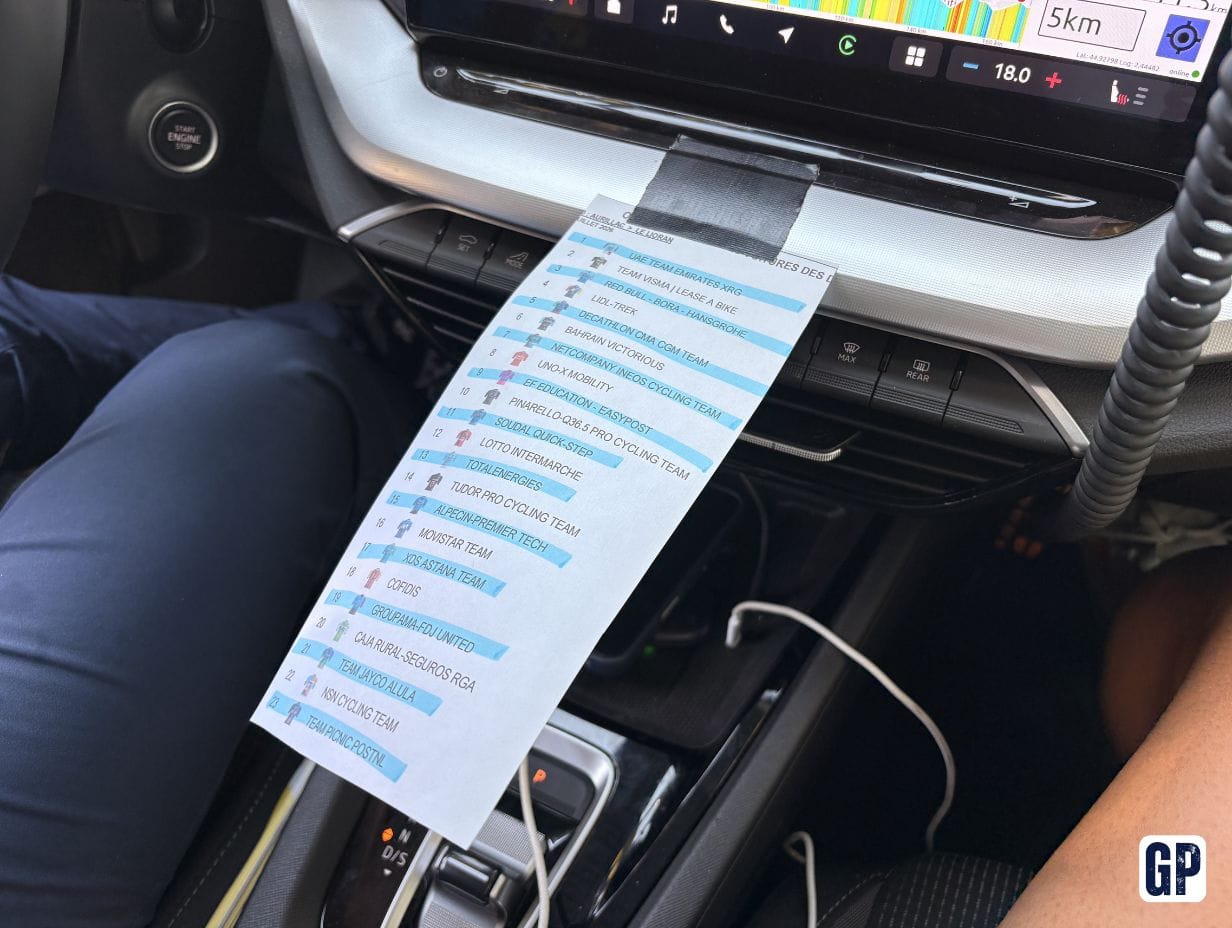
In a pro race, team cars are positioned behind the peloton in a very specific order. When a breakaway gets enough of a gap, the commissaires may allow certain cars to pass through the peloton to get behind their riders.
But the race does not always follow the script.
A peloton can split into several groups. A thirty-rider break can itself explode on a climb. The gaps can be too small to allow vehicles to slot in. An attack can leave a favorite isolated several kilometers ahead of his car.
It is precisely in those moments that neutral service becomes indispensable.
On this Stage 10 between Aurillac and Le Lioran, there were many groups and the gaps were often small. For much of the day, team cars could not move freely between the head of the race, the different chase groups, and the peloton.
Our car, the first of the Shimano vehicles, was therefore positioned as close as possible to the front of the race.
First behind a large breakaway of more than thirty riders. Later behind Javier Romo, alone off the front. And finally, in the last kilometers, just a few meters behind Tadej Pogačar, charging toward another solo win.
A puncture and only a few seconds to react
The first real intervention of the day involves Kévin Vauquelin.
The Frenchman from Netcompany-Ineos is in the lead group when he suffers a rear-wheel puncture. His team car is not close enough to step in immediately.
Kévin, the mechanic in the Shimano car, already understands what is happening.
He opens the door, identifies the wheel he needs, grabs it, and gets out of the car. The swap is done in a few seconds. A push on the back and Vauquelin can set off again.
From the outside, the intervention seems almost obvious.
You just take a wheel, remove the flat one, and send the rider back into the race.
But nothing is that simple.
The teams at the Tour do not all use the same drivetrains, the same cassettes, the same rotor diameters, or the same axle systems. Some bikes have 140 mm rotors, others 160 mm. Drivetrains can have 12 or now 13 speeds. Even within a single team, setups can vary depending on the riders and the stages.
Grabbing an almost-compatible wheel is not enough.
An ill-suited cassette may prevent clean shifting. The wrong rotor diameter can make the brake unusable or cause constant rubbing. A few seconds gained during the change can then turn into several minutes lost a few hundred meters later.
The mechanic therefore has to know the equipment used by every team, and also immediately identify the bike that pulls up in front of him.
That day the Frenchman is using particularly high-performance Continental tires, initially designed for time trials, but also more prone to punctures than more versatile models.
You have to act fast, but above all act right.
Ideally, a wheel change should stay under thirty seconds. At this level, every second at a standstill can make getting back to the group harder.
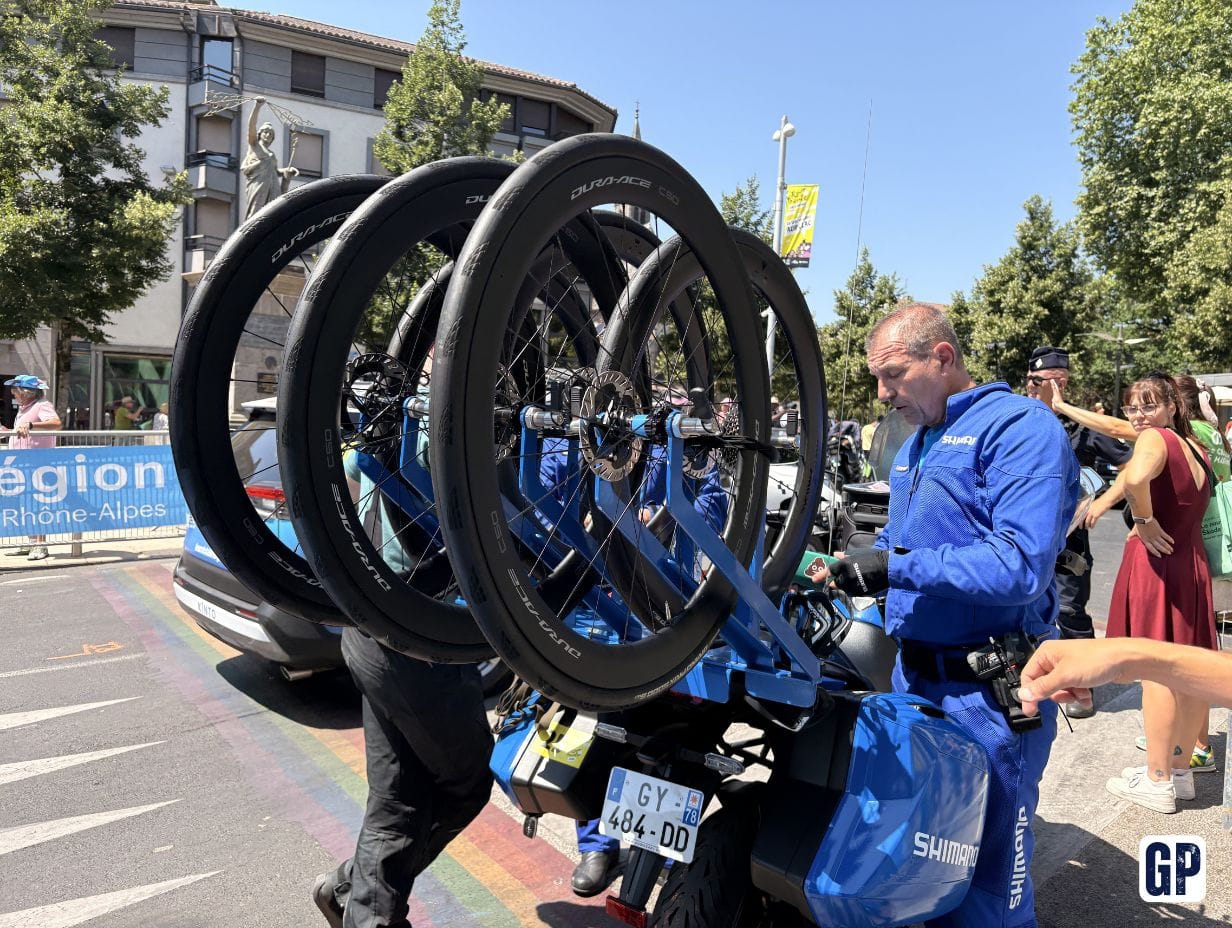
On a mountain stage, a few seconds can even be enough to lose contact for good. That is exactly what happened yesterday to Kevin, who unfortunately would never see the lead group again.
The mechanic has to know almost the entire peloton
This speed relies on massive preparation done before the race.
Shimano mechanics regularly talk with team mechanics to learn their technical choices: type of drivetrain, cassette, rotor diameter, tires, pedals, saddle height, or any changes made during the season.
In the car, the wheels are arranged in a precise order.
It is not a random assortment. Each spot corresponds to an identifiable setup, and the mechanic must be able to grab the right set without having to think for long.
Up to nine pairs of wheels can be carried in a single car. They cover different drivetrains, multiple braking standards, and the main configurations used in the peloton.
This technical diversity makes neutral service particularly complex today.
Back in the days of rim brakes and relatively standardized mechanical drivetrains, the same wheel could suit much of the peloton. Now, the multiplication of standards requires an almost individual knowledge of equipment.
And wheels are only one part of the setup.
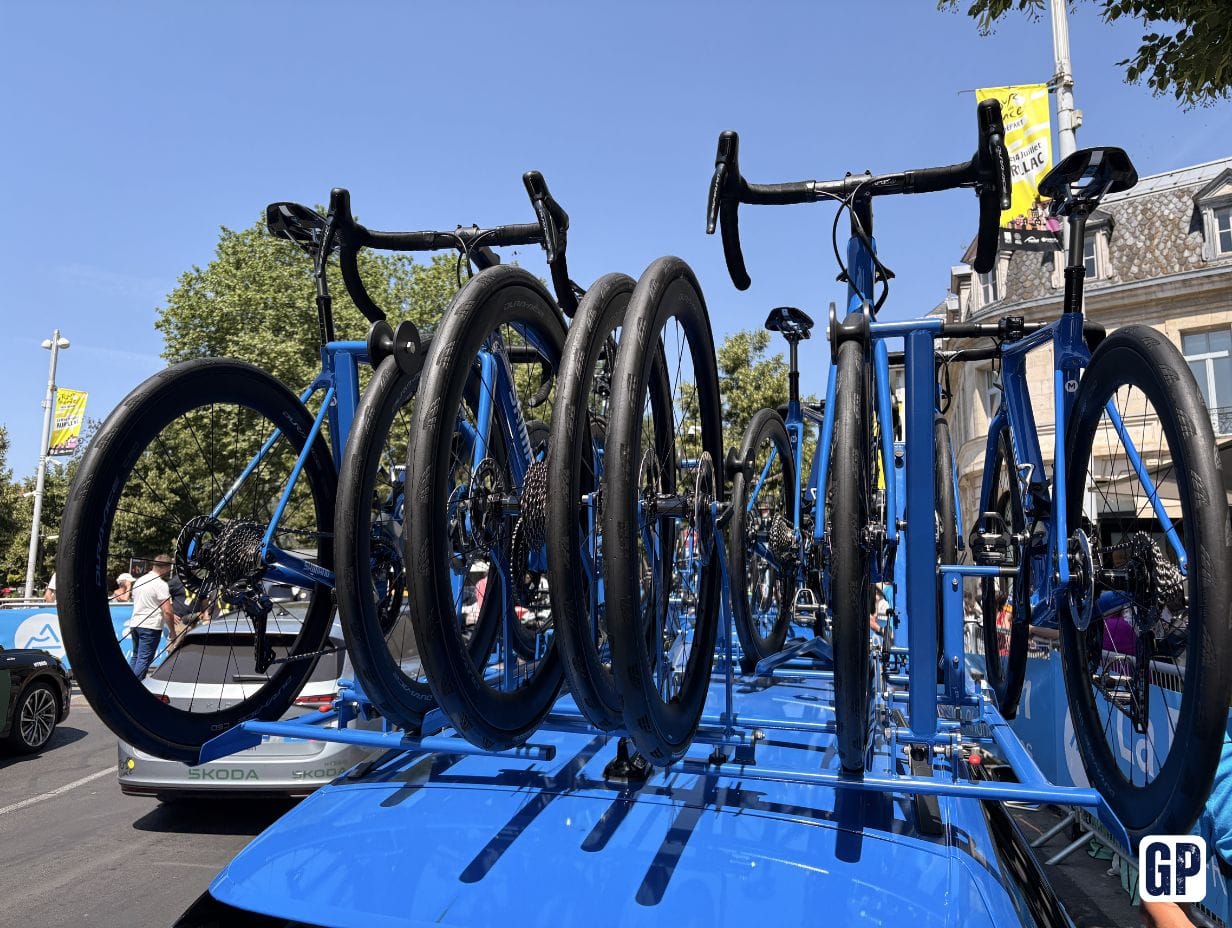
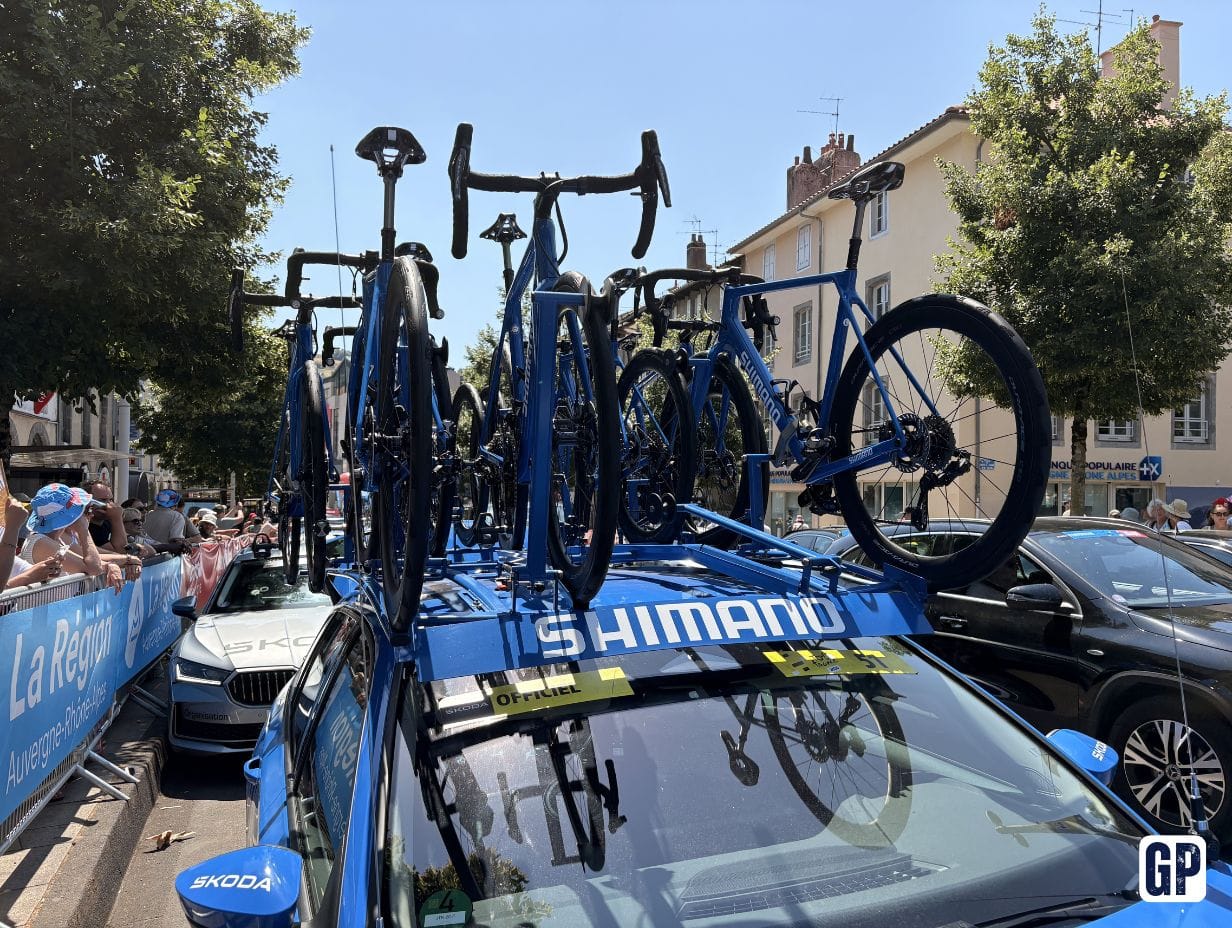
On the roof rack of our car there are also several complete bikes, ready to be handed to a rider whose machine is unusable.
Bikes set up for Pogačar, Vingegaard, or Seixas
Handing a rider a complete bike is often the fastest solution after a major crash, a broken frame, a torn-off derailleur, or a chain that cannot be freed.
But that bike still has to be usable.
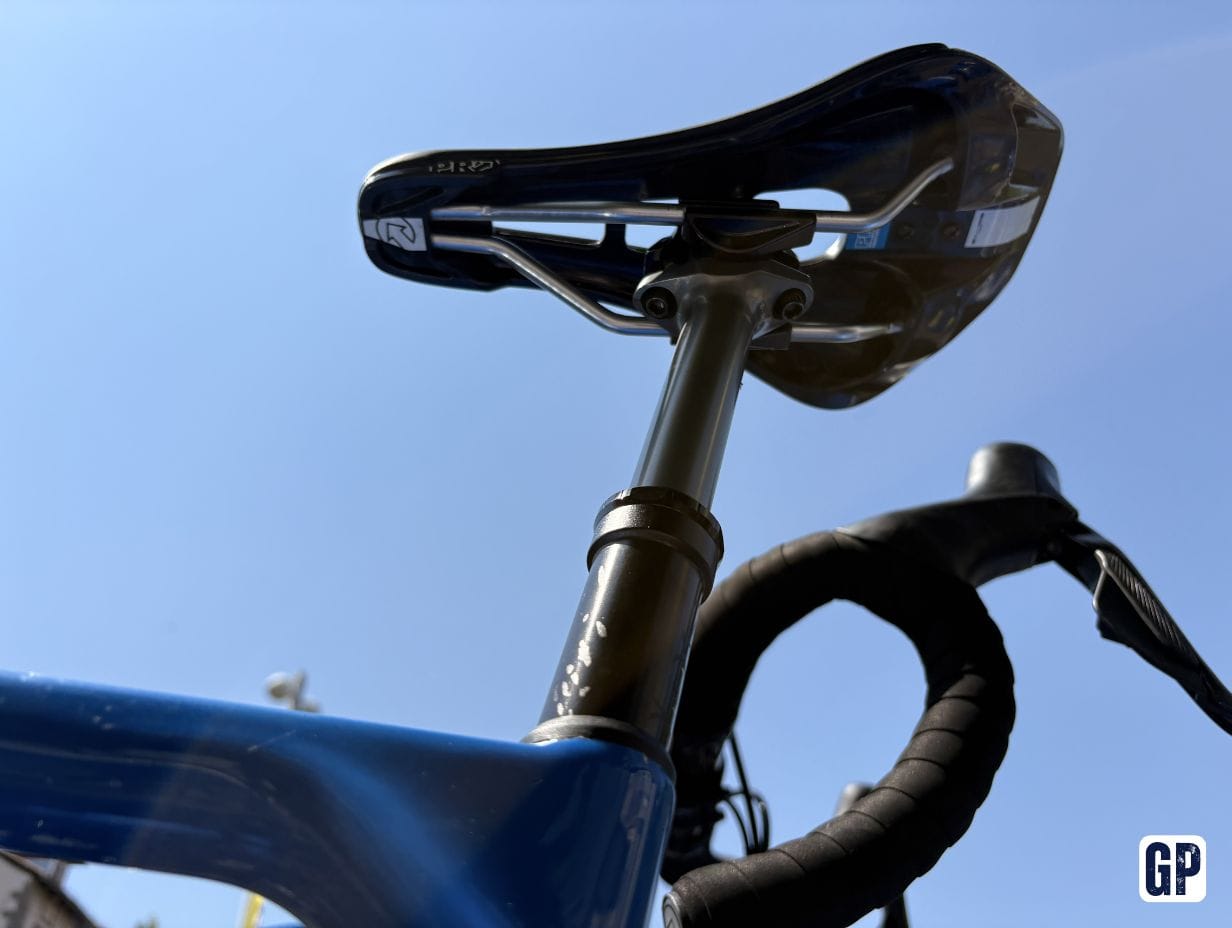
A professional cyclist cannot just hop on any bike and ride normally. A few millimeters of difference in saddle height can significantly change his position. The pedals must match his cleats. The frame size has to be coherent. The controls and gearing must allow him to finish the stage.
For the Tour de France, Shimano therefore prepares certain bikes according to the main GC contenders.
Saddle height and pedals can thus be anticipated for riders like Tadej Pogačar, Jonas Vingegaard, or Paul Seixas. In case of a problem, they can get a machine already very close to their usual settings.
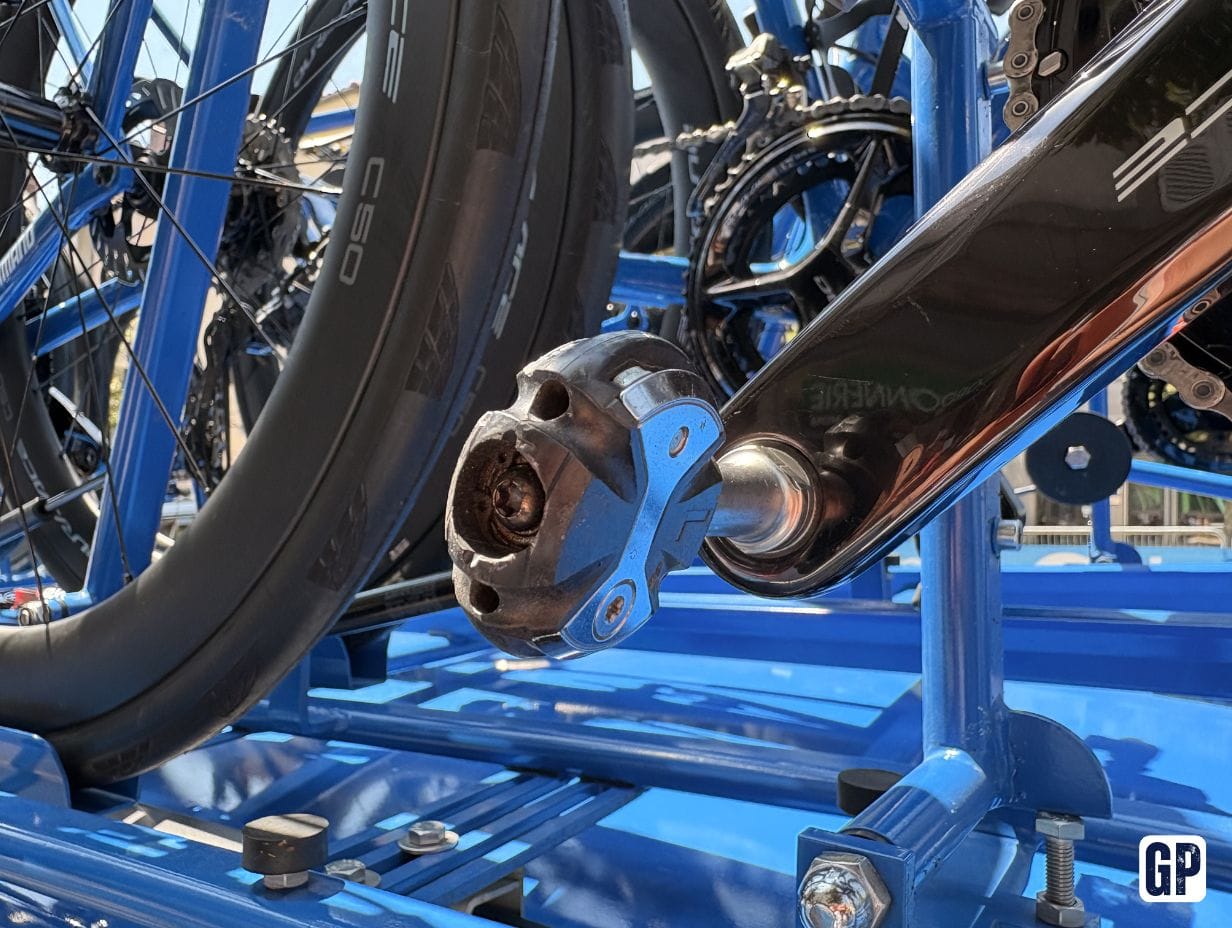
The other bikes cover several sizes and all use a dropper seatpost.
Its role is obviously not to help the rider corner better on descents like on a mountain bike. It mainly allows quick saddle height adjustment. The mechanic can make an initial adjustment before handing over the bike, then the rider can fine-tune his position once back underway.
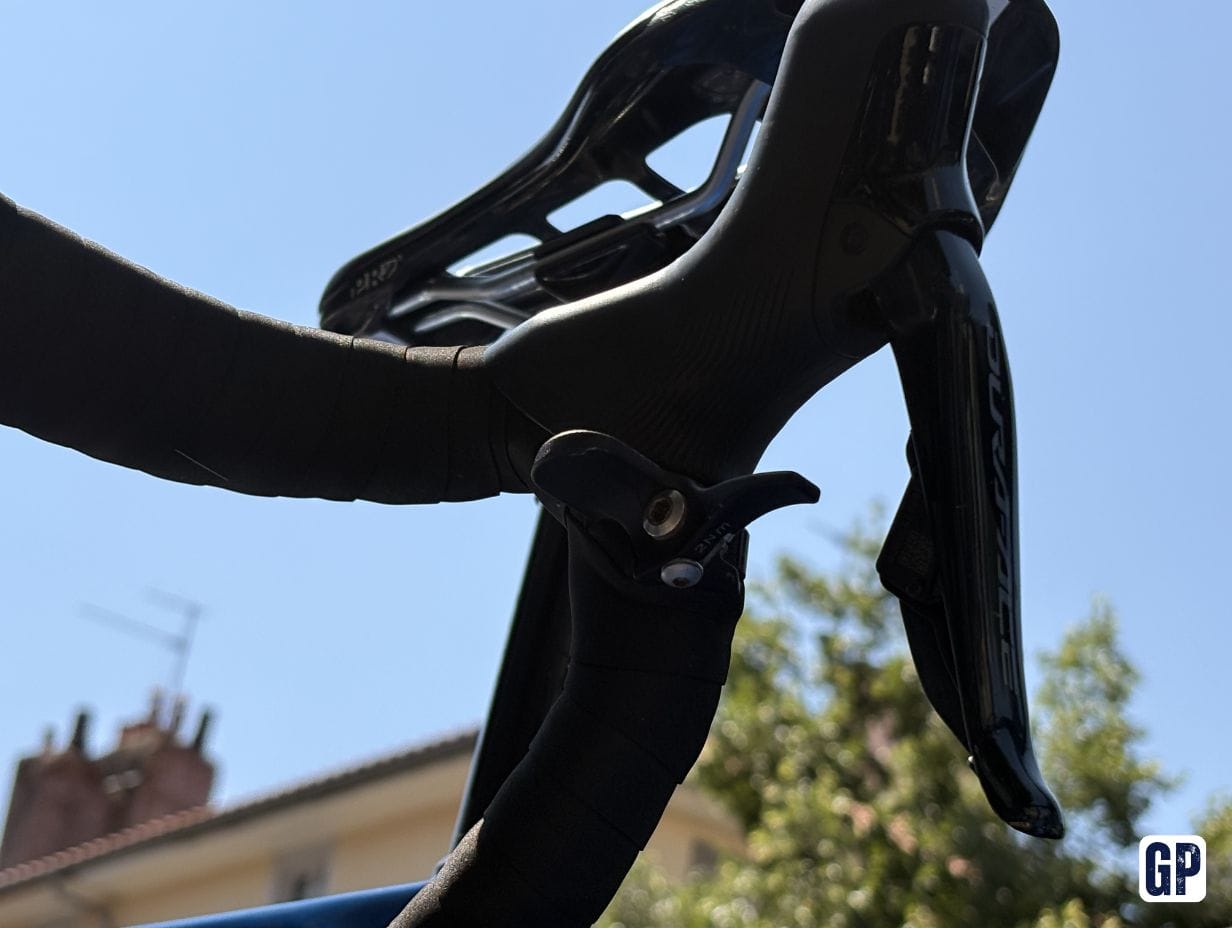
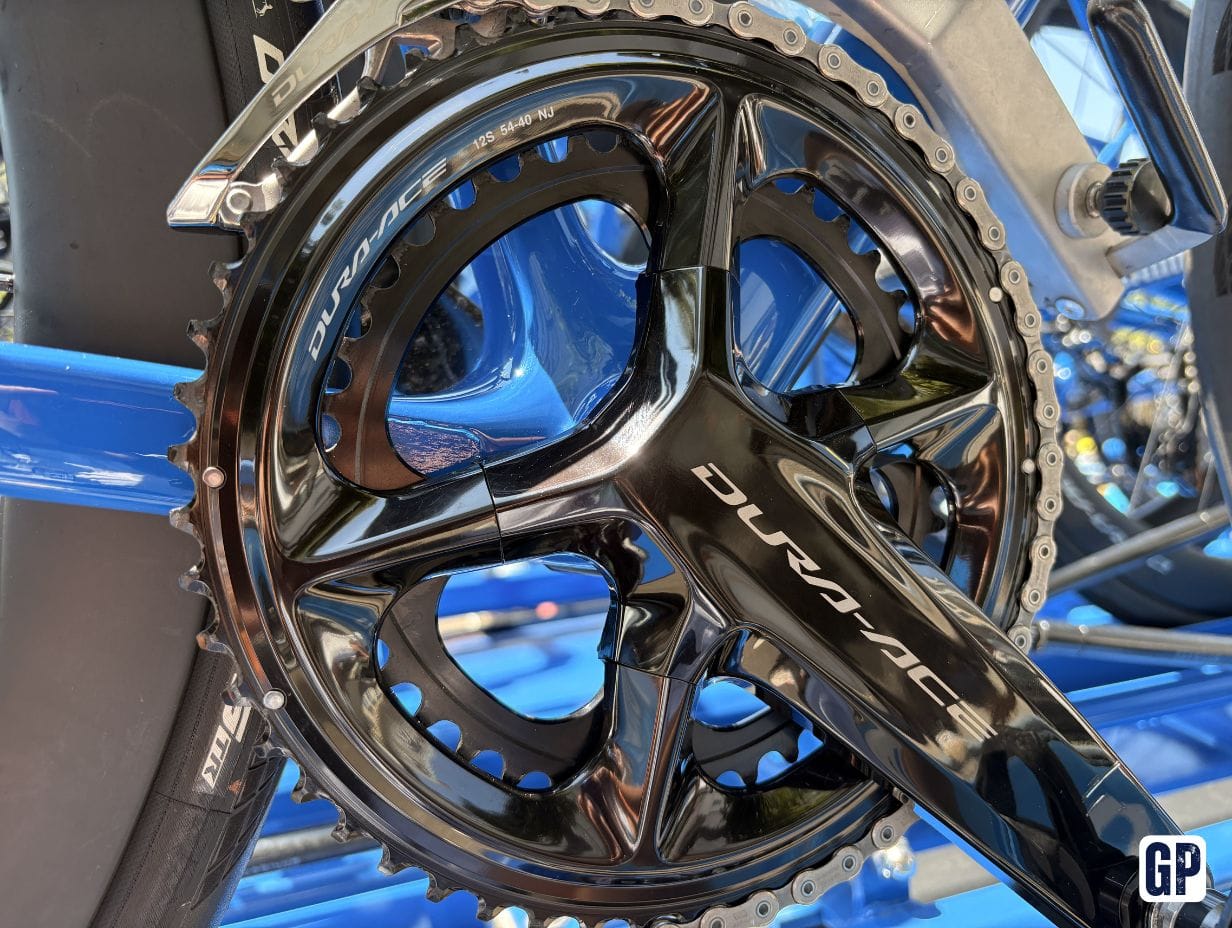
The bikes carried on the Tour are equipped with a Shimano Dura-Ace groupset, Dura-Ace wheels, and Continental GP5000 S TR tires in 30 mm, set up tubeless.
Pressure is generally around 4 bar, with adjustments based on the rider’s weight, the stage profile, and weather conditions.
The drivetrain uses 54 and 40-tooth chainrings, a versatile choice that covers the majority of Tour stages, from fast days to mountainous routes. The handlebar is 38 cm wide.
Of course, no neutral bike will perfectly replicate the rider’s usual machine. But its purpose is not to offer perfect comfort.
It has to allow him to stay in the race.
At over 100 km/h behind Javier Romo
The driver’s role is just as impressive as the mechanic’s.
At the wheel of our car, Servais Knaven is no ordinary driver. The former Dutch rider notably won Paris-Roubaix in 2001 as well as a Tour de France stage in 2003.
He knows the race, the behavior of a peloton, and riders’ lines.
That experience really shows in the descents.
When Javier Romo goes solo off the front, the Shimano car has to stay close enough to help in case of a problem, without ever hindering the rider or influencing the race.
In one of the day’s first descents, the speed tops 100 km/h.
In front of us, Romo takes every risk. Behind him, Servais keeps the right distance, manages the bends, and constantly watches what is happening around the car.
One hand on the wheel, part of his attention on the radio, he strings together the corners like a rally driver.
In places, the car takes the curves at over 60 km/h on narrow roads, sometimes lined with spectators. It has to follow riders who use the full width of the road, anticipate their changes of line, and let motorbikes or priority vehicles through.
You have to go fast, but never cross the line.
Neutral service has to be close enough to be useful and far enough to remain neutral.
It is a constant balancing act.
Radio Tour, VeloViewer, and reading the race
On board, decisions are not based solely on what we see through the windshield.
The car is directly connected to Radio Tour, the official channel through which the main race information is broadcast: attacks, punctures, crashes, requests for assistance, gaps between groups, or vehicle movements.
The different drivers in the Shimano fleet also communicate with each other.
This coordination makes it possible to distribute the cars and motorbikes among the different groups. When a race splits apart, you have to avoid all the vehicles clustering in the same place while dozens of riders are left without assistance several kilometers behind.
The setup is rounded out by VeloViewer, an app that centralizes route data.
The support crew can look up climbs, descents, danger zones, narrowings, technical sections, and the main strategic points.
This allows them to anticipate.
Before a long descent, the mechanic checks his equipment and gets ready. Approaching a climb likely to blow the group apart, the crew knows team cars may be blocked. When a road gets particularly narrow, the driver adjusts his positioning.
The ability to provide quick assistance therefore starts well before the rider raises a hand.
Behind Tadej Pogačar, the tension rises even more
In the final kilometers, the complexion of the race changes again.
Tadej Pogačar attacks and goes into the lead alone.
Our car moves in behind him.
It is probably one of the day’s most impressive moments. We are just a few meters from the yellow jersey, driving toward victory on one of the most beautiful stages of this Tour de France.
But inside the car, no one is really enjoying the show.
The level of attention rises again.
A puncture, a dropped chain, a crash, or a drivetrain problem can always happen. The UAE Team Emirates car is not necessarily right behind. If Pogačar has an issue, the responsibility to get him back in the race may therefore fall to neutral service.
At that moment, an intervention that takes too long could cost him a stage win.
The wrong wheel could make his bike unusable.
A complete bike that is poorly adjusted could stop him from defending his chances properly.
The mechanic barely takes his eyes off the rider.
He watches his rear wheel, his cadence, and any gestures that might signal a problem. The driver keeps the distance needed to intervene immediately.
Pogačar will ultimately encounter no issues and will win solo at Le Lioran.
For neutral service, it is almost the ideal day: being ready for anything without ever having to step in for the leader.
In the heat, bottles and nutrition
Neutral service is not just wheels and bikes.
On this stage raced in intense heat, the Shimano cars also play an important role in riders’ hydration.
The Tour has refreshment motorbikes able to distribute bottles. But when temperatures rise, they are quickly in demand from much of the peloton.
Riders who are isolated or far from their team car can then turn to neutral service.
On board, Shimano carries bottles and energy gels. When a rider requests it, a crew member can hand him something to drink or eat.
This may seem like a small thing.
Yet it can make a huge difference when a rider has been in a breakaway for hours, his team car is stuck behind the peloton, and the next feed zone is still far away.
Again, neutrality is essential.
Help must be available to all riders, whatever their team or equipment supplier.
Be everywhere while never getting in the way
All day long, one idea keeps coming back: neutral service has to be indispensable while remaining almost invisible.
It must follow the head of the race without influencing it.
It must pass some groups without putting riders in danger.
It must position itself close enough to intervene, but without offering an aerodynamic advantage.
It must hand over a bottle without getting in the way of an attack.
At times it must stop urgently, swap a wheel in a few seconds, then rejoin the convoy without disrupting the other vehicles.
Every intervention is watched by the commissaires.
Every move has to follow the race director’s instructions.
Even content creation is strictly controlled by ASO. From the car, it is forbidden to broadcast images or videos freely that show the race directly.
That is why some of the most impressive moments of this day can never be shared.
The 100 km/h plus descents, the moments spent behind the leaders, or the tension of the final kilometers behind Pogačar will mostly remain memories.
Frustrating for a content creator, sure. But ultimately quite consistent with this behind-the-scenes job.
The ones TV barely shows
On television, neutral service usually appears for just a few seconds.
A rider raises a hand. A blue car stops. A mechanic gets out, swaps a wheel, and pushes the cyclist to send him back on his way.
Then the broadcast returns to the head of the race.
You do not see the hours of preparation, the exchanges with the teams, the dozens of memorized setups, or the tension inside the cabin.
Nor do you grasp how hard it is to drive a car loaded with bikes at the speed of a professional peloton, on mountain roads that are sometimes tiny.
Even less the responsibility that rests on the crew’s shoulders.
A successful service does not guarantee victory.
But a failed one can make it disappear for good.
Servais and Kévin did not cross the line with their arms aloft at Le Lioran. Their names did not appear in the stage standings and no one was waiting for them on the podium.
Yet all day long, they enabled riders to keep believing in their chances.
Yesterday, I saw the best cyclists in the world up close. But it is the men of neutral service who left the biggest mark on me.