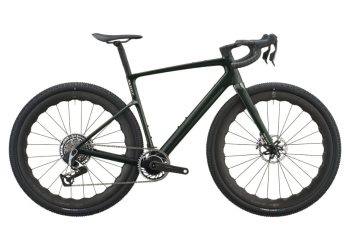
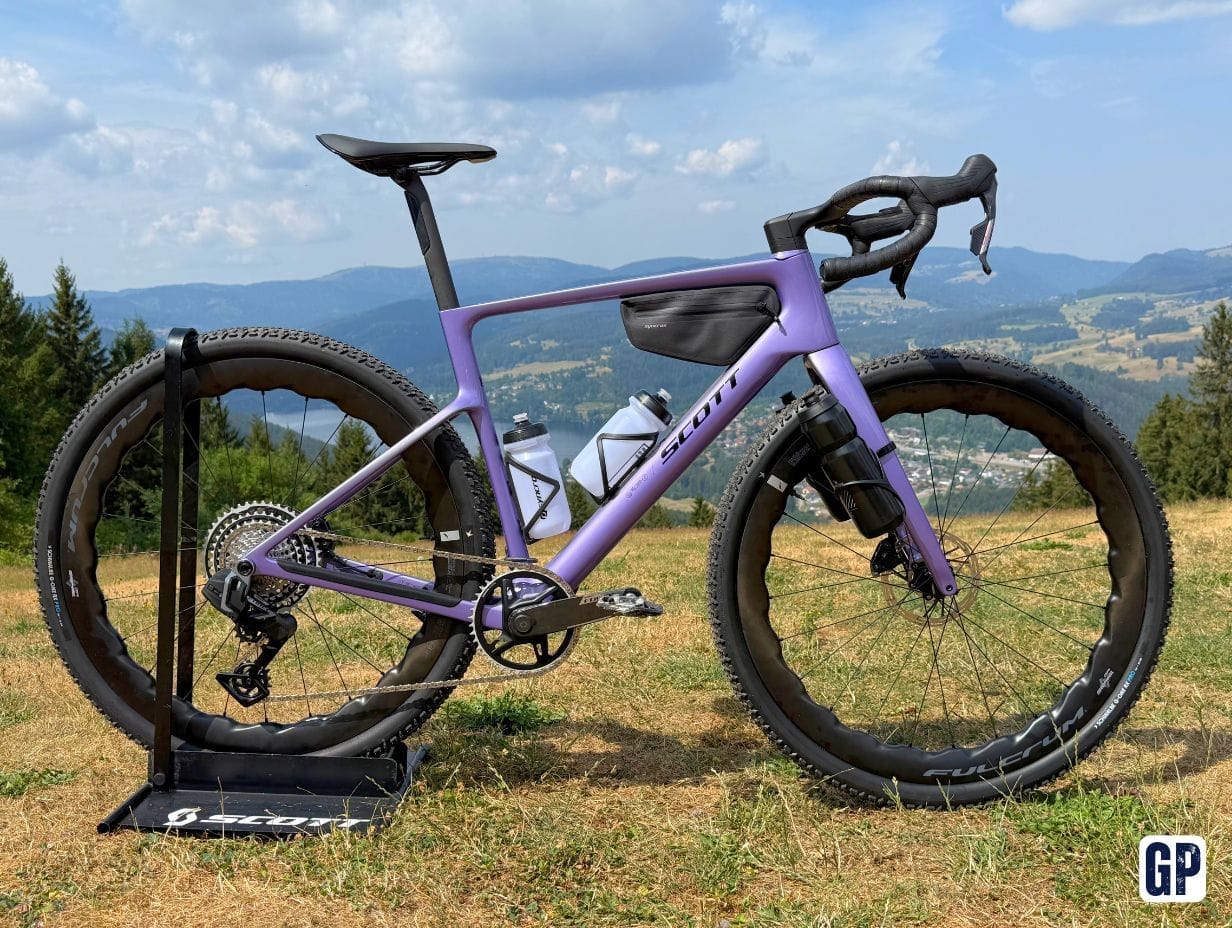

The new Scott Addict Gravel arrives six years after the previous generation. From the first few metres, one thing is quite clear: Scott has not tried to make a race gravel dressed up as a do-it-all bike. The priority lies elsewhere. Comfort, confidence, ease of use and riding pleasure.
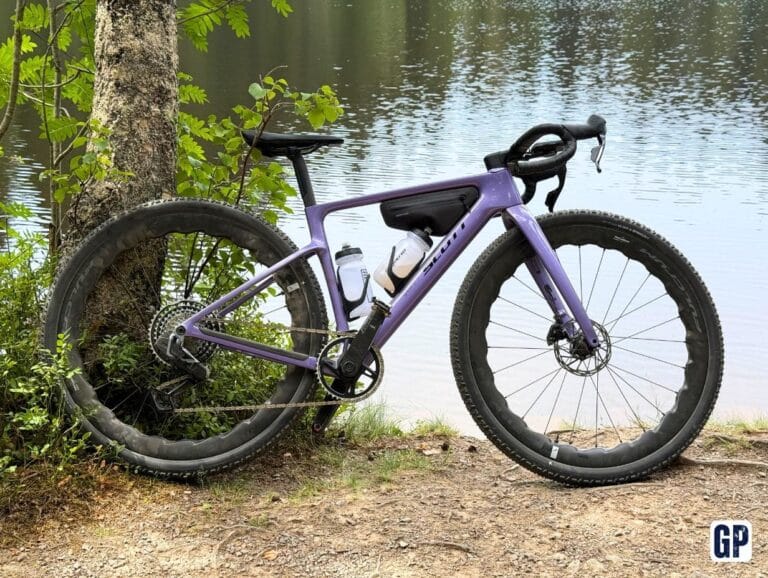
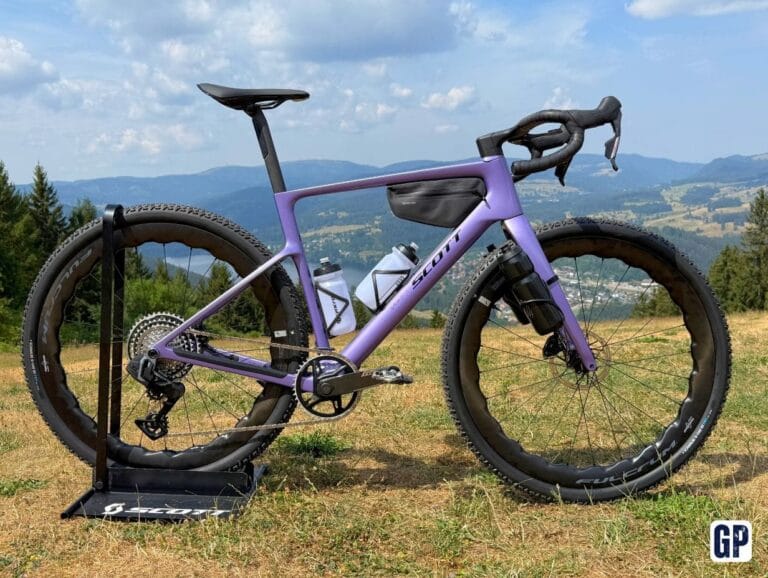
The version tested here is the Scott Addict Gravel 10. It comes with a SRAM Force groupset, a Fulcrum Soniq GR Carbon wheelset and a rather successful purple colourway.
Strengths:
- Very high comfort and compliance
- Clean integration of tools and accessories
- Reassuring stability on rough terrain
- Excellent Syncros cockpit
Could be better
- Limited responsiveness in accelerations
- Fork mounts only compatible with Syncros
A very clean, functional design
Visually, the link with the Scott Addict road is immediate. Same design language, taut lines, and the same desire to hide whatever can be hidden. In profile, the frame looks almost bare: no visible fasteners everywhere, no clumsy hatch, no graphic overload.
This pared-back side is not just about aesthetics. Scott has really worked on the bike as a whole, with Syncros, so that the components, storage and accessories do not break up the overall line.
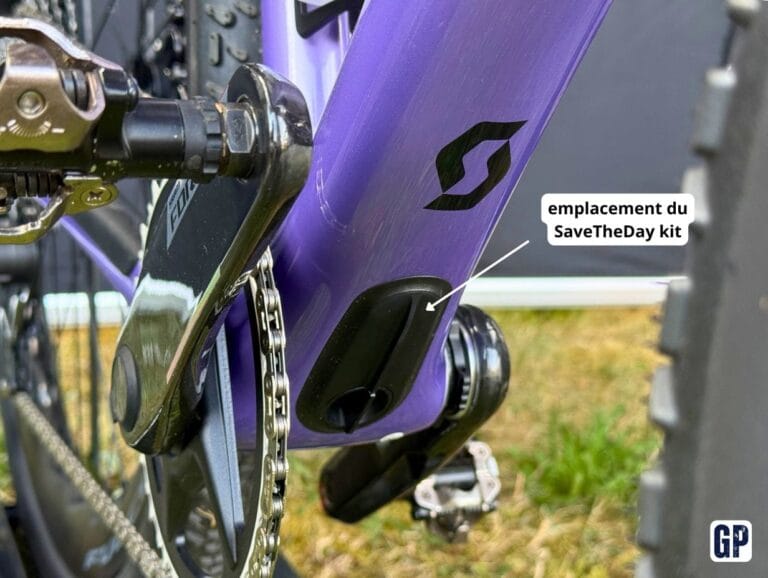
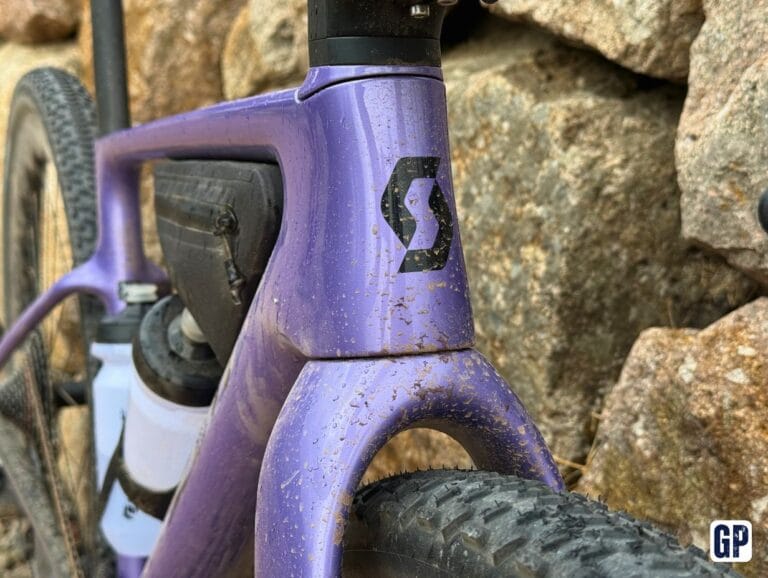
The Save the Day Kit hatch, placed under the down tube, is a good example. If it is only meant for rare emergencies, why make it visible at every glance? It lets you carry a mini pump, tyre levers and an inner tube. It is not very accessible and will quickly get dirty off-road, but it is not everyday storage. It is more of a backup solution, to forget about until the moment it becomes useful.
I like this approach. It accepts a limit of use, but puts it in the right place. A breakdown tool does not need to be as accessible as an energy bar.
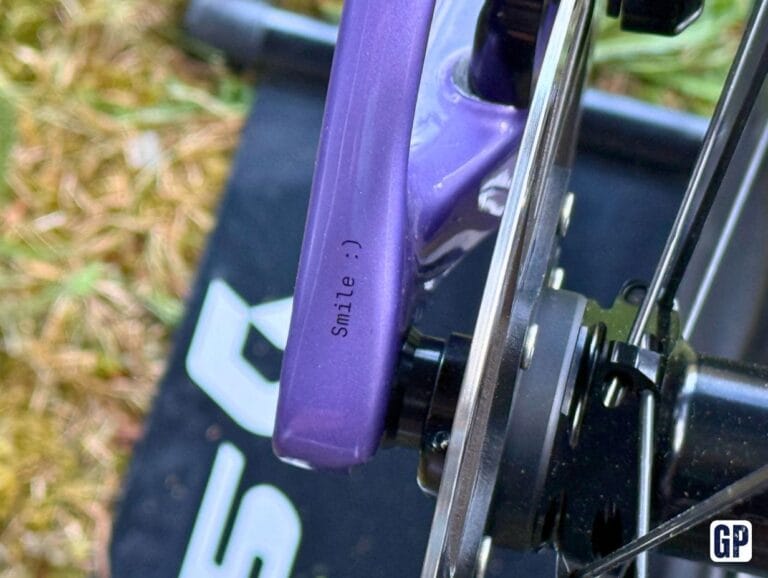
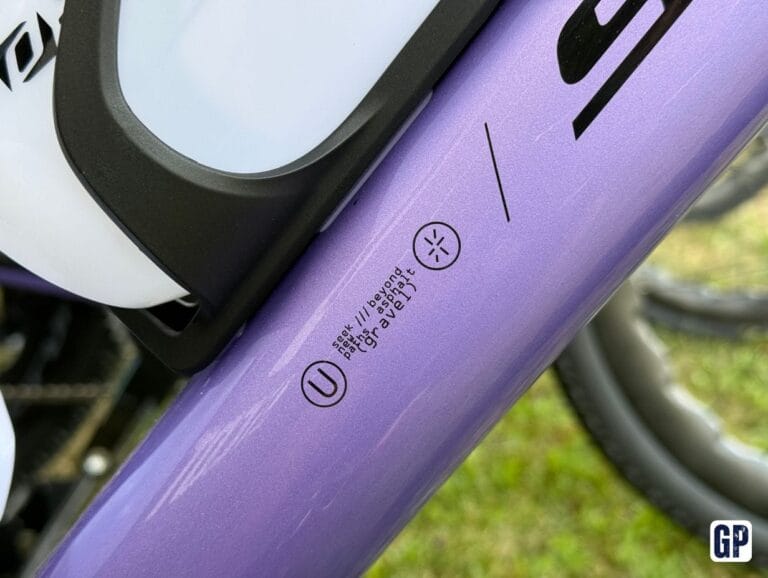
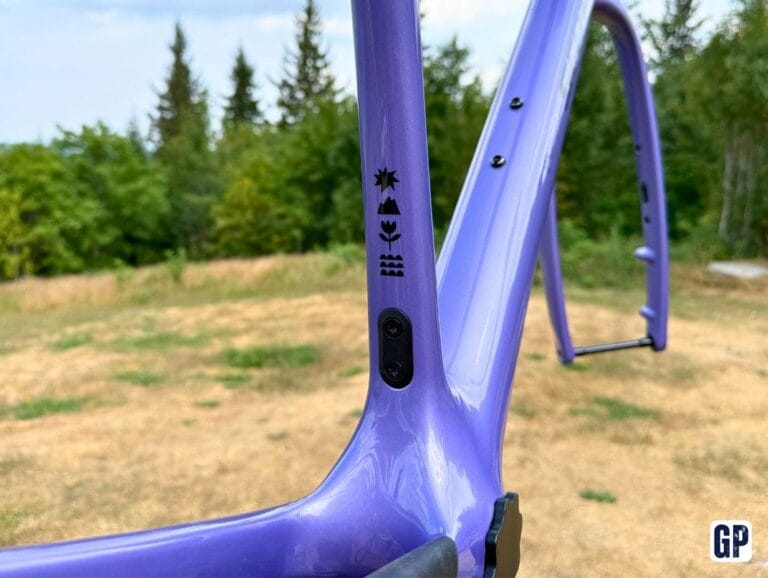
The little details also contribute to the object. Near the rear axle, a small “Smile”. On the top tube, by the mounts, an “I am hungry”. It gives a bit of personality to a very clean bike, almost visually silent.
A long geometry to inspire confidence
The Addict Gravel takes the spirit of the new Addict, but with the adaptations required for modern gravel. The bike is longer than a road bike, with the stack raised by 10 mm compared to the previous generation and the reach also longer. Scott compensates with a shorter cockpit, to keep a position on the hoods close to that of the Addict.
If you already ride a recent Addict, the transition should therefore feel quite natural. In my case, coming from a Scott Addict RC, the Gravel felt a touch bigger: I usually ride a size S, and the Addict Gravel in XS was perfect.
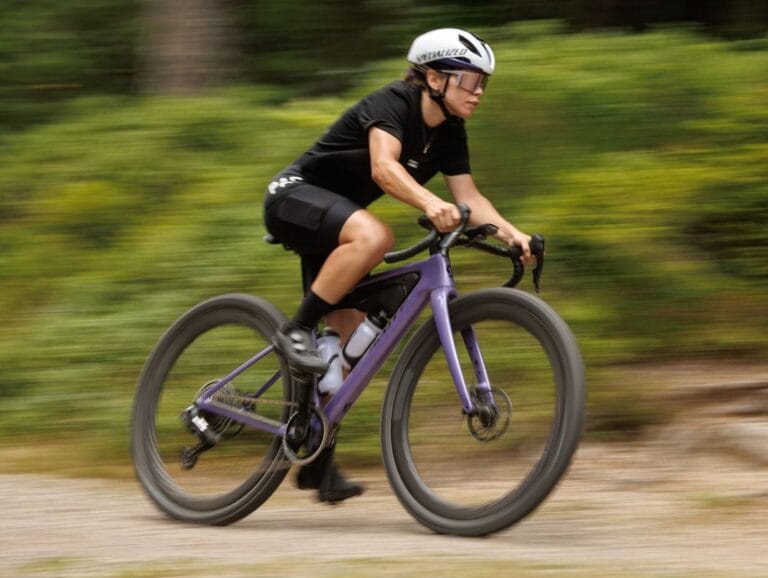
This extra length does not feel sluggish. The bike remains easy to place and handle. Above all it brings stability, especially when the surface gets looser. In size M, the wheelbase reaches 1,060 mm, and this choice fits well with the bike’s philosophy: less outright snap, but more control when you are going fast or when the surface deteriorates.
57 mm tyres, no toe overlap even in XS
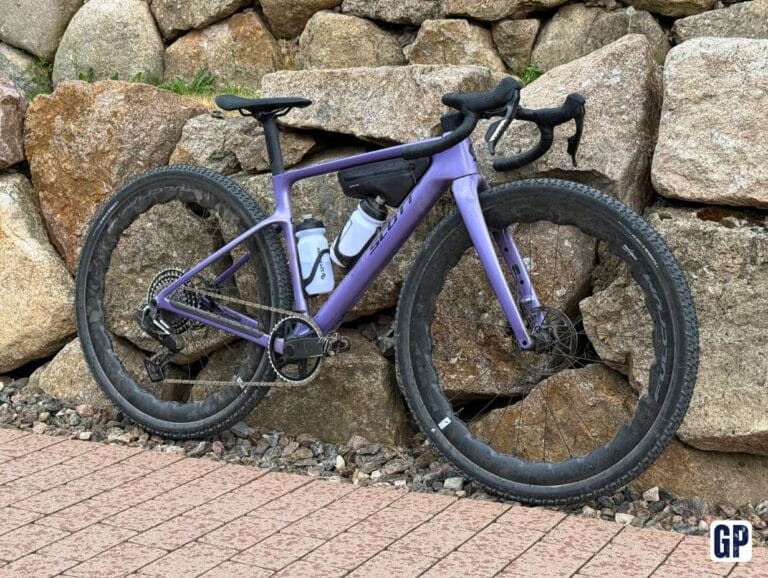
The new frame accepts tyres up to 2.2 inches (that is, 57 mm), usually used on MTBs, and increasingly seen in gravel. It’s a modern choice from Scott.
I rode the bike with 50 mm then 55 mm tyres. The change inevitably alters the behaviour: the larger the volume, the more the bike becomes compliant and stable. At 55 mm, it was a real 4×4.

The point I always watch on small sizes is toe overlap. Here, even in XS with 55 mm tyres, my foot did not touch the front tyre in tight manoeuvres. For me, that’s an excellent sign of the design.
On a modern gravel bike, especially when it accepts very large tyres, the absence of toe overlap on a small size really matters.
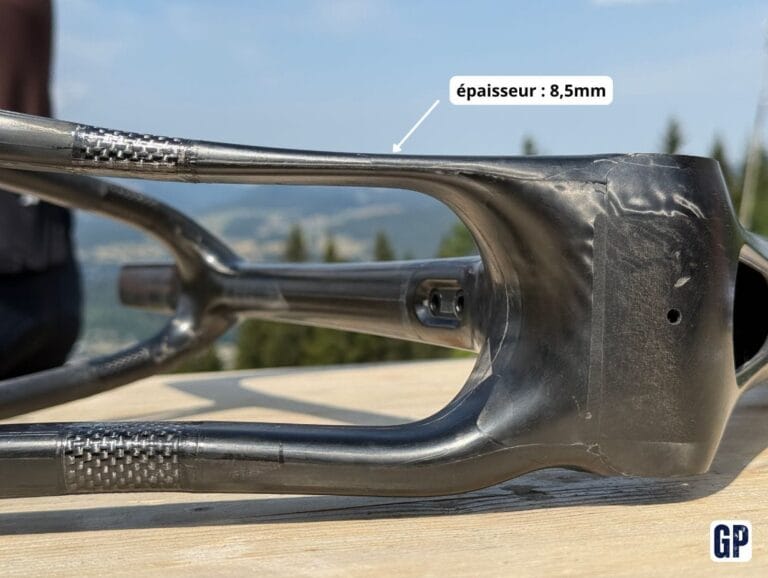
To achieve this clearance, Scott in particular pulled off a small feat of engineering by slimming the right chainstay: at its thinnest point, it goes down to 8.5 mm thick. This allows it to retain compatibility with large tyres while accepting a chainring up to 52 teeth, without completely transforming the geometry.
The Syncros cockpit is the real surprise
The new Syncros IC R501 CF II cockpit is probably one of the most successful elements of the bike. It is gravel-specific, in carbon, claimed at 290 g, with 67 mm of reach, 115 mm of drop and widths offered from 360 to 420 mm.
The shaping is carefully executed. The reach is short, the drop shallow, the levers stay aligned with the drops rather than splaying outwards, as on many very flared gravel handlebars. Result: access to the drops and to the brakes is simply excellent.
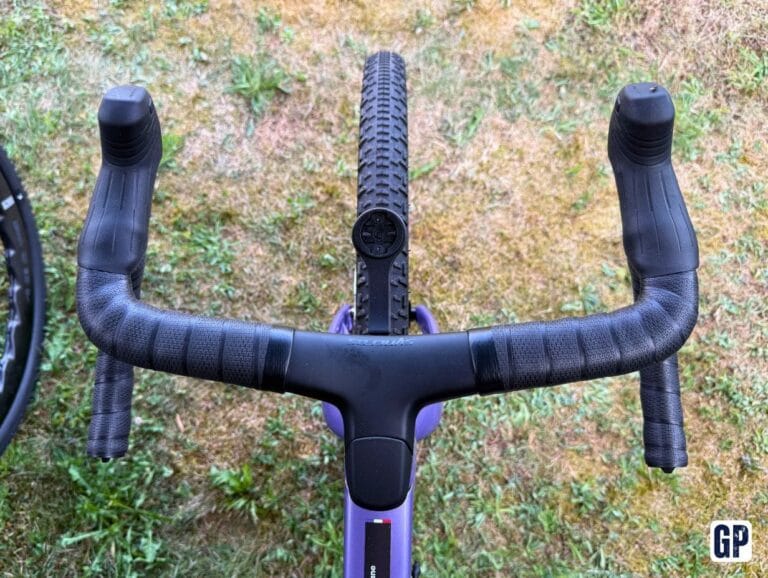
It is the kind of ergonomic work that genuinely changes the experience. I found myself reaching for the drops much more naturally. No bent wrists, no feeling of being wedged in, no need to think about position. Your hands naturally find the right place, and it feels good there. What more could you ask from a handlebar?
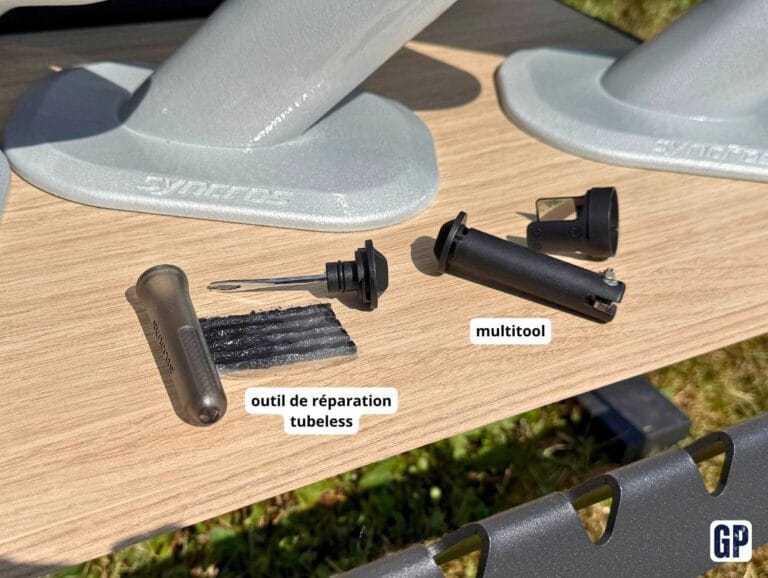
The cockpit also integrates Syncros tools that insert as bar-end plugs: on one side a mini multi-tool (two tools) including a Torx T25, on the other a tubeless repair kit with plugs. The T25 key lets you adjust all the Scott elements on the bike: cockpit, saddle, mounts, bottle cages. For the derailleur or third-party components you will need a more complete multi-tool, but the overall idea is sound.
💡 Good to know:
On this bike, Scott keeps its fork steerer at 27.2 mm – 1 1/14″ (instead of the usual 1 1/8″), a proprietary diameter already used on the Addict RC.
In practice, this strongly limits the options for replacement: if you want to change the stem or the cockpit, you will almost certainly have to stay with Syncros, because very few brands today offer components compatible with this standard.
Syncros & a bike designed as an ecosystem
This Scott Addict Gravel is not just a frame with compatible accessories. You can sense genuine collaboration with Syncros to create a system.
The D-shape seatpost (identical to that of the Scott Addict and Scott Addict RC) is compatible with the Syncros magnetic rear light. The frame gets a very discreet anti-drop chain guide (designed specifically for this bike) fixed by two screws at the back of the seat tube.
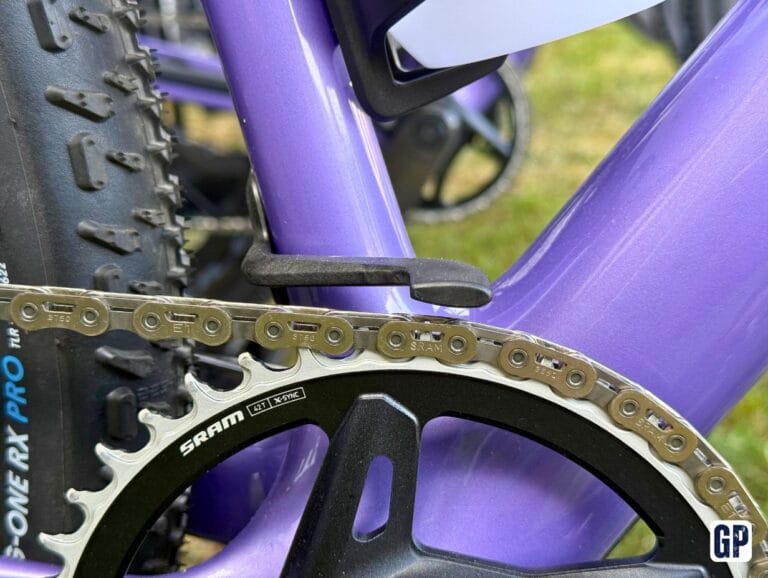
Since the Addict Gravel is exclusively designed as a 1x, Scott has not kept the two mounts usually dedicated to a front derailleur. These have been moved behind the seat tube to accommodate the anti-drop guide: it is clever because it allows you to keep a clean, pared-back profile.
The flip side is that this mount is proprietary: if you change chainring and want to keep an anti-drop guide, you will have to go via a compatible part offered by Scott.
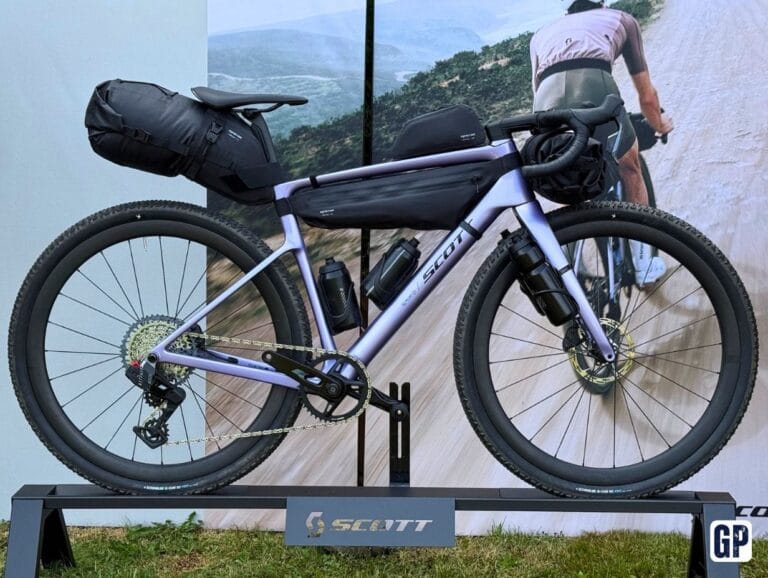
The frame gets inserts on the top tube, under the top tube, on the down tube, as well as inside the fork legs.
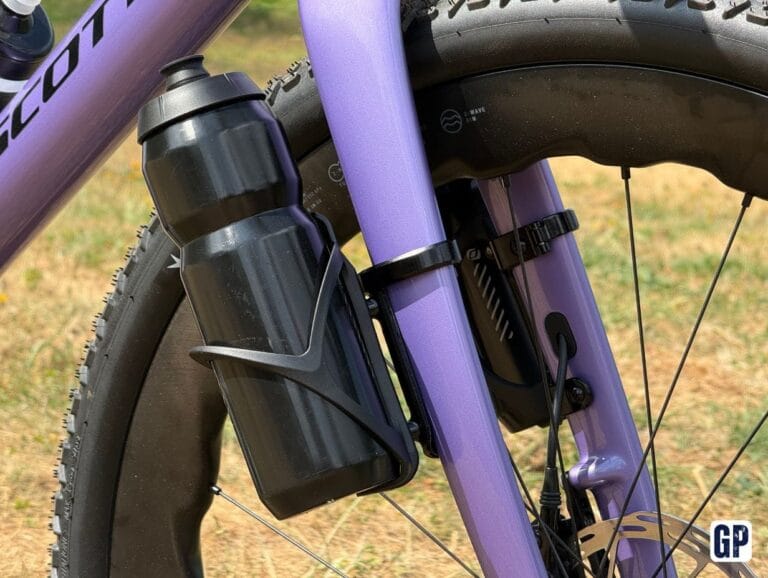
The fork mounts are Syncros-specific and limited to 2 kg. Their design, too, has been thought through: the bottles are moved slightly backwards and closer to the steering axis, which reduces the pendulum effect that turns the handlebar when the fork is loaded.
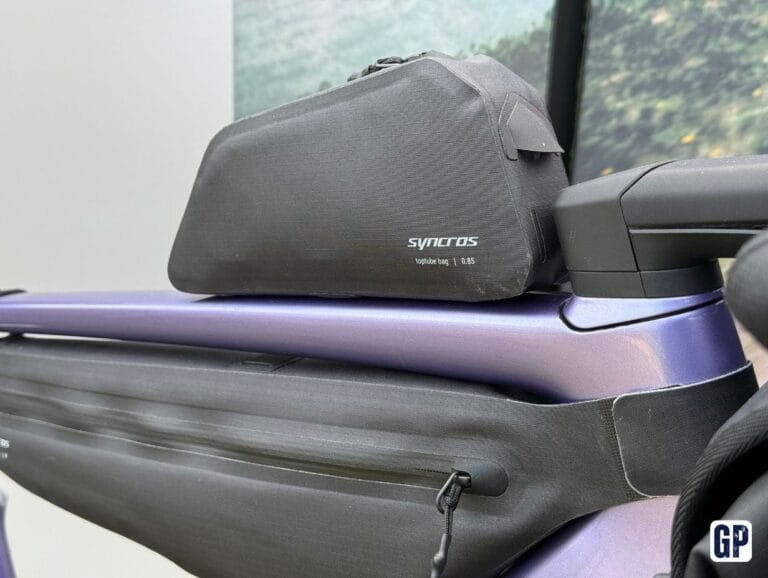
On my XS bike, however, the frame bag interfered with access to the bottle. Nothing insurmountable, but with a small size I would go straight for a side-entry bottle cage.
Lots of comfort, lots of grip
Scott claims a 30% increase in front-end compliance, thanks to the curved fork, the slimmer steerer and the new cockpit. At the rear, the brand also talks about major work on the seat tube, the dropped seatstays and the top tube, with a noticeable improvement in comfort over the previous generation.
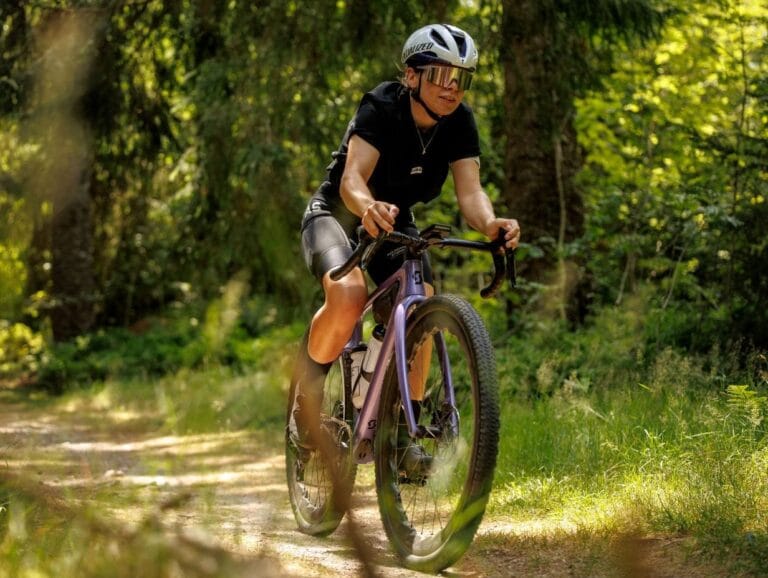
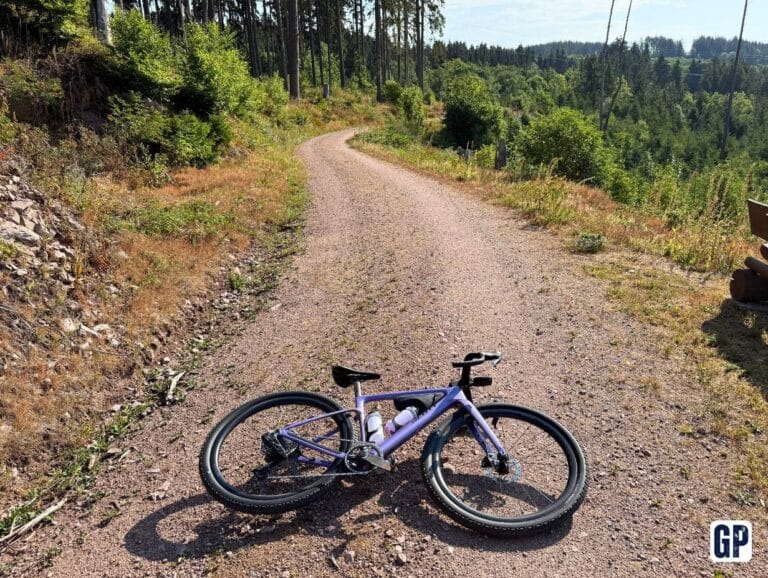
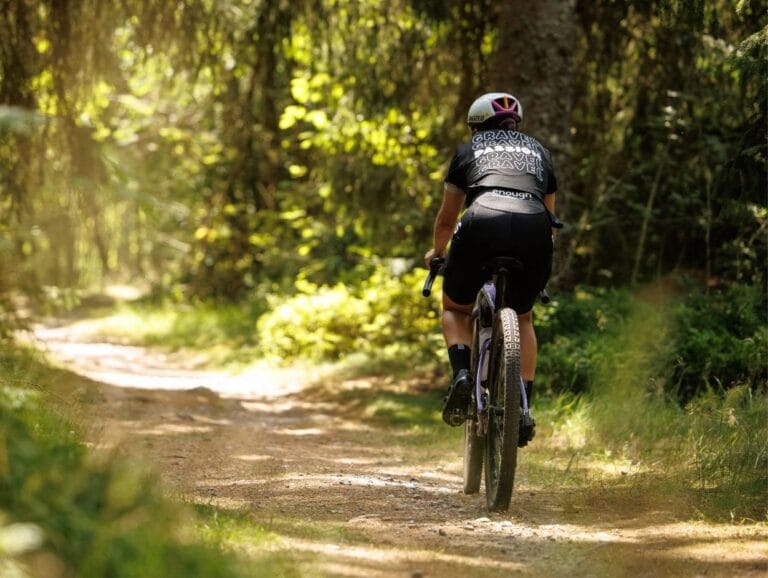
Out on the trail, the feel clearly matches this. The bike filters a lot. The large tyres obviously contribute, but the frame and cockpit add that impression of “calm”. On gravel descents, you can push hard without feeling the bike skitter about all over the place.
I really enjoyed riding this bike. It makes you want to pick lines, charge through the rough, take jumps, let it carry you. It doesn’t have the harsh, demanding side of some very performance-oriented gravel bikes. It inspires confidence.
And that confidence changes the way you ride. When you know the brakes fall right under your fingers, the handlebar soaks things up, the front stays planted and the tyres have margin, you relax more and you take (a lot of) pleasure in roaming the tracks.
The price of comfort: less snap
This comfort has a flip side. The Addict Gravel isn’t the most reactive bike I have ridden. Out of the saddle, on a steep climb or when really trying to accelerate, you feel some of your effort getting absorbed.
This isn’t a hidden flaw. It’s more a deliberate consequence of the project. Scott has intentionally reduced overall stiffness slightly to improve grip, comfort and predictability. In that logic, the bike works very well. But if your priority is kick, racing or outright efficiency, you may need to look elsewhere (or wait for a possible Addict Gravel RC version).
There are also options to make it more reactive: fit stiffer wheels, or the cockpit and seatpost from the Addict RC… The Scott ecosystem allows this in part. But in its current configuration, the message is clear: this bike prefers to build confidence rather than smash watts at every acceleration.
HMX, HMF and full range
The frame comes in two different carbon grades. The HMX version (tested here) is claimed at 794 g, which is 75 g less than the previous generation. The HMF version weighs 990 g, with 25 g saved. In both cases, Scott stays true to its obsession with weight, even on a bike designed for comfort and versatility.
The range comprises five models. The Premium is claimed at 7.8 kg. The Addict Gravel 10, the one in this test, at 8.2 kg. The Gravel 20 at 8.6 kg, the Gravel 30 at 8.7 kg and the Gravel 40, with mechanical Shimano GRX, at 9.4 kg. These weights are given set up tubeless and without the Save the Day Kit.
SRAM AXS across almost the whole range
From the Premium down to the Addict Gravel 30, Scott follows a very modern logic with 13-speed electronic SRAM AXS drivetrains, specified depending on the model as Red, Force or Rival. The Addict Gravel 10 tested here therefore gets Force, while the Premium moves to Red.
You have to go down to the Gravel 40 to switch to mechanical Shimano GRX with 12 speeds. Even on this most accessible version, Scott still fits hydraulic disc brakes. It is a welcome choice on a gravel bike, where braking power and modulation remain important: the brand has not tried to drag the price down by switching to mechanical callipers.
The cockpit also marks a real difference across the range. The carbon combo Syncros IC R501 CF II appears from the Addict Gravel 10. The Gravel 20, 30 and 40 keep a more classic solution with a separate aluminium stem and handlebar, less spectacular but also simpler to set up or replace.
A range from €2,699 to €8,999
The range starts at €2,699 with the Addict Gravel 40, equipped with mechanical Shimano GRX, and goes up to €8,999 for the Addict Gravel Premium. In between, Scott offers the Gravel 30 at €3,999, the Gravel 20 at €5,499 and the Gravel 10 tested here at €6,499.
The biggest jump is between the Gravel 30 and 20, with €1,500 difference. It is not explained by the drivetrain alone: the wheels also step up significantly on the Addict Gravel 20 (Fulcrum Soniq GR Carbon), which inevitably weighs on the price.
Conversely, the Gravel 40 gives access to the new frame for under €2,700, with a simpler and heavier build (8.7 kg set up tubeless – without the Save the Day Kit).
The range is therefore particularly broad: from a relatively accessible carbon gravel bike to a very high-end build at almost €9,000.
Who is the Scott Addict Gravel 2027 for?
This new Scott Addict Gravel is aimed above all at riders who want a modern, good-looking, highly integrated gravel bike, able to ride long and have fun when the terrain gets more technical.
It will be less obvious for riders looking for a lively, racy gravel bike, with an immediate response to every acceleration. That is not its temperament, and that is what makes it interesting.
Scott has not just enlarged the Addict’s tyre clearance. The brand has built a bike where the design, tools, cockpit, bags, geometry and compliance all point in the same direction. There is real consistency of use.
What I take away most of all is a bike that is very pleasant to ride, very reassuring, with a remarkable cockpit and a finish that makes you want to linger over the details. In short, a gravel bike for taking a lot of pleasure.