
We often talk about brands. Rarely about suppliers.
In the cycling industry, debates revolve around geometries, standards, drivetrains, and marketing promises around vertical compliance or lateral stiffness. But there is one player whose name almost never appears on the tubes, and yet underpins much of modern performance: Toray.
Behind the majority of high-end carbon frames lies the same industrial origin. And that raises questions. How did a Japanese company, born far from bikes, become an almost unavoidable link in this industry? And above all: is it a monopoly, or a subtler kind of dominance?
To understand Toray, you have to look beyond bikes.
🚀 In brief:
Founded in 1926, Toray entered carbon fiber in the late 1960s with a long-term investment strategy.
The company strengthened its position by integrating the entire chain, including PAN precursor production, to control quality, consistency, and costs.
The cycling industry’s dependence is structural and asymmetric: bikes account for little of Toray’s business, and supply tensions have reinforced the priority given to other sectors.
The initial problem: producing a strategic fiber at scale
Carbon fiber was not born for sport. It stems from industrial and military logic. In the 1960s and 1970s, the priority was not to make a frame lighter, but to produce materials that are strong, stable, and usable in aerospace and defense.

The challenge is less scientific than industrial: producing a fiber that is strong enough, with consistent quality, and above all at viable volumes.
Toray, founded in 1926 as a textile company, entered carbon fiber in the late 1960s. It was not a marketing move. It was a heavy, risky, capital-intensive industrial bet. Carbon fiber was then a narrow, uncertain market, dominated by U.S. military applications.
Toray’s strategic insight was not tied to sport. It rested on a broader conviction: composite materials would become foundational to the industry of the future.
And to achieve that, you have to invest early, massively, and for the long term.
The founding insight: control the entire chain
What sets Toray apart is not only its ability to produce carbon fiber. It is the company’s determination to control the entire process.
Carbon fiber comes from a chemical precursor, most often PAN (polyacrylonitrile). Many players produce fiber from precursors bought elsewhere. Toray, by contrast, progressively integrated precursor production.
This choice changes everything.

By mastering the upstream, the company controls quality, consistency, and costs. It can tailor mechanical characteristics to its clients’ needs. It becomes not just a supplier, but a technical partner.
In aerospace, this strategy is decisive. Boeing, Airbus, and other manufacturers seek suppliers capable of delivering massive volumes with absolute reliability. Toray gradually established itself as a key player.
Cycling was then only a peripheral market. But it would benefit from that industrial credibility.
How Toray established itself in cycling
Carbon bikes took off in the 1990s and 2000s. The first generations of frames were sometimes fragile, often experimental. Brands sought fibers that were not only high-performing, but also reassuring.
Toray had two assets:
- First, a reputation forged in aerospace.
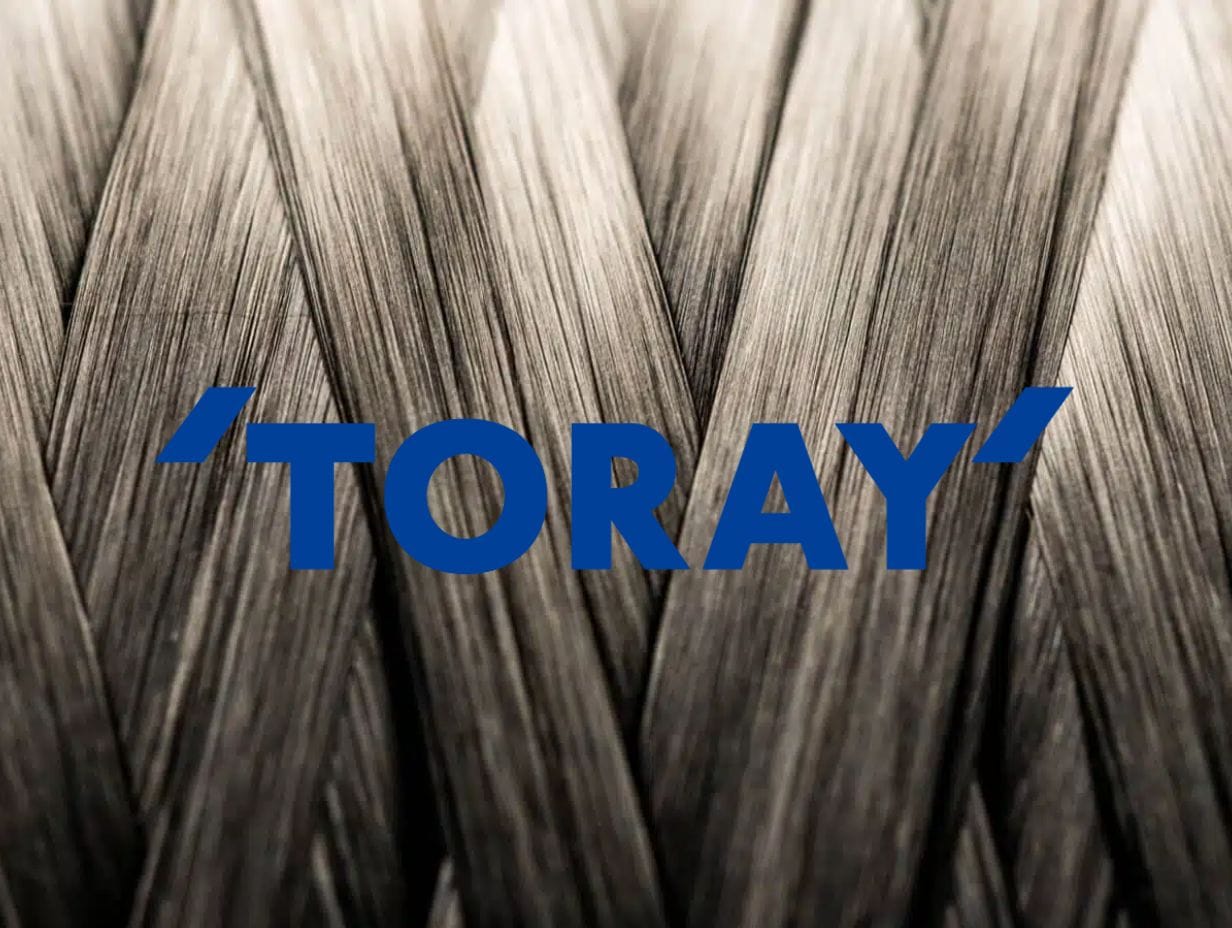
- Second, the ability to offer different fiber ranges: T700, T800, T1000… Each grade represents a trade-off between strength, stiffness, and weight.

Bike brands could then build their narrative around these grades. Marketing seized on it. The Toray name became almost an implicit quality label.
Gradually, a standard took hold.
A high-end frame “with Toray T800 or T1000” became a selling point.
Toray is not the one communicating directly to cyclists. Brands leverage its credibility to bolster their own.
It is a shrewd position: Toray does not depend on cycling, but cycling depends largely on Toray.
Dominance or monopoly?
Calling it a monopoly would be excessive. Other carbon fiber producers exist: Mitsubishi Chemical (Pyrofil), Teijin (Tenax), Hexcel, SGL Carbon…
But in the cycling industry, Toray occupies a place disproportionate to its competitors.
Why?
First, because the bicycle sector is conservative. Brands work with the same suppliers for years. Switching fiber means recalibrating layups, retesting, revalidating molds and industrial processes.

Second, because the Asian factories (notably in Taiwan and China) where most frames are produced have historically built their relationships around Toray.
The result is not a legal monopoly.
It is a structural lock-in.
The dependence is not imposed. It became natural.
A business model built on diversification
What makes Toray particularly powerful is that cycling represents a marginal share of its revenue.
The company is active in:
- aerospace,
- automotive,
- energy,
- fine chemicals,
- technical textiles,
- industrial membranes.

Group revenue is measured in the tens of billions of euros.
That changes the perspective.
If the bike market slows, Toray does not wobble.
If a brand disappears, the impact is negligible.
The power relationship is asymmetric.
For a bicycle brand, changing fiber supplier is a strategic risk.
For Toray, losing a brand is anecdotal.
The moment of strain: the raw materials crisis
The pandemic and supply chain tensions exposed this dependence.
Lead times exploded. Fibers became harder to secure. Priorities shifted to strategic sectors such as aerospace or defense.
Cycling, despite its commercial boom, was not a priority.
Some brands then discovered how fragile their supply chain was. Diversifying suppliers became a topic, but remains complex.
The crisis did not weaken Toray. It rather underscored its central position.

Why Toray does not seek mainstream visibility
One might imagine Toray capitalizing on its technical reputation among cyclists. It does not.
The brand remains deliberately discreet.
Its model is B2B, built on long-term contracts and industrial reliability. Marketing visibility in sport would not change its core business.
This lack of communication almost adds to its aura: everyone knows the name, few really know what it stands for.
The limits of an ultra-standardized system
The dominance of a single player raises a broader question.
If most frames use fibers from the same supplier, where does real differentiation lie?
In:
- design,
- layup,
- quality control,
- in-house engineering,
- brands’ ability to work the material.

Fiber is only one ingredient. But it is a common one.
This puts some marketing claims about material exclusivity into perspective.
Toray continues to invest heavily in R&D. The company is working on stronger, lighter fibers, but also on composite recycling, a major challenge for the future.
The real challenge is not competitive. It is environmental.
Carbon fiber production is energy-intensive. End-of-life for composites remains problematic. If regulation shifts significantly, the model could be constrained.
For now, no player seems capable of upending the established balance.
What the Toray case reveals
Toray’s story in cycling tells more than a simple industrial success.
It shows how an entire industry can be structured around an invisible supplier. How strategic value does not always sit with the visible brand, but with mastery of the raw material.
Cycling loves to tell stories of champions, visionary engineers, disruptive start-ups.
Toray embodies the opposite: industrial patience, vertical integration, consistency.
It is not a monopoly in the strict sense.
It is a dominant position built on fifty years of quiet investment.
And as long as carbon remains the king material for the high end, this discretion will likely continue to shape the sector’s balance.
Reference sources
- Toray Industries – Corporate overview and composite materials activities: toray.com
- Toray Carbon Fibers Europe – Fiber ranges (T700, T800, T1000) and applications: toraycfe.com
- Toray Industries – Annual Report (2023-2024) – Key figures, business mix, advanced materials strategy: toray.com
- Boeing – Use of composites on the 787 Dreamliner (aerospace context): boeing.com
- Hexcel Corporation – Overview of composite materials and competitive positioning: hexcel.com
- Mitsubishi Chemical Group (Pyrofil) – Carbon fiber activities and direct competition: m-chemical.co.jp
- Teijin Carbon (Tenax) – Global carbon fiber production and served markets: teijincarbon.com
- SGL Carbon – Data on the global carbon fiber market: sglcarbon.com
- Grand View Research – Global carbon fiber market analysis (breakdown by sector): grandviewresearch.com
Photo credits: Toray