
For several years now, Cube has cropped up whenever the spec-to-price ratio is discussed. In comparisons, on-test, or in rider conversations, the takeaway is usually the same: at an equivalent level of frame and components, Cube bikes come in noticeably cheaper than many rivals.
All the more intriguing given that Cube doesn’t sell direct-to-consumer and sticks with a traditional dealer network.
Rather than treating this as an anomaly, it’s worth looking at Cube as an industrial case study. This positioning is neither new nor opportunistic: it rests on a set of coherent structural choices the brand has stuck with for years.
🚀 In brief:
Cube remains a privately held company founded in 1993, with a strategy focused on industrial costs and stability rather than short-term financial targets.
Production is set at the start of the year by model and build level and isn’t increased mid-season, which limits overstock but can lead to delays or out-of-stock situations.
Strong vertical integration (frames, C62/C68X carbon layups, Newmen components and finishing kit) to cut middleman margins and supplier costs.
A company built as a manufacturer before a brand
Cube was founded in 1993 in Bavaria and remains, to this day, a private company. This is fundamental to understanding its strategy.
Unlike groups driven by short-term financial targets or pure brand-valuation logic, Cube prioritises industrial capacity, cost control and stability.

This independence enables a pragmatic approach: invest heavily in manufacturing, streamline logistics flows, handle volume, and accept not meeting all immediate demand if doing so would jeopardise the overall balance.
Deliberately limited production to avoid overstock
A little-known aspect concerns volume management. At the start of the year, Cube sets the number of units to produce by model and by spec level. Once those volumes are reached, production isn’t artificially extended mid-season.
“For the consumer, this can translate into long lead times, or even the unavailability of certain high-demand models. But for the brand, the benefit is major: this strategy prevents the build-up of overstock, a structural problem in the bike industry.”
Overstock generates significant costs (storage, logistics, tied-up cash) and often leads to aggressive end-of-season clearances. These forced promotions erode not only margins, but also the perceived value of the products and subsequent ranges.
Cube prefers to sell its entire production at a coherent price rather than artificially inflating volumes and risking heavy discounting.
Deep vertical integration
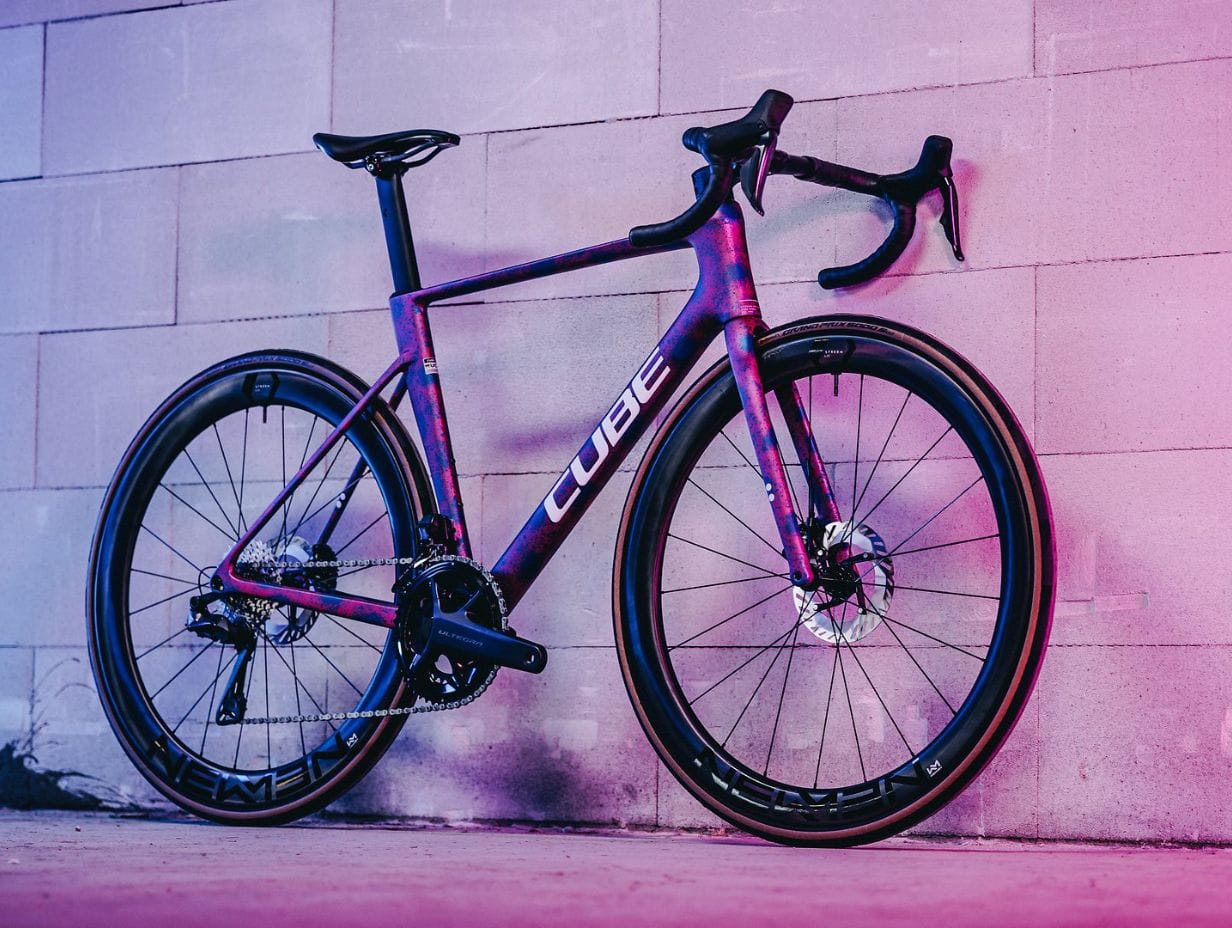
The other pillar of the Cube model is its degree of integration. The brand designs its frames in-house, develops its own carbon layups (C62, C68X), and brings a large share of components in-house: Newmen wheelsets, cockpits, seatposts, saddles and accessories.

This integration significantly cuts middleman margins and the costs tied to “premium” third-party suppliers. Where some brands assemble frames and stack components from multiple players, Cube controls a large part of the value chain. The result is straightforward: at like-for-like spec, the final cost is mechanically lower, without compromising performance or reliability.
Economies of scale rarely seen in the bike industry
With more than 1 million bikes produced each year, Cube benefits from economies of scale that few brands can claim. These volumes allow extremely favourable terms with suppliers of groupsets, carbon fibre and other strategic components. Where a smaller player will pay a price close to retail, Cube buys on industrial terms.
This helps explain why some Cube bikes are priced close to what the groupset alone would cost on other brands. It’s not a marketing sleight of hand, but a direct consequence of the critical mass the company has reached.
Deliberately understated communication
Cube has never chased a brand image built on prestige or storytelling. Its communication stays factual, sometimes even austere. This restraint, very German in spirit, long contributed to a perception of the brand as “less desirable” than some showier rivals.
But that sobriety also has a clear upside: fewer marketing costs to pass on to the retail price, and less pressure to keep prices artificially high to preserve a premium image. Cube invests more in its factory and processes than in staging the product.
What Cube teaches us about bike industry economics
Cube isn’t an undervalued brand by mistake, but by choice. By deliberately limiting production, avoiding overstock, integrating a large part of its value chain and controlling industrial costs, it manages to offer particularly competitive bikes, without DTC (Direct to Consumer) and without hidden compromise.
In an industry often dominated by marketing, Cube reminds us that the battle is won first on the factory floor, in logistics and through industrial coherence. It’s a less spectacular approach, but highly effective over the long term.
Reference sources
- Road.cc – Cube Lightning C68X SLX review & factory insights
- Singletrackworld – Factory tour Cube Bikes
- Digital2Go – Cube Bikes increases efficiency in warehouse management with MultiScan