
It had to happen. Five years after the launch of the Dura-Ace R9200, Shimano appears to be preparing the successor to its flagship road groupset.
This time, it is no longer just about patents or rumours. Several components of a new generation of Dura-Ace were spotted at the 2026 Vuelta, fitted to bikes of the Alpecin-Premier Tech team.
Cyclingnews photographed the kit near the team bus before the start of the first stage, while Escape Collective also confirms having seen this new generation. Both outlets agree on several major changes: 13 speeds, new levers, a new rear derailleur… yet still a semi-wireless architecture.
Shimano has, of course, not yet made anything official. So take this information for what it is: the sighting of a groupset that is very likely still in development.
But the photos already say a lot.
Shimano may finally move to 13 speeds
That is obviously the headline change.
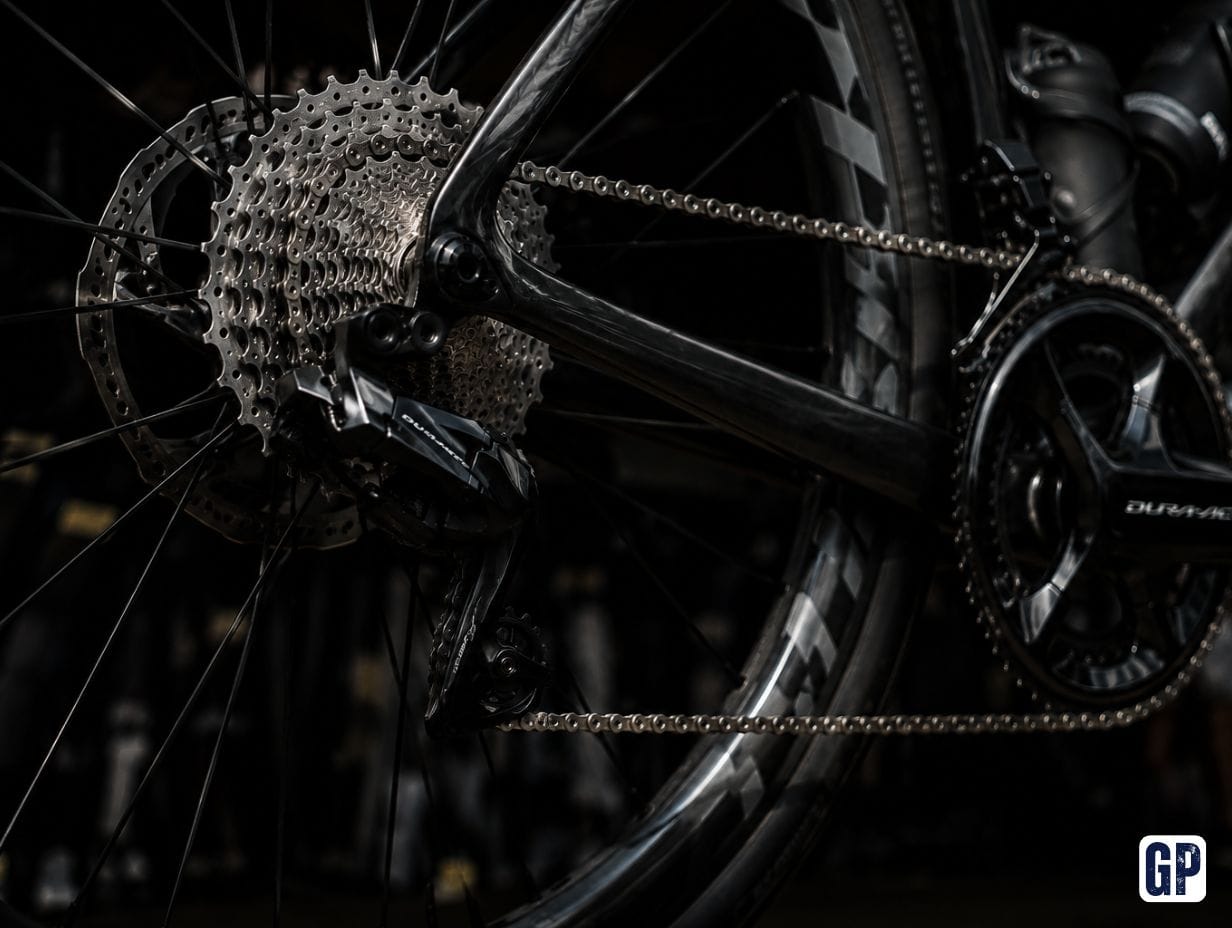
Counting the sprockets on the cassette fitted to the photographed bike, you indeed get 13 speeds.
The move had almost become inevitable. Campagnolo now offers 13 speeds on its Record and Super Record groupsets, SRAM already uses this architecture on its XPLR drivetrains, and Shimano had already crossed that threshold on some of its latest MTB drivetrains.
The current Dura-Ace R9200, launched in 2021, went from 11 to 12 speeds. Its successor would therefore add another sprocket five years later. At the same time, Campagnolo is back in the game with its Record 13, which makes Shimano's move even more anticipated.
The gearing spread remains to be seen.
The photos don't reveal the tooth count of the smallest sprocket. Shimano could stick with an 11-tooth start or drop to 10, like SRAM.
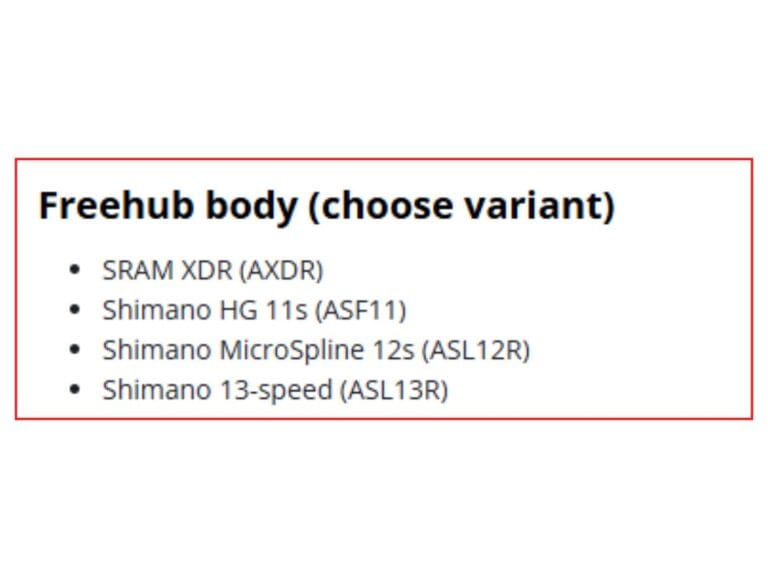
More interesting still: according to Cyclingnews and information circulating around this prototype, this 13-speed cassette could require a new freehub body standard, different from the classic Shimano HG.
If confirmed, adding one gear would not be entirely straightforward for riders looking to upgrade an existing bike.
And that is probably one of the most interesting points to watch at the official presentation.
Still double chainrings, but 1x seems to be in the plans
Another important piece of information: the front derailleur has not disappeared.
The bikes spotted at the Vuelta still have a double chainring drivetrain. The future Dura-Ace would therefore remain a groupset capable of running 2x.
But the photographed crankset is intriguing.
The fitted chainrings look different from the traditional Dura-Ace rings that blend seamlessly into the crankset. Covers can be seen at the fixing bolts, which could simply be explained by the use of development components.
It could also indicate Shimano's intention to offer a more modular architecture.
And inevitably, it is hard not to think of 1x on the road.
Cyclingnews precisely raises the hypothesis of better compatibility with 1x configurations. That would be fairly logical in view of the market's current evolution: 1x is steadily gaining ground on the road, notably in racing and on very aerodynamically focused bikes.
We are still a long way from being able to announce a Dura-Ace specifically designed for 1x. But Shimano at the very least seems to be leaving itself more doors open.
No fully wireless Dura-Ace
That is probably the biggest surprise in these first images.
One could imagine Shimano using this new generation to ditch electric cables altogether. That would apparently not be the case.
The Dura-Ace R9300 would retain an architecture close to the current R9200: the levers communicate wirelessly with the system, but the front and rear derailleurs remain connected to a central battery installed in the frame.
A cable is clearly visible near the rear derailleur on the bikes observed. Escape Collective arrives at the same conclusion and points out that the small size of the photographed derailleur leaves little room to integrate a battery directly into it.
It is almost paradoxical.
Shimano has recently adopted a fully wireless architecture on its XTR Di2 MTB groupset, and the latest evolutions of its GRX drivetrains have also shown that the brand has mastered this technology. The Shimano GRX Di2 12V precisely illustrates this shift towards more open architectures on the gravel side.
For its highest-end road groupset, however, Shimano seems to prefer keeping a single large central battery.
A choice that is probably less seductive on a spec sheet, but which also has some arguments: long battery life, compact derailleurs and no individual batteries to recharge.
For the mechanic who has to route Di2 cables through a fully integrated frame, the revolution will have to wait a little longer.
Completely redesigned derailleurs
The rear derailleur seems to be changing significantly.
It appears particularly compact and adopts a new mount.
Cyclingnews mentions a system that in principle recalls SRAM's UDH, even if Shimano is obviously using its own architecture. Some reports even mention the presence of an anti-rotation device.
For now, it is impossible to determine whether this evolution will require new frames or whether Shimano is planning different mounting solutions.
Escape Collective also raises this question of compatibility with existing frames.
And between a possible new freehub body and a new derailleur mount, this is probably where one of the big question marks of this future groupset is hiding.
The move from 12 to 13 speeds will be interesting. But if adopting the R9300 also requires a new freehub and a compatible frame, migrating from a bike equipped with R9200 could quickly become far less straightforward.
The levers gain a proper under-thumb button
The changes are not limited to the number of sprockets.
The new levers show several small shape tweaks, but above all an additional button located on the inside of the hood.
Unlike the secondary Di2 buttons sometimes hidden under the rubber of current hoods, this one protrudes clearly and seems designed to be actuated directly with the thumb.
A small LED even seems to have been integrated nearby.
The concept obviously recalls the new SRAM Red AXS controls. And that is probably a good thing.
Having more functions on the controls is particularly useful with modern GPS head units: page changes, head unit control, managing certain electronic functions…
The extra button could also allow Shimano to evolve the shift logic. For now, it is of course impossible to know its exact function.
Shimano looks set to stick with aluminium for its crankset
Another telling detail: the crankset still appears to be made from aluminium.
While SRAM and Campagnolo make extensive use of carbon on their top-tier road groupsets, Shimano continues to champion its metal crank technology.
The overall silhouette also remains fairly close to the current Dura-Ace, even though the power meter looks to have been redesigned.
After the issues that led to the gigantic recall of certain older bonded Shimano cranksets, this choice may inevitably raise eyebrows.
But aluminium remains almost a technical signature of the Dura-Ace crankset. And unlike many of the new features visible elsewhere on the groupset, Shimano does not seem to have felt the need to start from scratch.
An official reveal is getting closer
Several clues had already suggested that something was brewing at Shimano.
Prototypes of new Dura-Ace pedals had notably been spotted at Paris-Roubaix in the spring. Then, at the end of July, Shimano officially unveiled its new generation of Dura-Ace wheels WH-R9370, notably with a new C99 front wheel and a rear disc wheel.
The R9370 name obviously did not go unnoticed while the current groupset carries the reference R9200. We had already detailed this new platform in our piece dedicated to the Shimano Dura-Ace WH-R9370 wheels.
We now have levers, a crankset, derailleurs and, above all, a 13-speed cassette photographed in competition.
The puzzle is really starting to take shape.
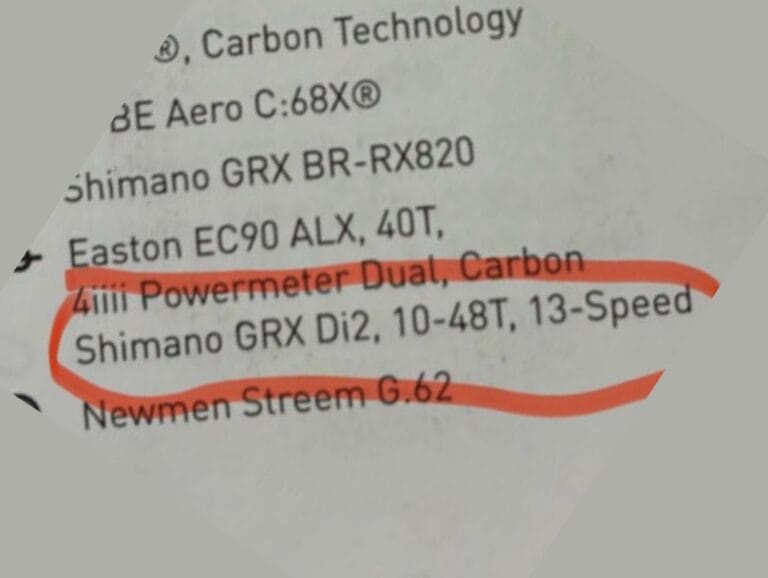
That does not, however, mean that a commercial launch is imminent. On our side, we're leaning towards early 2027 for new products, as suggested by this forthcoming gravel bike slated for a January reveal that already carries a GRX 13-speed mention.
These components can therefore still evolve before they arrive on the market.
Our take
This first glimpse of the Dura-Ace R9300 is ultimately quite representative of Shimano's philosophy.
No spectacular revolution. No big battery stuck on the derailleur simply to be able to write full wireless on the box.
Instead, Shimano seems to be progressively improving an architecture that already works very well.
The move to 13 speeds was almost expected. The additional button on the hoods even looks more interesting day to day.
But the two real topics lie elsewhere.
First, compatibility. A new freehub body and possibly a new derailleur interface could make this generation much less easily backwards-compatible than one might hope.
Then, 1x.
Shimano is clearly keeping the double, but between this 13-speed cassette, a crankset that looks more modular and the general evolution of the market, it's hard not to see a much more 1x-friendly Dura-Ace taking shape.
At this stage, only one certainty: the next Dura-Ace really does exist and it is already rolling in the pro peloton.
And now that it has come out of the Shimano truck, hiding it for very long is going to be tricky.