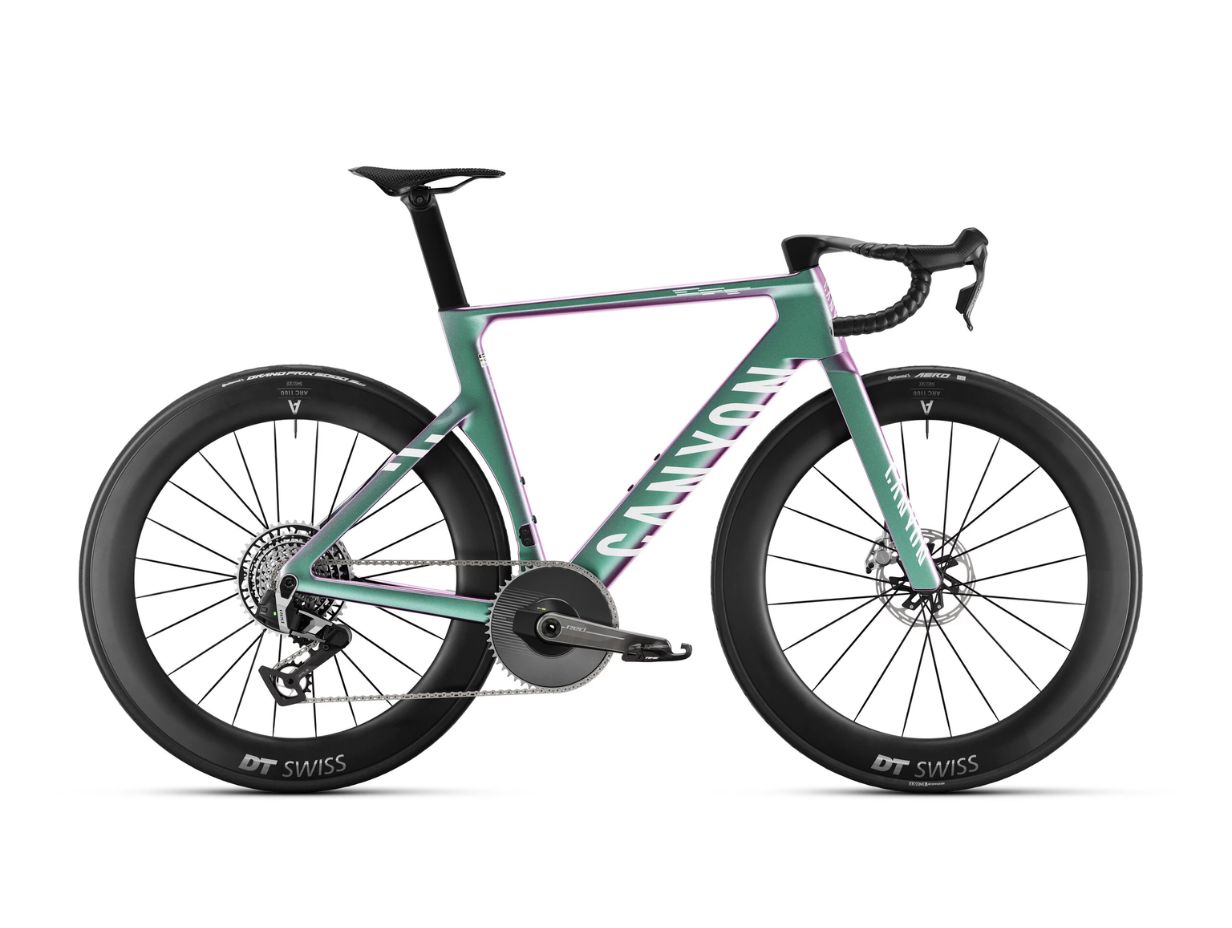
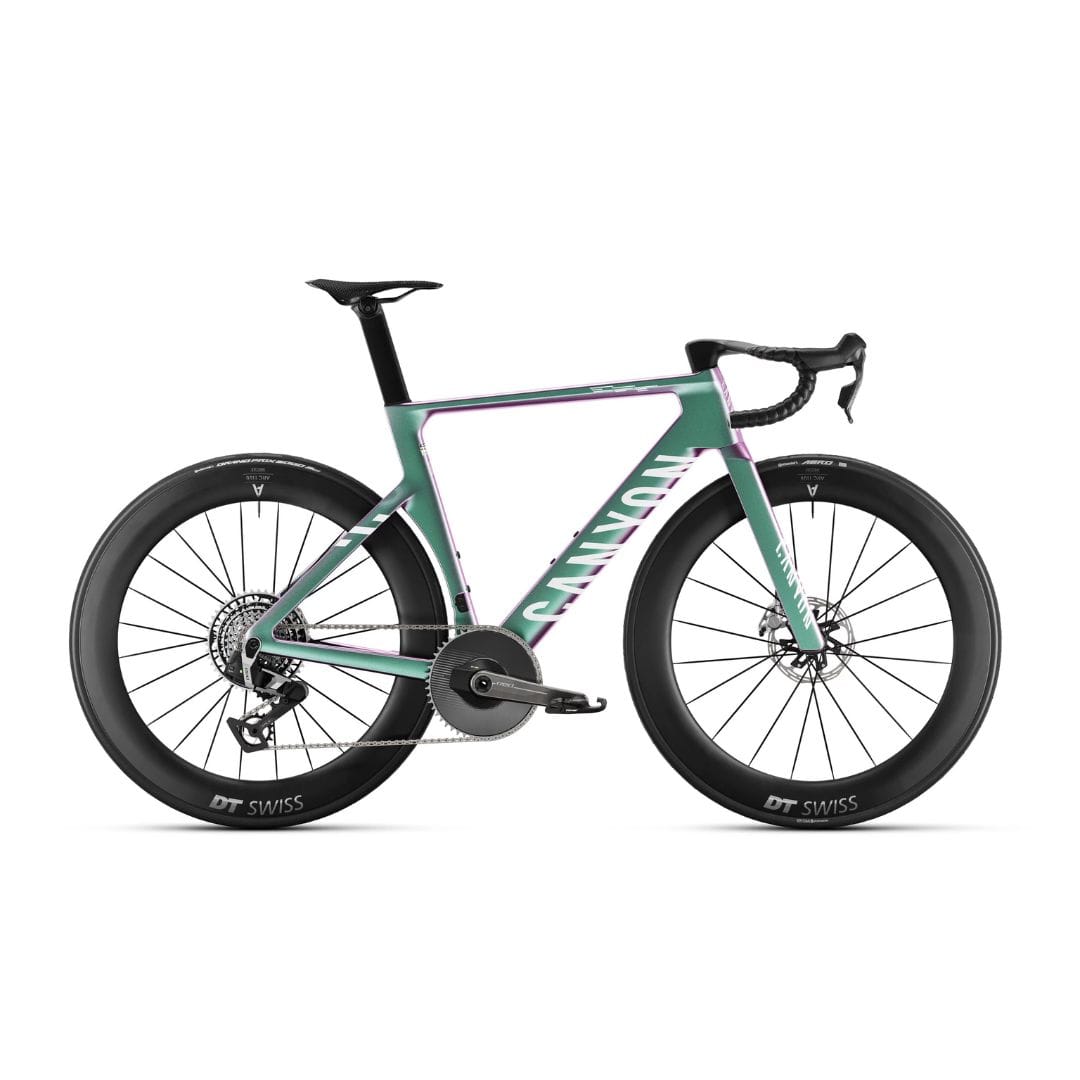
Canyon isn’t starting from scratch with this new Aeroad CFR. The frame remains very close to the generation launched in 2024, already well established in the pro peloton.
The real change is elsewhere: in the cockpit, personalisation options and drivetrain compatibility. This is a targeted update, not a platform revolution.
🚀 At a glance:
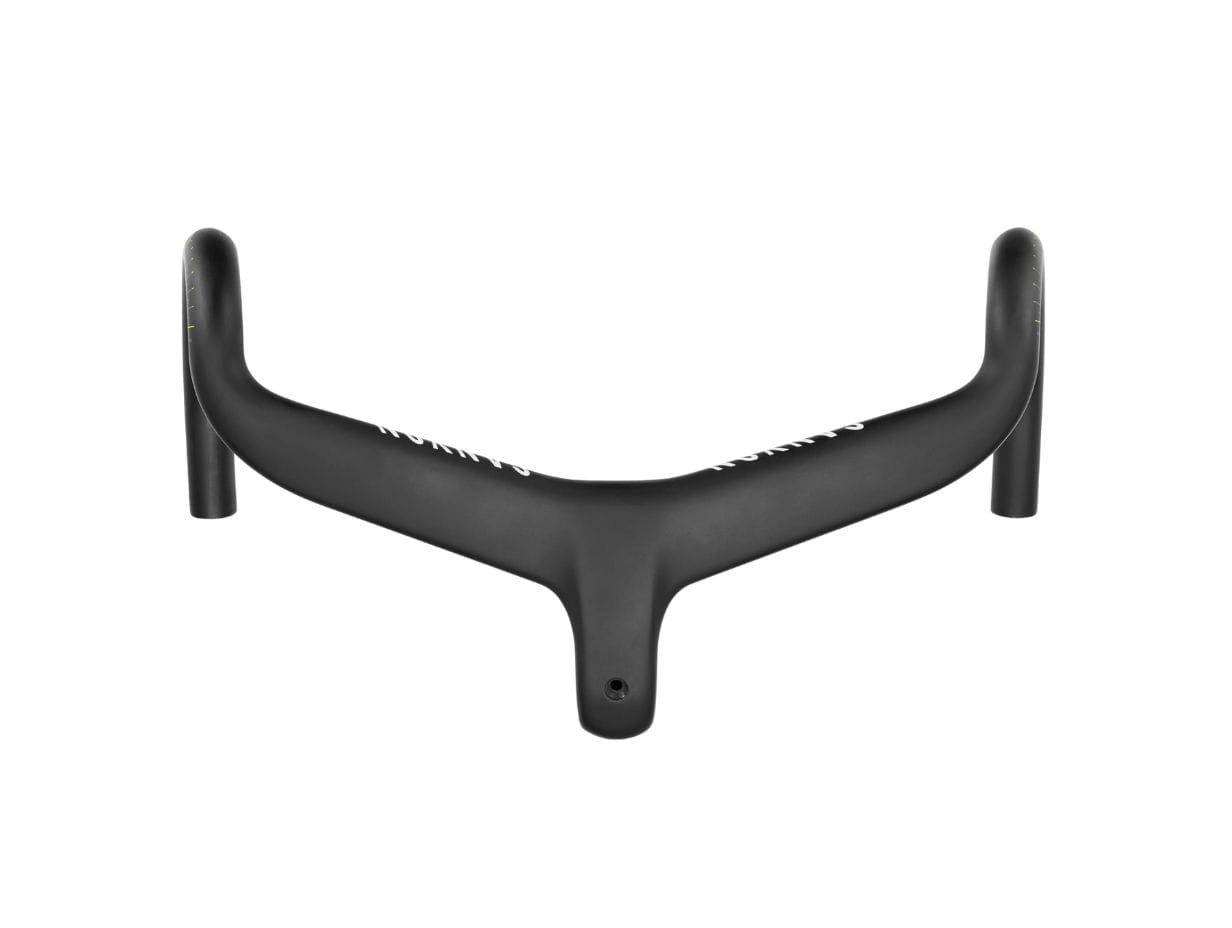
The Canyon Aeroad CFR 2026’s main change is the new CP0053 RACE Bar cockpit.
Canyon reports 198 watts of drag under TOUR Magazine’s independent protocol, on a very specific LTD configuration.
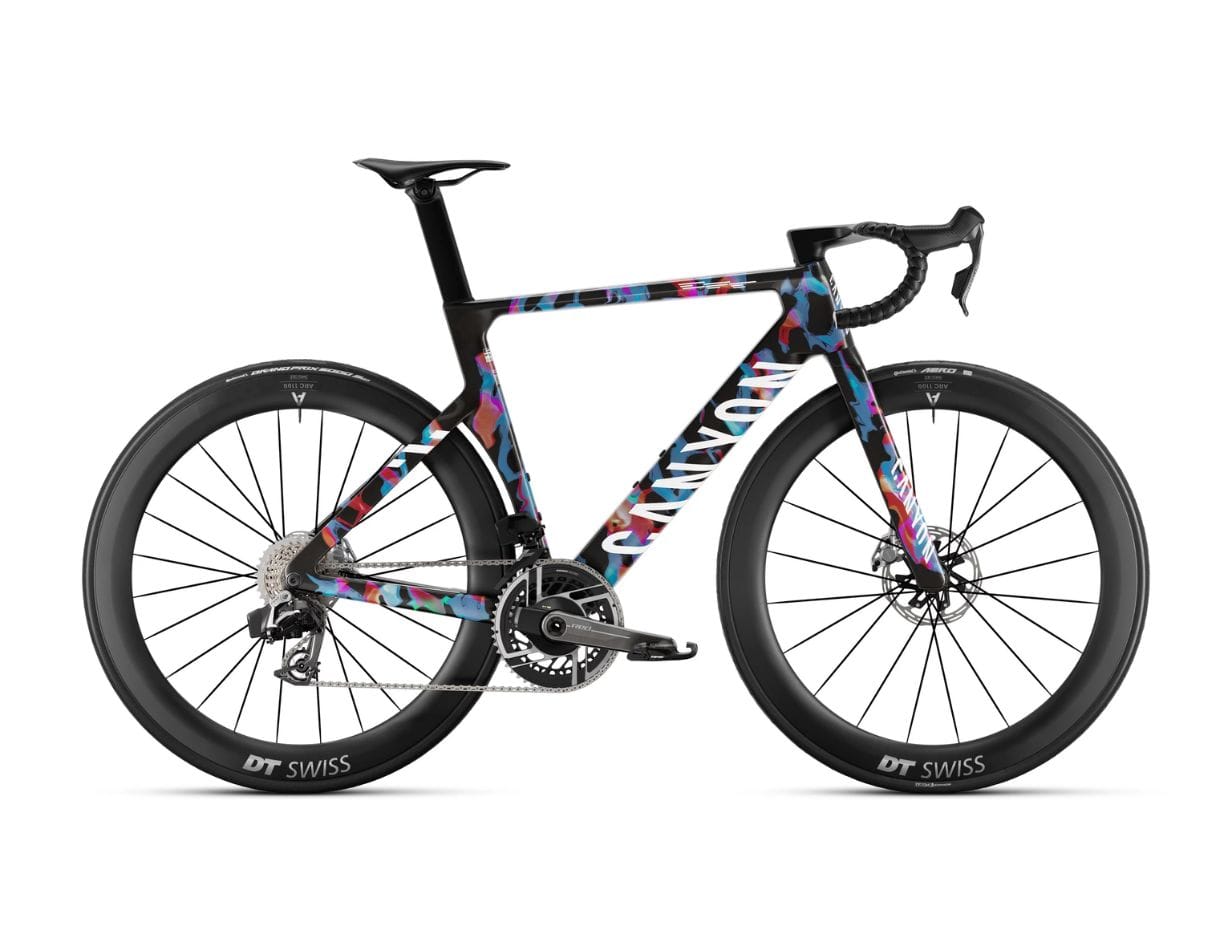
The frame adds UDH compatibility and more options via MyCanyon.
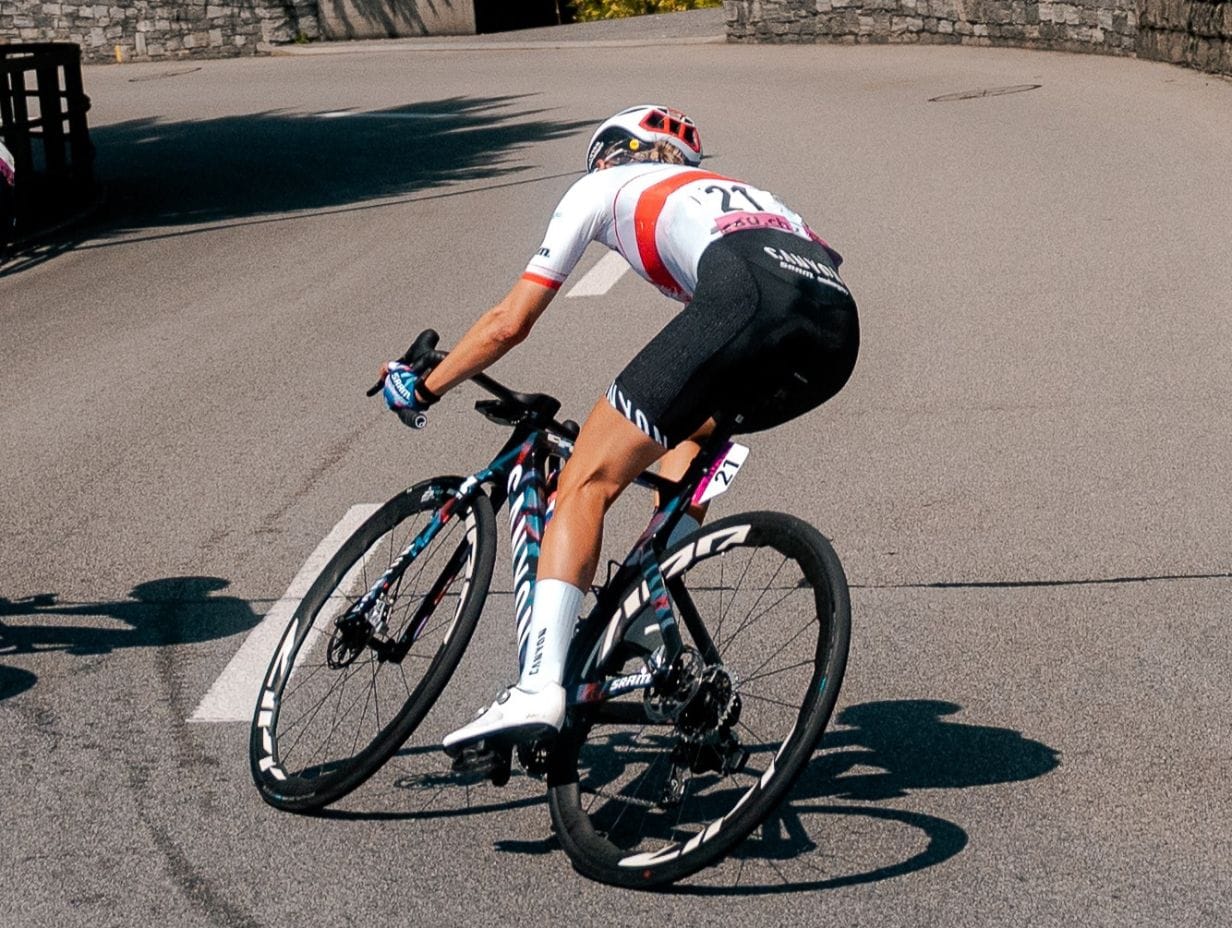
This is a logical move. The Aeroad had little left to prove: it’s already racing at the highest level with Alpecin-Premier Tech, CANYON//SRAM or Movistar, and remains one of the most visible aero bikes in the WorldTour.
Canyon is aiming less to reinvent its race bike than to refine what can still be improved: rider position, front-end stiffness, overall aero and compatibility with coming standards.
The CP0053 RACE Bar mainly changes rider position
The headline new feature on this Aeroad CFR 2026 is the CP0053 RACE Bar cockpit. Compared with the CP0048 PACE Bar, Canyon claims 120 g less, higher torsional stiffness, and 2 watts gained in the wind tunnel on the bare bike.
Taken in isolation, 2 watts won’t transform a bike. But the point here isn’t just hardware drag. The CP0053 adopts a one-piece V shape, with 14° of flare in the drops, 10 mm more effective reach and 20 mm less effective stack.
In other words: it pushes you toward a lower, more compact, more race-oriented position. Canyon mentions up to 25 watts saved in real-world conditions, mainly thanks to reducing the rider’s frontal area. Read that for what it is: potential linked to position, not an automatic promise for every rider.
That nuance matters. A more aggressive cockpit can make you faster if you can actually hold the position. Conversely, if it puts too much strain on the neck, lower back or shoulder girdle, the benefit can quickly vanish on a long ride.
198 watts in the wind tunnel: an impressive number, but tightly defined
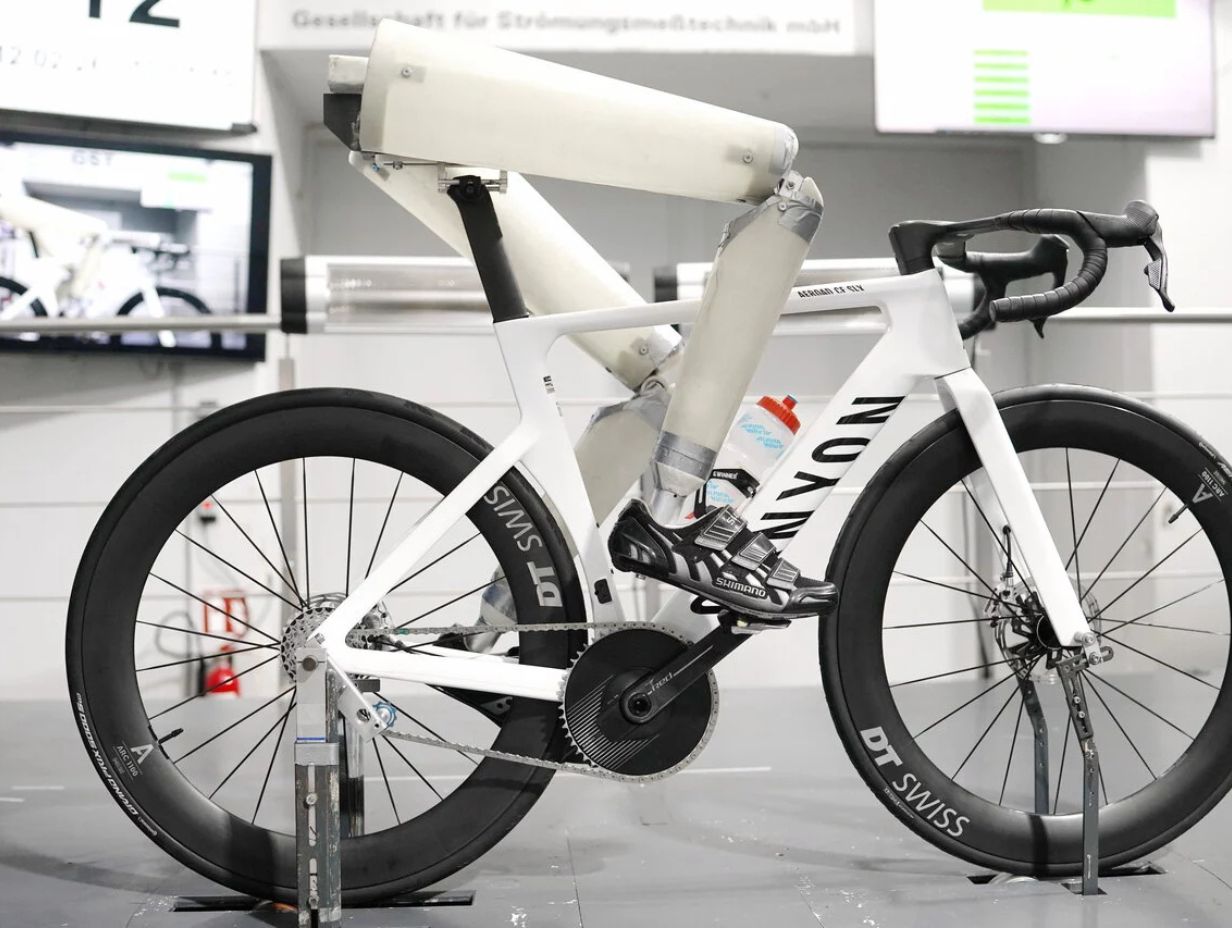
Canyon highlights a result of 198 watts of drag under TOUR Magazine’s independent protocol, carried out at the GST Wind Tunnel in Immenstaad, Germany.
The test is run at 45 km/h, with a moving-leg dummy, laser alignment and a yaw range from -20° to +20° to simulate different wind angles. The configuration used notably included a SRAM Red AXS 1×13 drivetrain, DT Swiss ARC 1100 Dicut 65 mm wheels, Continental Aero 111 tyres in 26 mm and GP 5000 in 28 mm, the CP0053 RACE Bar cockpit and the SP0105 seatpost.
It’s a very solid figure for a pure road race bike. But it shouldn’t be treated as an absolute truth outside the protocol. Aero performance depends hugely on position, wheels, tyres, frame size, wind and the rider.
This result mainly confirms one thing: Canyon is positioning its Aeroad CFR LTD in an extreme aero approach.
UDH: a discreet detail, but important for what comes next
Another useful change: the frame becomes UDH-compatible, for Universal Derailleur Hanger. In practice, Canyon adopts a standardised interface at the derailleur hanger.
A UDH hanger is easier to replace, more aligned with the evolution of modern drivetrains, and makes the frame more durable with upcoming groupsets.
More importantly, it will make life easier for professional teams riding Canyon bikes, who will then be able to very easily set up 1x builds with an XPLR derailleur.
MyCanyon: more personalisation, less a fixed spec
Canyon is also expanding options via MyCanyon. On the Aeroad CFR and the CF SLX, it becomes possible to fine-tune the build: seatposts, wheels, crank lengths, stem lengths, drops or cassettes depending on the version.
For seatposts, three options are listed: SP105 Aero with 10 mm setback and 146 g, SP106 Aero Zero Setback with 0 mm setback and 137 g, or SP0093 VCLS Aero Comfort with cutout, 10 mm setback and 160 g.
On wheels, Canyon adds Scope Artech options. The Artech 6, with 65 mm rims and Pirelli P-Zero SLR TLR tyres, are clearly aero-focused. The Artech 4, with 45 mm rims and Continental GP5000 TT tyres, look more versatile, with an announced weight of 1120 g for the pair.
Drops to choose between speed, control and ergonomics
Canyon also offers several drop options. The Classic drops remain the baseline. The Race drops take over from the former Aero drops, with slightly reduced flare and increased drop to boost control in sprints or fast descents.
The Compact drops reduce effective reach by 10 mm compared with the Classic drops, with a more ergonomic approach.






Reviews
There are no reviews yet.