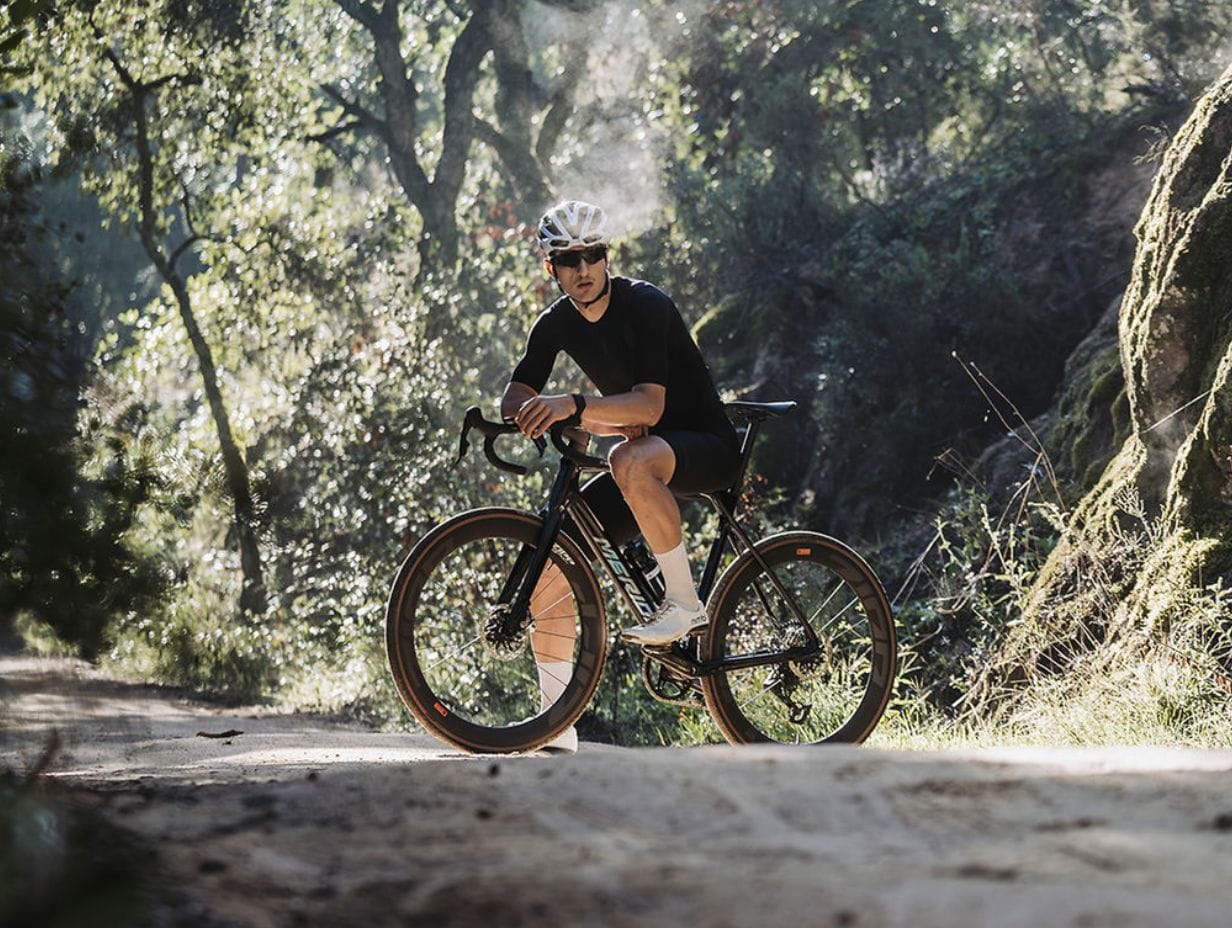
Gravel racing keeps evolving. With the new Merida Mission, the Taiwanese brand delivers a bike built for speed and UCI events, drawing directly on its road and cyclocross know-how. After the Silex, which is geared towards adventure and bikepacking, and the Scultura Endurance GR, designed for versatility, Merida now unveils a model focused on pure gravel performance.
🚀 In brief:
The Merida Mission is designed for speed and UCI events, with a CF4 frame weighing 1,100 g.
It accepts tyres up to 40 mm for a balance of grip and efficiency.
Five versions are available, with prices from €2,199 to €8,599.
A gravel bike born for racing
Inheriting the name of Merida’s first foray into the hybrid space between road and gravel, the Mission picks up the torch from the Mission CX, while pushing the limits of off-road speed.
This new frameset clearly targets riders in the UCI Gravel World Series, performance-focused cyclists, and those who want the snap of a road bike without giving up the freedom of gravel.
The legacy of the Scultura Endurance and the Silex
The Mission’s design draws directly from the Scultura Endurance, an endurance road model, while integrating off-road capability inherited from the Silex. The result: a balanced frame, lower and more aggressive, engineered for responsiveness and high-speed stability.
Merida says it wanted to fill the gap between the Scultura Endurance (more road) and the Silex (more off-road), to offer a competition-focused gravel bike that keeps road DNA while handling varied terrain.
Geometry that balances speed and stability
The Merida Mission’s geometry was developed around one principle: “in the bike, not on it”. The lowered bottom bracket and lower centre of gravity improve stability, while the 72° head angle and a 391 mm reach deliver precise, lively handling on tarmac and gravel.
Compared with the Scultura Endurance (stack: 584 mm) or the Silex (607 mm), the Mission drops its front end further to 569 mm, underscoring its decidedly sporty intent.
40 mm tyre clearance - the sweet spot?
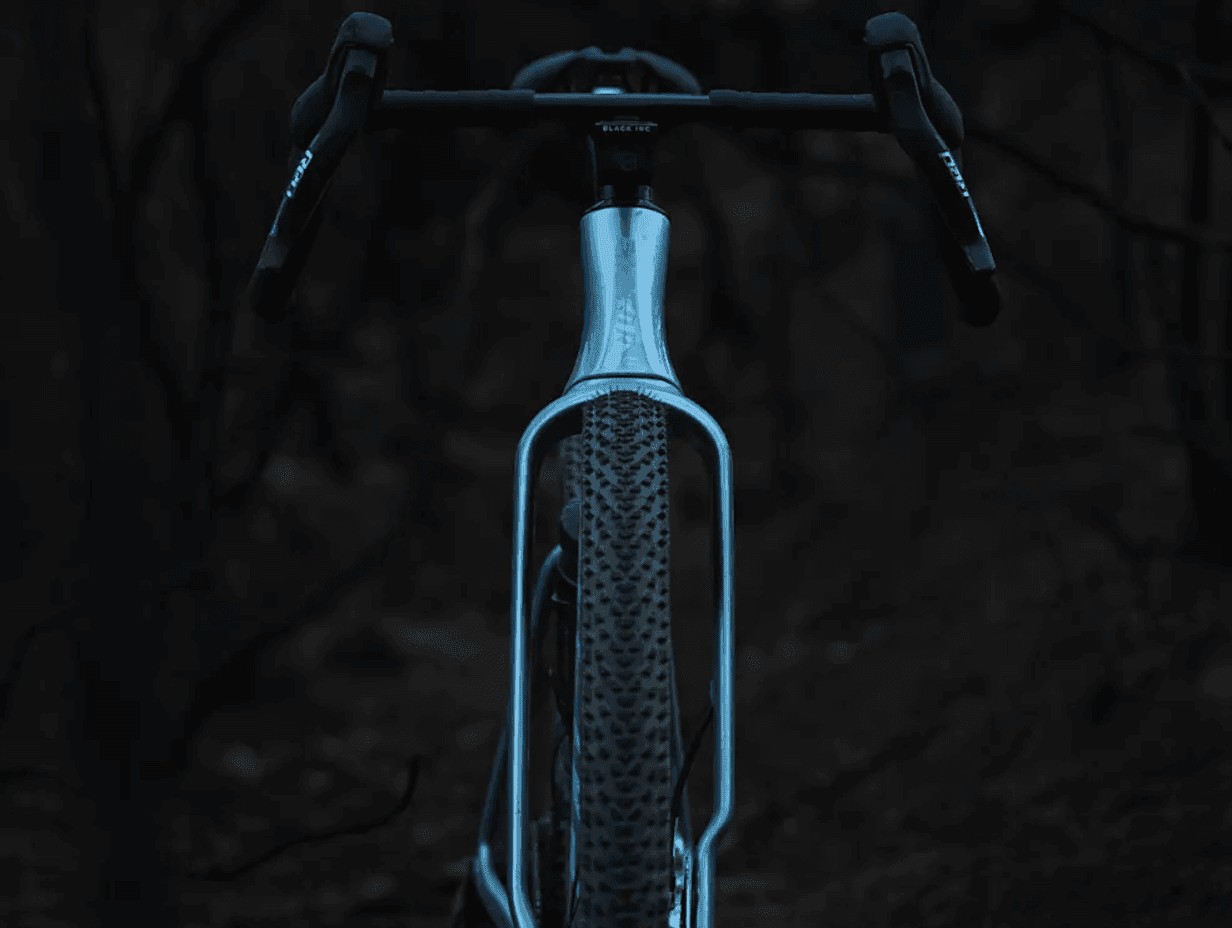
The Mission can take tyres up to 40 mm, a deliberate choice to stay within racing gravel standards. That allows it to blend aerodynamics, low weight and precise steering, whereas the more adventure-oriented Silex goes up to 45 mm.
Merida sees this width as the ideal balance between grip and efficiency: enough to perform just as well on fast tracks as on tarmac.
Technical details and innovations
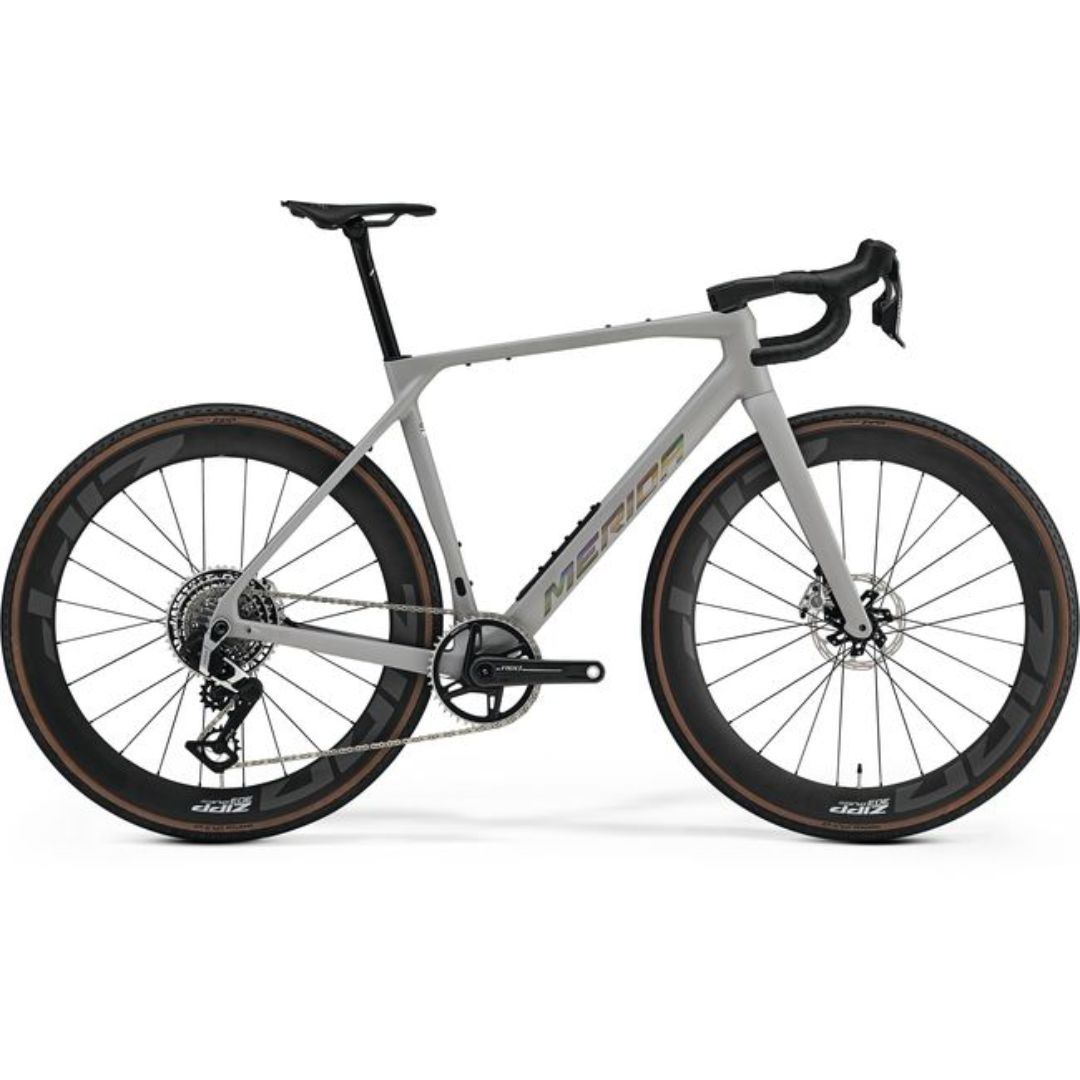
CF4 carbon frame, one-piece cockpit and full integration
The CF4 frame has a claimed weight of 1,100 g for the main triangle, paired with a 500 g fork.
All Mission models share this same high-end platform, featuring fully internal cable routing and a TEAM SL GR1P one-piece carbon cockpit with wider flare and ergonomics tuned for gravel control.
A drivetrain built for performance
Two philosophies:
- SRAM XPLR 13-speed on the 6000, 9000 and 10K models, for riders who value simplicity and low weight.
- Shimano 2x on the 4000 and 7000 versions, for those seeking versatility and wide gearing on the road.
The frame is also compatible with modern 2x road groupsets (up to 52×36), a rarity on a race-oriented gravel bike.
Integrated storage and broad compatibility
Merida introduces its G.U.T. (Gear Useful Things) system here: an integrated compartment in the down tube with a Fidlock opening, able to hold an inner tube and tools.
There are also three mounts for bottle cages, a “bento box” mount on the top tube, and compatibility with mudguards.
Finally, the frame uses the UDH standard for maximum flexibility (road/MTB “mullet” builds possible).
Price and availability
Five builds are offered, all based on the CF4 carbon frame:
- Mission 4000: Shimano 2x drivetrain → €2,199
- Mission 6000: SRAM XPLR 13-speed drivetrain → €3,499
- Mission 7000: Shimano 2x drivetrain → €4,899
- Mission 9000: SRAM XPLR 13-speed drivetrain → €5,499
- Mission 10K: SRAM XPLR 13-speed drivetrain → €8,599
Our take on this Merida Mission
With the Merida Mission, the brand stakes its claim in the European gravel racing segment.
Between the Silex’s versatility and the Scultura’s rigour, this new model clearly targets riders looking for speed and precision rather than long-distance adventure.
The approach makes sense: one-piece cockpit, integrated storage, aggressive geometry and 2x road compatibility… But we would have liked much more tyre clearance.






Reviews
There are no reviews yet.